Kwanon Prototypes
Contents Page 2
(Scroll down or click on Links)
Kwanon X
Kwanon A
Kwanon B
Kwanon C
Kwanon D - camera-wiki.org/Third Design - Peter Dechert
Kwanon D - Peter Dechert, Hayato Ueyama
Kwanon D Replica
The Canon Pages
Page 1 Canon
Page 2 Kwanon Prototypes
Page 3 Canon Models
Page 4 Canon X-Ray Cameras
Page 5 Canon Lenses & Accessories
Page 6 Canon Flash Units
Page 7 Canonflex
The Kwanon Design Evolution
There were a number of different designs of the Kwanon prototype, all fitted with the 50 mm f/3.5 Leitz Elmar-like collapsible lens called “KasyaPa” (identified as a Tessar design in an ad), although it is murky about what was actually built and what were operational or mock-ups. There is the original Leica II like Kwanon X which Canon acknowledges was built by Goro Yoshida but in regard to the advertised versions which led to the Hansa Canon, the History Hall of the Canon Camera Museum tells us that:
“A total of three Kwanon camera variations appeared in ads but the cameras were all either illustrations or wooden models, not actual products. In other words, the “Kwanon” was never actually put on the market. Although Yoshida testified that he had completed ten “Kwanon” cameras, no one had actually seen any one of them.”
Canon doesn't leave much room for doubt about its view. Presumably, that means that people that worked directly with Goro Yoshida hadn't seen them either and that must include Takeo Maeda who became Canon's president in 1974. Any thoughts to the contrary would need some very solid evidence. However, two separate stories may have become conflated. Whilst there is still no evidence of any additional Kwanons being made, Hayato Ueyama tells us (page 30 of his book) that after Goro Yoshida resigned from the Laboratory in late 1934, he set up in the Takeda Building in Kobiki-cho, Kyobashi-ku, Tokyo, where he “prototyped a brother to the Kwanon camera” and that some
The period advertisements show a somewhat Leica II-like black enamelled camera but with the film winding knob unusually placed on the front for the first three versions and no rewind knob, the film was transported from cassette to cassette. The body was hexagonal instead of with rounded ends and this would remain a signature design feature throughout the life of the Canon interchangeable lens rangefinder cameras and into the SLR era. The shutter speeds range followed the typical Leica II progression, Z, 20, 30 40 60 100, 200 and 500. There were no slow speeds. Specific details of the lens mount are unknown so whether it met Leica specifications is also not known, although each of the ads further down claims that “any lens can be attached according to your wishes”, implying some degree of compatibility with interchangeable lenses. It is clearly not a Zeiss Contax mount so Leica (Whitworth 26 TPI) would be presumed but noting Peter Dechert's comments in his book that until 1947, Seiki Kogaku and Nippon Kogaku engineers thought that Leica used a 1 mm metric thread (M39, equivalent to 25.4 TPI), it could have actually been M39.
Hayato Ueyama believes that due to the lack of money, equipment, people and skills, rather than representing separate prototypes, models A through D (A to C appeared in the advertisements) are the same “camera” with some reworked ideas about mainly the viewfinder and concerns about Leica's patents. He also believes that it was a real prototype, but more Leica II than the Contax inspired ads. There is some evidence quoted from people that worked there at the time that at least one body did exist in some form but I'm not convinced about the timing - there must have been a number built between Goro Yoshida departing and the first camera being marketed in the time that Nippon Kogaku was developing the lens and the mount - the first prototype mount took 8 months to complete.
If a prototype camera did exist in some form in mid to late 1934, I don't believe that it is any of the cameras pictured in the ads further below. The two June 1934 Kwanon A images are clearly both illustrations. The July 1934 Asahi Kwanon B is clearly a more sophisticated illustration but not a photo. The Ars Camera version is more life-like and perhaps the only one that is not pure illustration, although that is not certain and at the miniumum, there is artistic touch-up work involved. If a photo is the basis, what was the photo of? Canon says maybe a wooden model. Camera, or model, why didn't it appear in the other ads? The September 1934 Asahi Kwanon C ad is the most telling. Even in its low resolution form, it is clearly based on the same illustration as the July 1934 Asahi Kwanon B ad, only the viewfinder has been changed. The viewpoint, the proportions, the shadows, the “reflections” and the positions of the dials are all identical.
According to Hayato Ueyama, the Kwanon ads were placed by Goro Yoshida without consent being sought from anyone else. To put the timing of these ads into perspective, the Precision Optical Instruments Laboratory was established in November 1933 by some blokes with few skills, not much money, or other resources, and working out of an apartment building and the first ad appeared in June 1934. That's only 7 to 8 months later, a similar time that it later took engineers at Nippon Kogaku to just design the lens mount for the Canon. The last Kwanon ad was in September 1934, only 10 to 11 months after the Laboratory was established. If you believe the ads at face value, you would have the impression that in that time, they had investigated, designed and built prototypes of a camera that was now available to buy and was a cross between a Leica (lens mount, body and rangefinder) and a Contax (shutter), not to mention a self-timer that somehow incorporated slow speeds. In other words, none of the ads implies that it is an announcement for a camera “in development”, or “available soon”, it simply says “here is this remarkable camera and this is the price”.
Each of the ads for the Kwanon A, B and C features the same marketing slogan attributed to Yoshida (note, my app translation of submarine and aeroplane types and my amendment by cross reference to known types may not be accurate, but you get the idea):
“The submarine is I (type)
The plane is Type 92
The camera is KWANON
These are all best in the World”
All the ads also highlight the same 6 features (words and/or translations may vary slightly):
(1) Equipped with automatic focusing (rangefinder). The connection between the lens and the rangefinder is equipped with a steel rod with ball bearings, so there is no need to worry about one spot wearing out quickly.
(2) The rangefinder uses prisms eliminating the risk of double images.
(3) After shooting, there is no need to rewind the film and it can be immediately replaced with a new one.
(4) The self-timer device also serves as a slow shutter.
(5) The Z-type focal plane shutter is made of metal, (see below) so it does not warp in hot or cold, or when it is wet or dry, and is durable.
(6) Any lens can be attached according to your preference.
I can't comment on the focusing, the “rod” confuses me (and Hayato Ueyama too), but the rangefinder seems to be what would be expected. Although we don't know anything concrete about the proposed magazine to magazine system, it is likely that it was inspired by the Contax which could be loaded magazine to magazine, or to a spool and the film rewound at the end (unlike the Kwanon A to C, it had a rewind knob). The Kwanon film magazines likely also followed the Zeiss design which was adopted for the Hansa Canon and following Canon bottom loaders.
However, leaving aside point 6 and the fact that no affordable accessory lenses were being offered or available, two features clearly indicate this is an ambitious laundry list of aspirations rather than reflective of any available camera, or in development by the Laboratory, i.e. it was still at the concept stage. The self-timer, which doubles as a slow shutter and the metal shutter were clearly far in advance of both existing technologies and the Laboratory's capabilities. Regarding the self-timer, when Hayato Ueyama asked Tamotsu Fukazawa, who joined Seiki Kogaku in March 1935, i.e. some 9 months after the first ad, he confirmed that it was the dial in front of the shutter button (when asked many years later, Yoshida apparently couldn't remember it). Relevantly, Hayato Ueyama adds that Tamotsu Fukazawa's work was apparently not influenced by the “black bodied Canons”, i.e. the advertised Kwanons, implying that a line had been drawn earlier on, although clearly, some design elements were retained.
My translate app has trouble with the shutter material, but according to Hayato Ueyama, “it is said to be a metal shutter made of duralumin”, an aluminium alloy containing copper and magnesium. This could not be used for curtains, the metal foil type not appearing until the late 1950s anyway. The “Z-type” is undoubtedly a clue, quite possibly it means “Zeiss type”. Other than curtains and vertically travelling Contax metal slat shutters, there are metal blade type shutters, but the first didn't appear until the 1950s and the first successful one was not until the 1961 Copal Square.
Whilst modern comparisons focus on the simpler Leica II, in the beginning at Roppongi, there certainly seemed to be great admiration for the technically more interesting Contax and the large Carl Zeiss conglomerate generally, e.g. the addition of the front mounted film wind knob and probably the magazine to magazine system. Hayato Ueyama tells the story that shortly after starting at Roppongi, Rentaro Uchida, Saburo Uchida's nephew, dismantled both a Contax I and Leica II, but whilst putting the Leica back together again was straightforward, he had to take the box of Contax parts to the Carl Zeiss facility for reassembly. According to Rentaro Uchida, that is when it was decided to follow the Leica internal design rather than that of the Contax. To me, that suggests that the Contax shutter had indeed been the inspiration, but undoubtedly, no working Kwanon A, B or C could ever have been made incorporating all the advertised features, and clearly, there was much work still to be done between these ads and the first Hansa Canon.
Whilst Peter Dechert simply dismisses some of the features with, “the six numbered claims in the copy include several features which apparently never existed”, I think that misses the question of whether any of these Kwanons existed other than as design ideas. I'm only guessing, but Yoshida's motivation for placing the ads may have been simply to excite market attention to assist with a search for financial backers. Hayato Ueyama quotes several people who expressed frustration at the time with the apparent unavailability of the Kwanon and lack of response to enquiries.
Below is part of a detailed design drawing from a Japanese site, unfortunately of low resolution (the sheet was curved and photographed at an angle, I have sort of straightened it, increased the contrast and upsized it). The heading machine translates to “Kannon Camera Assembly Diagram”. It's not known whether this is a copy of an original, or a more recent depiction, but it clearly features a cassette to cassette film transport system with central tripod socket and it looks like a Leica type viewfinder/rangefinder system so it is undoubtedly depicting either the Kwanon A or B (see further below):
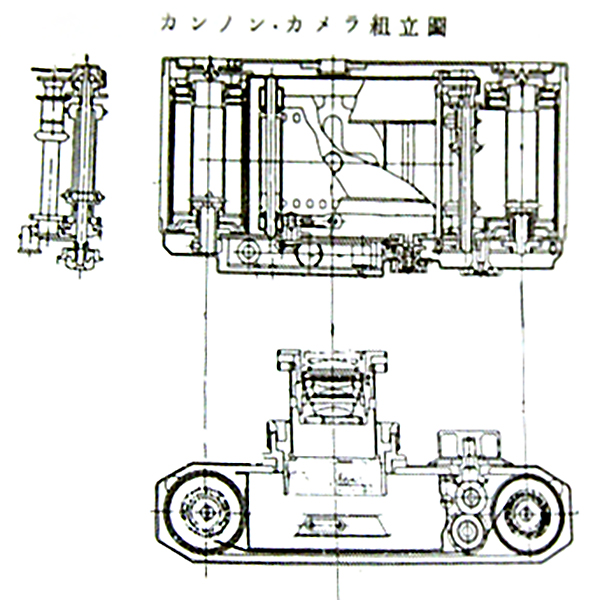
Note, the elevation view is shown upside down. There are also two interesting things to note in relation to the Canon D Replica discussion further below; the centre hole in the pressure plate and back for focus adjustment and the tripod mount is on the lens axis, not in the centre of the bottom plate like the early Hansa Canon. Therefore the Hansa Canon bottom plate is more likely to be an adapted Kwanon design rather than an adapted Kwanon part.
Whilst camera-wiki.org identifies four prototype designs referred to alphabetically as A to D, Peter Dechert refers to three designs, lumping A and B together as the first design, plus a magazine photo which he calls D. There is another quite different one called the “Kwanon X” which is an actual camera which Canon tells us came first. For this section, I am relying on Peter Dechert, Hayato Ueyama, the History Hall of the Canon Camera Museum and camera-wiki.org which references both Dechert and a later 1996 book by Japanese author Yoji Miyazaki, “Canon Rangefinder Camera”. At the end of the list, there is one more camera to consider but my belief is that it is a replica of some sort.
Kwanon X
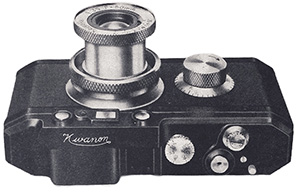
1933 Kwanon X:
It features the Kwanon name plus the logo depicting the deity on the top plate. On the left is the engraving on the Camera Museum display copy (see camera further below) and on the right is a graphic artist's interpretation on the Canon Global site:


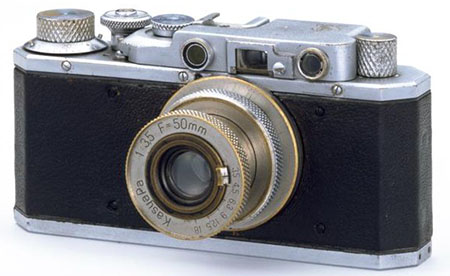
It is unlike either the other Kwanon designs, or the Hansa Canon, or later models. The camera is a close copy of the Leica II but with the distinctive hexagonal body ends of all Canon rangefinder cameras. The lens is engraved “KasyaPa” like the other Kwanon lenses and looks similar to those depicted in illustrations with a knurled focusing ring differentiating it from the Leitz Elmar's finger operated tab with knob.
The History Hall of the Canon Camera Museum tells us:
“When Yoshida made his first prototype camera he named it the Kwanon, after Kannon, the Buddhist goddess of mercy, as he was a Buddhist and an ardent believer in Kannon. The camera’s logo depicted a thousand-arm Kwannon Goddess, and even its lens was named “Kasyapa” which came from Mahakasyapa, a disciple of the Buddha.”
Although Canon dates it to 1934 like the other prototype designs, the Museum description clearly puts this camera before the others. This is Peter Dechert's theory too but he thinks that it could date to as early as 1933 and Hayato Ueyama is unequivocal that it is from 1933 before the Laboratory was established. It shows no influences from the technically superior Contax released in 1932 but by the time of the Kwanon prototypes/concepts, there were clearly aspirations in that direction.
However, there are some that apparently believe that it was assembled from leftover and later parts some time afterwards. Whilst it looks quite presentable in photos, it is described as being crudely made. Certainly, neither the viewfinder, nor viewfinder/rangefinder cover, are “leftover”, or “later”, Canon items.
The provenance of this camera is, according to Peter Dechert, that it was sold by the Shimbido camera shop in Tokyo in 1937 and was bought back by Canon at an Osaka trade fair in the late 1950s. I believe that Canon wouldn't have bought Kwanon X back or featured it so heavily over the years if it had any doubts. Peter Dechert also notes that Takeo Maeda, one of the original founding group and in charge of sales by the early 1960s (president from 1974), used it prominently to promote the Canon 7. For marketing purposes, Canon actually made several reasonably accurate replicas, except for the odd rangefinder windows. One of these is the camera that represents the Kwanon X on the Canon History Museum site (the one at the top of this section is the real one which is the same image used on the Canon Global site, but there, Canon toned down the brassing):
Kwanon A
June 1934 magazine ads, Ars Camera ad on left, Asahi Camera ad on right:
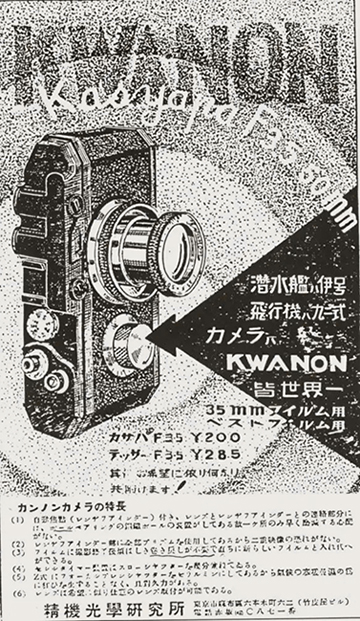
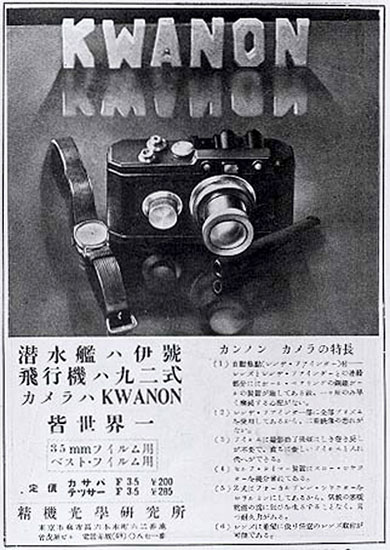
For the first three designs, the film advance and counter are on the front and there is no rewind knob. They all also have the dial in front of the shutter button which is claimed to be the advertised self-timer. The main variation seems to be the viewfinder. This first version depicts a narrow cover over the rangefinder mechanism, a typical centrally placed Leica-like viewfinder window and two tubes running back to the viewfinder and rangefinder eyepieces. There was no top plate engraving.
Kwanon B
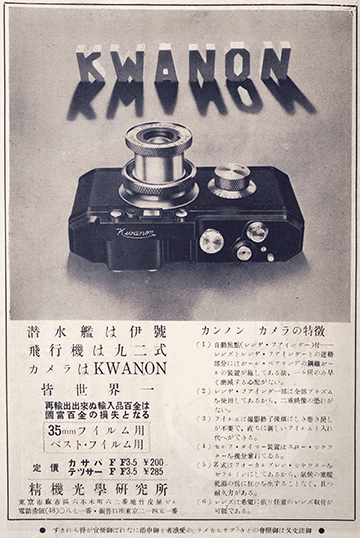
The image in the July 1934 magazine ads depicts a very similar camera except that instead of the tubes for the viewfinder and rangefinder eyepieces, there was a more Leica II-like viewfinder/rangefinder cover. Also, the self-timer dial is more resolved and there may be an extra button, or it might be the knob on the end of a black A-R shutter release lever according to Hayato Ueyama - he calls it that several times in his book. The ad on the left is from Ars Camera, on the right from Asahi Camera:
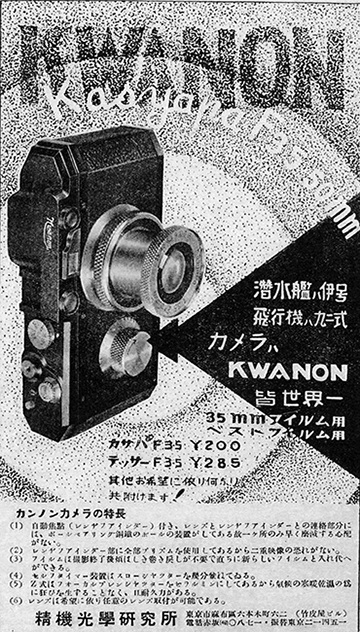
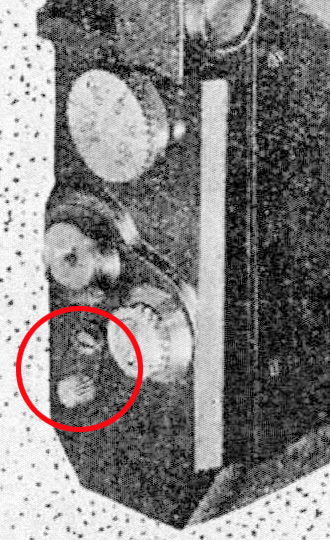
Detail from the first ad of the area behind the self-timer dial. I have lightened the camera detail and at full resolution, it definitely looks like there is a lever to me and what is often assumed to be a button is unquestionably a ribbed knob, but is a release lever needed when film is not going to be rewound in a magazine to magazine system? No other authority that I am aware of has identified it as a lever and knob and Peter Dechert has also simply drawn it as a button. If it is a lever, its purpose may be something else, but what, and on the other hand, Ueyama has spoken to people who were there at the time and that must carry a lot of weight. Also, the Contax allowed either magazine to magazine operation, or magazine to spool - perhaps Yoshida was thinking about either incorporating a similar facility, or abandoning the magazine to magazine system altogether, even though the rewind knob was not yet in evidence:
The camera in the second ad looks like more of an artistic interpretation and lacks detail in the shadow area of where the lever might be but the ribbing on the knob is visible:
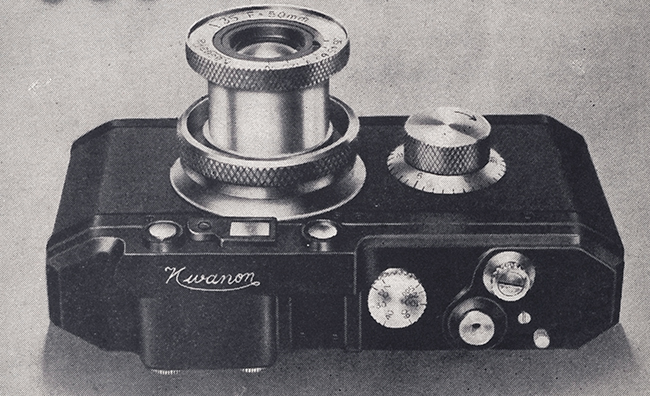
Peter Dechert calls it the final stage of the first design. The Kwanon name with a curved line under was now engraved on the top plate.
Kwanon C
The Asahi Camera September 1934 ad in Hayato Ueyama's book depicts an otherwise similar body (I believe the July 1934 illustration reworked), but significantly, the built-in Leica type viewfinder between the two rangefinder windows has been replaced by a foldable albada finder mounted in a shallow recess in the top plate:
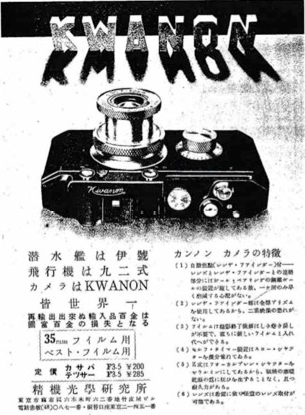
Peter Dechert explains that it is commonly called the Kwanon C but refers to this as the second design based on the main difference, the viewfinder system. This is his drawing based on the ad:
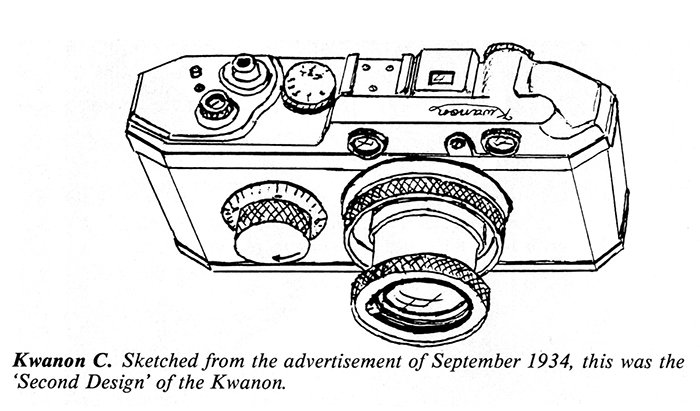
(Image from Peter Dechert's book, Canon Rangefinder Cameras 1933-1968)
Kwanon D - camera-wiki.org/Third Design - Peter Dechert
Camera-wiki.org calls this one the Kwanon D, Peter Dechert calls this the Third Design. Both he and camera-wiki.org (Dechert is quoted as the camera-wiki source) cast doubts on whether the vague illustrations are of the Kwanon D/Third Design, or are still of the Kwanon C/Second Design. Nevertheless, both the drawing in Dechert's book and the camera-wiki.org description speculate that this design has already adopted some of the forthcoming Hansa Canon features, e.g. the film wind knob has moved to the top plate with the film counter remaining on the front. However, Peter Dechert's drawing shows that the lens mount is the Nippon Kogaku focusing type of the Hansa Canon. Given the vagueness of the original illustrations and descriptions, I'm not sure how he can make any claims about the design other than by assuming, as he says on page 19 of his book, that “many of its structural features can be inferred from parts used on the very earliest Canon Hansa cameras”, i.e., by guesswork. In fact his drawing on page 22 is entitled “Suggested ‘Third Design’ Kwanon.” It could be accurate, but most likely is not.
Nippon Kogaku was approached late in 1934 and Goro Yoshida left shortly afterwards. Hayato Ueyama quotes Nippon Kogaku's focusing mount designer, Eiichi Yamanaka, who says it took about 8 months to complete the prototype mount. According to research done by Hans Braakhuis, a patent was applied for on 27 June 1935 so the two claims line up. Therefore, its first appearance on a camera body would unlikely have been before the “Canon” name trademark application was also submitted in June 1935. By this time, the complete Canon design must have been approaching finality under new designer, Tomitaru Kaneko, with the Hansa Canon being announced in October 1935, complete with a photo of the camera as we know it. The idea of a Kwanon fitted with the mount seems highly improbable.
Notably, Hayato Ueyama doesn't mention this version of the Kwanon, but does note that Goro Yoshida did have different ideas that he would sketch out, possibly explaining the “vague illustrations” referred to above.
Kwanon D - Peter Dechert, Hayato Ueyama
Peter Dechert's book features a blown up small image said to be from a post-War Japanese magazine of a camera that looks very similar to what I have called the “Kwanon D Replica” below. Hayato Ueyama features the same image and says it is the Kwanon D picture in the “much delayed” book, “How to Use a Camera”, published by Kogeisha in January 1949. Given the difficulties with Japanese translations, it may be the same publication. The Japanese text above the camera in the image in Dechert's book says that it is a “Kanon” (name in English) first produced in Showa 9 (1934) and fitted with a “KasyaPa f3.5” lens. Peter Dechert also calls it “Kwanon D” which seems to imply it is the same as the previous one. With the film wind knob still on the front, it's not like his “third design”, or the equivalent camera-wiki.org Kwanon D. It looks like both their Kwanon C designs but with what looks like a rewind knob added:
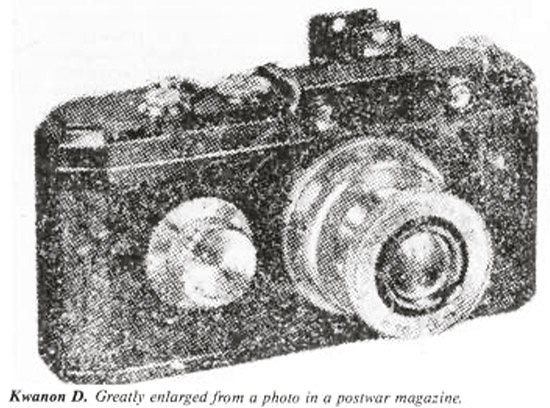
Because of the rewind knob, it may be assumed that this version abandons the magazine to magazine film loading feature. However, there may be an alternative to be considered. The camera is the same as the Kwanon C, except for the rewind knob. It still includes the self-timer, which makes me think that it is again unlikely to be a working example, if such things existed at this time. The camera is still clearly the Goro Yoshida design and therefore still likely based on unrealistic aspirations. The B was advertised in July 1934, the C in September 1934 following the viewfinder rethink to avoid Leica's patents and Yoshida departed before the end of 1934. The 1934 release of the pre-packaged disposable daylight loading 35 mm film cassette by Kodak was unlikely to have had an immediate impact on the Laboratory's thinking and Hayato Ueyama instead surmises that the change in film transport may have been caused by difficulties due to the fact that the Contax had a removable back and the Kwanon didn't. That would assume a working prototype to test his ideas.
My alternative thought is that the appearance of the rewind knob on what looks like the Kwanon C could just be Yoshida adding a magazine to spool option to the earlier magazine to magazine film tranport to bring it into line with its Contax inspiration. I'm not promoting this as a more likely scenario, simply suggesting that there are maybe more possibilities to consider, especially as the influence of the Contax and its film transport system doesn't seem to get much attention. In any case, I doubt that the Kwanon D can be considered as a transition to the Hansa Canon, the real work to turn ideas into a working camera still had 12 months to run, they were barely half-way there and in the second half, they had the technical skills and management discipline of Nippon Kogaku to ground them and help keep things on track.
The pictured camera can be one of several things, an actual Kwanon prototype from later in 1934, which Canon and some people that worked at Seiki Kogaku strongly assert were never made, one of the mock-ups which are generally acknowledged to have existed (the photo itself could be pre-War, even from the time the mock-ups were made), an illustration (hard to say with the picture quality), or a replica. Peter Dechert is fairly positive about this being genuine, as he is about the existence of other examples and he suggests that various early Hansa parts originated with the Kwanon. He acknowledges that they were never marketed but seems to be doubtful about Canon's claim that none were ever made. In fact, he believes that the “Third Design Kwanon came close enough to production for parts, or at least dies, to have been completed in anticipation of assembly and sale.” He also thinks that the Kwanon D “is possibly the ‘Hansa Canon style Kwanon F3.5 camera’ advertised for sale by a Shimbido shop and presumably lost during the war.” Peter Dechert postulates that when Goro Yoshida departed Seiki Kogaku, he may have been taken one or more Kwanon examples with him and as he was a friend of the store's owner, Hideo Hokura, he could have sold the cameras through him. All that sounds plausible but without one verifiable fact, from the existence of Kwanon prototypes to their sale, to anchor it, it is just a story based on possibilities that make sense to Peter Dechert.
Specifically in regard to the Kwanon D, Canon says there was no such camera. From the History Hall:
“There was a camera called the “Kwanon Model D,” discovered in Osaka around l955, however, it was a copy of a “Leica Model II,” and was not made by Yoshida. The manufacturer of the “Kwanon Model D” is still shrouded in mystery.”
I am somewhat confused - the magazine photo is earlier and more Kwanon than Leica II, I presume that we talking about two different cameras.
Kwanon D Replica
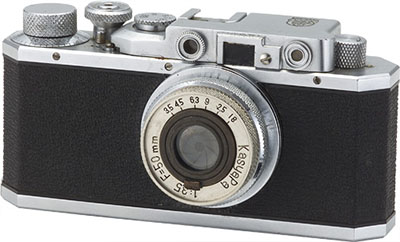
The camera below appears to have the same features, including rewind knob, as the Kwanon D in the magazine/book photo. At first glance, it could be be the same camera appearance wise. However, as grainy and as low resolution that the blown-up photo is, there is no evidence of any brassing. More importantly, a couple of the controls are slightly different, as is the top plate subtly, see below. The KasyaPa lens appears near identical to that on the Canon X and the same as in drawings and ad renderings for the other Kwanon prototypes. Apart from the addition of the rewind knob and also the differences noted against the magazine/book photo, superficially, it appears to be a reasonably accurate representation of the Kwanon C. Some of the auction photos:
.jpg)
.jpg)
.jpg)
.jpg)
.jpg)
.jpg)
.jpg)
The Camera sold at a Skinner auction house auction in Boston, USA, on 29 July 2006 for a record US$138,000 for a Canon model. One story was that Canon Inc. was not interested because there is no engraving of the “Kwanon” name. That's questionable whether it's a valid concern with a prototype, but almost certainly, Canon also had other much more serious doubts.
Some collectors and respected websites have been favourably disposed towards the authenticity of this camera, albeit not without their own doubts too. Even Peter Dechert has his name connected to it. From examination of the photos, my own view is that it is a fake designed to deceive, a fair but still inaccurate one on the surface and a sloppy one under the skin.
My first issue with this camera is the body shell. With the base plate removed, it appears to be a later die-cast example. Whilst most Hansa Canons/Canon Originals and all subsequent models through to the post-War Canon S II used a formed construction which was pressed into shape, it is true that there were early cast examples. According to both Kannonji Makoto, in an article in the June 1982 edition of Japanese magazine, “Camera Collector's News”, and Japanese author Hayato Ueyama, the very earliest Hansa Canons, and perhaps any prototypes, featured a machined sand cast body and from the pictures in Peter Dechert's book and other pictures I have seen, they are hard to tell apart from die-casting. In fact, Dechert erroneously believed that they were either die-cast or milled. However, regardless of the construction technique, both formed and cast Hansa Canon bodies and also the first die-cast Canon S II and B II body shells exhibit the typical light colour of natural aluminium alloy (see Hansa Canon & Canon Original). The reason why I believe the auction Kwanon features a later die-cast body is that the body shell lip of the Kwanon is significantly darker than natural and almost exactly like the darkening introduced on later Canon II Bs in 1950. Auction Kwanon body shell above and late Canon II B below:
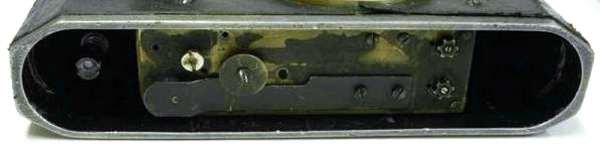
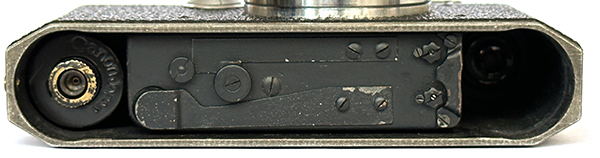
Also, the tip of the film spool spindle appears to have two notches which are not seen on any other Canon spindle (different to the single notch for the Rapid Winder introduced with the Canon III, although, I note that the Leica III introduced two notches for Leitz's Leicavit inspiration). The shutter is a cloth curtain type rather than metal type promised by the first three ads. Accepting that there may have been progress towards a more realistic design, compare the Kwanon shutter crate to the Hansa Canon types further below, particularly the first Leica II type. Clearly, it is not as early as even the first three types without the disk (future opening curtain cam used with slow speeds), or the first two without the two screws for the future slow speeds retard rod flat spring. It is missing some screws, maybe to help keep it in character, and the 6 toothed tension adjusters didn't appear until the Canon S. These also look “toothier” than any Canon examples, early, or later. Also note the right end of the flat spring cut-out, the auction Kwanon shows an angled and radiused corner whereas on the Hansa Canons with the cut-out, when it came, it is a sharp right angle and it continued as a right angle until a new spring was introduced with the post-War die-cast Canon S II body. The tensioners, spring, a couple of odd screw placements and the shutter dial, discussed further below, with one less speed step and different spatial positioning of shutter speed markings to both Kwanon prototypes and all Canon models, makes me question whether this is a Canon shutter at all.
I'm not convinced by the rest of this Kwanon D either, noting again that Canon strongly asserts that no evidence has been found that any Kwanon prototypes were actually constructed, not including the original Kwanon X. Whilst there is now a rewind knob, there has been no obvious addition of a rewind release control (with most Leica copies, it is a lever) to enable the rewind to be used, even though there may be one on the B and C models (see Kwanon B and also below). Also, there is no focus adjustment plug in the camera back, a feature of all production Canon models before the 1946 S II. There needs to be a matching hole in the pressure plate but it's not there in this one, see above photo of the lens mount and detached shutter curtains and hence, the naked pressure plate. Accessing the camera's film plane through the plug hole had been the standard method of adjusting the back focus of lenses on bottom loading Leica cameras until Leitz introduced focus standardisation for its Leica in the early 1930s (the back plug was also used on 1940's Nippons, the first post-War Niccas and pre-1935 Soviet cameras). One assumes that correct focus is important for a prototype and it certainly appears to be there in the Japanese drawings at the top of Kwanon Prototypes.
Earlier, I mentioned that the controls on the Kwanon D in the magazine/book photo were different to this one. In fact, the controls of the camera in the photo are very similar to the controls in the rendering of the Kwanon B in the ad further above, namely the chrome shutter button and the dial in front of it, which according to Hayato Ueyama is the self-timer listed in point 4 of various ads. Below is a comparison between the ad Kwanon B on the left and the auction Kwanon D on the right (note also the platform under the D shutter dial, more further below):
.jpg)
.jpg)
As mentioned in regard to the Kwanon B, Hayato Ueyama refers to the knob and nearby chrome screw on the top plate as an A-R shutter release lever. Whilst seeming unlikely, I agree that one of the clearer Kwanon B ads might indeed show a lever with the chrome screw being the pivot point and the knurled knob at the end - in the other B ad I have featured here, the area is just black with only the screw and knob/button visible. However, what is definitely different about the auction D is that it has a large black screw in place of the self-timer dial in front of the shutter button rather than the chrome dial of earlier Kwanons, including the magazine photo, and no button, or lever, either. Also, its shutter button just looks like a black pimple on the top plate. There is no collar, nor thread for a cable release, both of which featured on every Kwanon version, including the X, and all Hansa Canons (no thread from Canon S to IV Sb2). All of them were also chrome. Given the brassing elsewhere on this body, the black shutter button looks remarkably wear free.
Then there is the shutter dial and its platform underneath it on the top plate. From the Kwanon X to the Canon II B, main dial shutter speeds are marked Z (B later), 20 (20-1 if with slow speeds), 30, 40, 60, 100, 200 and 500, i.e., in 8 steps, and the physical spacing is similar. Below are dials from the Kwanon B (from a much higher resolution version of the ad further above), a Hansa Canon and the auction Kwanon D:
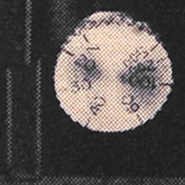
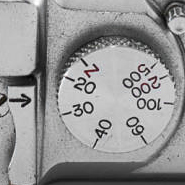
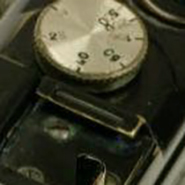
The auction Kwanon D is clearly the odd one out, missing the “30” speed and therefore only having 7 steps and the spacing is also quite different between the “20”, or possibly “25”, and what is presumably the “Z” marking. The “4” in “40” is open, I am not aware of any “4” on a Canon dial which is not the closed type. Note, the auction description claims the dial is marked “2, 25, 40, 60, 100, 200, 500”. Clearly, the “2” is not possible without a slow speed escapement and must be a typo for “Z”, but “25” could be correct because the second digit in the dial photo is impossible to discern with certainty, but nevertheless, is improbable for a period when focal plane shutter speeds generally started at 20. In any case, it confirms that “30” is missing.
Not obvious from these photos but can easily be confirmed from the Kwanon ads, Peter Dechert's Kwanon C sketch, the magazine/book Kwanon D photo and the auction Kwanon D photos is that the auction Kwanon D shutter dial has a slightly raised platform under it whereas all the other Kwanon prototype images show a completely level top plate in this area. Also, the accessory shoe features a Leica II-like pressure depression in the top of the side rail with two screws at the front and one at the rear - this only appeared on the Hansa Canon after Canon S production commenced in 1938. The best of the renderings in the Kwanon ads don't show the depression and the screw pattern is reversed with the single screw at the front. The early Hansa Canon was flat but with a curved cut-out from either side.
Along with film transport, another big issue for me is the base plate below. The earlier Kwanon designs wound film from one magazine to another (not the Kwanon X with its Leica-like rewind knob and maybe the magazine/book Kwanon D which is a bit of a mystery) , i.e. there was no need for a film rewind knob. This body has a rewind knob and what appears to be a fixed spindle shaft for the removable take-up spool so obviously has been adapted for single magazine use. However, the base plate still has two bottom locks, both with the Hansa Canon-like cassette opening/closing mechanism, which is the “C” shaped device on each lock. The one at the spool end is redundant now and that is a big problem. In its place, there should be a vertical shaft/pin to support the spool. Every Leica and Leica copy without a fixed spool has some method of supporting it, otherwise there would likely be winding and flatness issues. Both “C” shaped openers show an equal amount of brassing but only the one at the cassette end should have been contacting anything. The lock at the cassette end has a tab (outside of the “C”) which would normally turn under the saddle usually screwed to the end of the shutter crate (see Hansa shutters further below) which in this case is missing - screws are there but no marks on the paint to indicate it had been there. How the base plate is currently secured is a mystery to me (there also seems to be a tab at the spindle end - possibly redundant even with a cassette to cassette system):
.jpg)
.jpg)
In comparison, below are inside and outside views of an early Hansa Canon base plate with centre tripod mount still - on the outside there is the blanked-off indentation for the second lock/magazine key, so presumed to be an adapted Kwanon design. Note, both the Kwanon D replica and the Hansa Canon centre the tripod mount but the earlier Kwanon drawing further above shows it offset to align with the lens axis. The key for this Hansa Canon base plate lock is designed so that it can only fold in one direction, typical of most examples. Whilst the two way design featured on the auction Kwanon D didn't become a typical Canon feature until probably 1946 (the S I examples I have seen still have the one way key but the J IIs seem to have either), I have seen at least three early Hansa Canon examples with centre tripod socket and the two way keys. But there is a difference, none of the Hansa Canons feature a key, either two or one way, with a pin hole in the centre of the shaft at the base of the arrow like the auction Kwanon, generally this seemed to arrive after the War (although it is there on a one way key on a Canon NS base plate, if original):
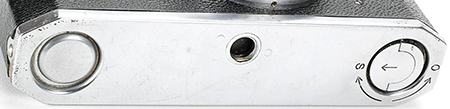
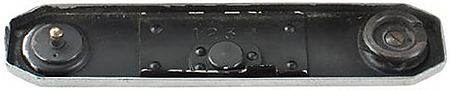 (Web images)
The outline of the three rivets for the tripod mount are just visible. On the inside, there is a pin for the spool end. There is also a channel section baffle/body support, typical of Leica practice and later Canons, blind riveted to the base plate in the same way as the tripod mount (Peter Dechert's book shows base plate 1316 with no signs of rivets on the inside for either the channel or mount but the items themselves are still the same). The notch in the channel is explained in the Hansa section. On the auction Kwanon, the missing channel can perhaps be explained by its prototype status but the tripod mount and its attachment are also completely different on the prototype and there seems to be some sort of lumpy bodge going on under the black paint.
It occurs to the cynic in me that the unexpected rewind knob and associated film transport bits, and the problems that this caused with the bottom plate etc., may have been added to explain the absence of parts for the “designed” cassette to cassette system and it is convenient that the damaged shutter curtain makes it inoperable.
Other than the redundant magazine opener, I also find other aspects of the brassing less than convincing. The black enamel paint on the body is in good, smooth, relatively scratch free condition (apart from the base plate) yet the brassing appears to some degree along all the hard edges. It seems to occur discreetly, evenly, symmetrically balanced and dare I say, with artistic good taste. Remember, this is supposed to be a prototype camera, perhaps a little rough at the edges and it wouldn't have been treated with care. The brassing on the bottom of the shutter crate appears to be rubbed with no hard or ragged edges whereas the reality is that there are very few wear points on a shutter crate and it is much more common to see chipped paint here or flaking paint, not worn. There is a lot of brassing and fine scratches and pitting on the lens barrel but much of it is even and circular, not really typical of a hard used retractable lens where scratches are usually along the barrel. Then there is the camera lens mount - there are fine marks on the surface but a lot of it is linear, not circular as would be expected and there are no signs of a well used mount that the degree of brassing and broken shutter curtains would suggest.
Yet with all my concerns about the camera, I look at the top plate shape and it is a work of art, except for the shutter dial platform, relatively faithful to the detail in the earlier renderings. The rewind knob is unexpected and the shutter dial, accessory shoe and the shutter button are questionable but the rest of it is convincing to a point. The lens too, with its unique focusing ring, is faithful to what we have already seen on the Kwanon X and renderings, however, lower down and under the skin, such as the body shell, the shutter crate, the unresolved locking and film transport issues with the bottom plate, all seem like the result of less careful attention to detail. It's like the story of two different cameras and makes me wonder whether the top plate, and possibly the lens too, may not be authentic prototype parts that someone has later assembled with newer bits and pieces into a complete make believe Kwanon? Maybe, but probably not. The impression I get is that the camera is meant to deceive and if you accept its appearance, you may not question the rest.
I should mention that whilst the KasyaPa lens looks authentic, its only real difference appearance wise to an Elmer, or Russian FED version, is that it uses a knurled focus ring at its base rather than a finger operated tab with knob, something relatively easy to reproduce, as are new engravings.
The back story to the Skinner auction (now called Bonhams Skinner) seems to be that although Peter Dechert is credited with assisting with the catalogue notes, there was no documented expert evaluation, supporting documentation, or other assurance of provenance. Peter Dechert's access to the camera and own thoughts are unknown, although a forum post from the time of the auction, by somebody I consider knowledgeable, claims his contribution was based simply on photos. The catalogue claims: “From information supplied by the consignor, the camera was acquired ten years ago from the daughter of a real estate agent in the Bronx, New York, along with a Contax I and a Leica II, who reported that all three cameras had been in the family since the early 1950s.”
A slightly more detailed story was provided by Jeanne Schinto writing for the November 2006 Maine Antiques Digest: “A consignment from a collector who is a Nikon specialist, it sold after a battle between two phone bidders for $138,000, more than four and a half times the high estimate and a Canon auction price record. Skinner sci-tech department head Nick Hawkins said the buyer was a collector overseas.”
And: “The Kwanon had good provenance. It also could legitimately be called extremely rare, even unique. Hawkins said the consignor acquired it about ten years ago from a family in the Bronx. They'd had it in their household since the 1950's after having received it as a partial rent payment from tenants, Hawkins said. How did the tenants get hold of it? Who knows? But the balance of their rent that month was paid by two other cameras, a Contax I and a Leica II, according to the family.”
Continuing: “The numeral 2, stamped into the inner surface of the Kwanon's base plate, lends credence to the idea that it was the second operable prototype made by the company.” To me, it seems that the “numeral 2” could actually mean anything, even if it had been one of the Kwanons made by Goro Yoshida. I also question the “good provenance”, I personally think that it is very questionable, there is virtually nothing about this camera's known history to link it to Japan and Seiki Kogaku circa 1934, or 1935.
However, regardless of anything else, apart from maybe the rewind knob and a few minor trim bits, you can accept it as a fair representation of what a late Kwanon prototype may have looked like, if built. Under the skin, I doubt that any bits even resemble a pre-War Canon. Is there a connection to the very similar magazine/book photo? Given the small but significant differences, unlikely, except as maybe inspiration for someone.