Canonflex
A rangefinder company makes an SLR
Contents Page 7
(Scroll down or click on Links)
1958, the year the SLR Arrives
The Canonflex Era
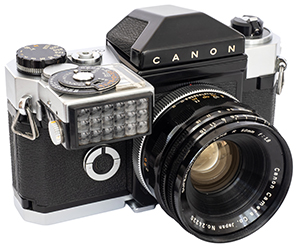
Canonflex, Canon's first SLR
Canon R Mount
Canon R Mount Lens Types
Canonflex Lenses in Release Order
Using Rangefinder Lenses
The Canon Pages
Page 1 Canon
Page 2 Kwanon Prototypes
Page 3 Canon Models
Page 4 Canon X-Ray Cameras
Page 5 Canon Lenses & Accessories
Page 6 Canon Flash Units
Page 7 Canonflex
1958, the Year the SLR Arrives
Everything before then was just preparation. The first photographic SLR cameras were large format types that arrived before the end of the 19th century. 35 mm SLRs first entered production in 1936, or 1937, and it was either the Russian Sport, or German Ihagee made Kine Exakta, both dates and order depending on your point of view. The reversed image waist level viewing was made a lot more convenient with the introduction of the eye level pentaprism viewfinder on the Italian made Rectaflex in 1948, although Zeiss had been working on the similarly specified Contax S since before the War. The annoying blackout after taking the shot was eliminated in 1954 by Japanese camera maker Asahi Optical Co. when it released the Asahiflex II with instant return mirror. In this period, mechanisms were also developed which allowed open aperture viewing and then when the shutter button was pressed, the aperture would automatically stop down to the predetermined number before the shutter opened. Most SLRs quickly incorporated these advances, but there was still this one thing holding the SLR back.
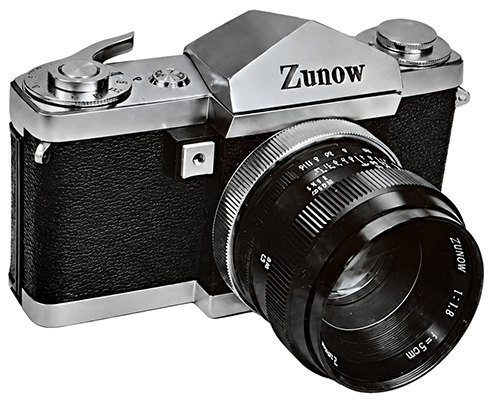
Then in August 1958, legendary large aperture lens maker Zunow Optical released the Zunow camera (Zunow Pentaflex in some documents) that finally made the SLR as convenient to use as the rangefinder camera, it incorporated an aperture that not only automatically stopped down when shooting, it automatically returned to fully open after the shutter closed. Zunow didn't change the world, it was merely the first and marks the point of change. A nice looking camera with professional aspirations, it closely anticipated the Nikon F with a removable prism, interchangeable finder screens and mirror lock-up, the only item missing was a self-timer. A motor drive and 400 frame back had been announced but didn't make it to market. Like the Canonflex, it featured a breech lock but its lock was on the body and the bayonet tabs were on the lens. However, small, inexperienced and beset with quality issues resulting from employing many subcontractors to substitute for inhouse capability, production ended in 1959 with only 600 made. This camera is with the 5 cm f/1.8 lens but a 5.8 cm f/1.2 standard lens was also offered at launch as well as a 35 mm f/2.8 wideangle lens.
Canon and Nippon Kogaku had been working on their camera well before the Zunow broke cover and they were now ready. One company put aside its rangefinders, listened to photographers and dived in head first - spoiler alert, it wasn't Canon. The Nikon F headline features included an accessory motor drive, mirror lock-up, interchangeable focusing screens, aperture linked lenses which enabled both aperture and shutter coupled metering and four fully automatic aperture lenses from 35 mm to 135 mm at its 1959 release. And its ecosystem continued to grow.
Whilst the Canonflex and Nikon F have always been viewed as natural competitors, was that really the case? Features cost money. The Canonflex launch price was ¥59,500 whilst the Nikon F launched at ¥67,000. Professionals would not have blinked at the Nikon's price given its features list, but it could be argued that the Canonflex's real failing was that it was too expensive for the enthusiast market which its features seemed more aligned to. For example, the semi-automatic aperture Minolta SR-2 had launched in late 1958 at ¥51,500. Actually, it was more automatic than the description of Canon's semi-automatic 200 mm lens further below, after stopping down automatically, the aperture would re-open on winding the film forward. Minolta did call it “automatic” as did Yashica with its 1960 Pentamatic. However, by 1960, there were also proper fully automatic aperture challengers from Topcon, Miranda and Asahi Pentax spanning a range of features, capabilities and prices.
The Canonflex Era
Canon made interchangeable lens rangefinder cameras from 1935 to 1968 and lenses for these cameras until 1975. Production of its four Canonflex SLR models and the R lens mount spanned a subset of just five years from 1959 to 1964 before being replaced by a new design with a revised lens mount. In 1959, Canon was producing its most successful rangefinder yet, the Canon P and the even more successful Canon 7 was yet to come. Canon was obviously aware of the growing interest in SLRs and their advantages in particular use cases and the threat they posed to its rangefinder business, but in 1959, its first SLR was an addition to its very successful rangefinder legacy and its extensive and well developed accessories portfolio rather than a new direction for the company. For this reason, the Canonflex leveraged existing accessories and even lenses and vice versa, the 1961 Canon 7 rangefinder inherited the redeveloped for the Canonflex long lens system.
The Canonflex cameras are clearly the beginning of Canon's transformation from a rangefinder maker to an SLR maker but they were embedded into a rangefinder world where they could share the resources, but not compete to their strengths against the rangefinders, or to Canon's strengths against the competition. Canon was the rangefinder company with 25 mm and then 19 mm wide angle lenses and an extreme aperture f/0.95 50 mm lens and everything in between, yet the Canonflex was not ever blessed with anything wider than the 35 mm f/2.5 released in August 1960 after the first model had been buried, or with a larger aperture than f/1.8 until the release of the fourth model, the Canonflex RM, in 1962. To be fair, wider angle SLR lenses were difficult requiring a new retrofocus design and at the time, the only Japanese camera makers offering anything wider than 35 mm were Nikon and Miranda. The SLR's natural advantage was the use of long focal length lenses. Here, Canon offered a full range of manual lenses up to 1000 mm, but as noted, many of these would be shared with the Canon 7, which with the Mirror Box 2, would also become a de facto SLR. No automatic aperture lens would be longer than 135 mm, the only semi-automatic lens would be the 200 mm and the rest were preset, or fully manual.
Canonflex, Canon's first SLR
Canon launched the Canonflex in May 1959. Whilst not quite cutting edge, the state of the art features included a 1000 shutter speed with X sync at approximately 1/60th of a second, an instant return mirror, automatic aperture control, split image viewfinder, accessory clip-on shutter coupled selenium cell exposure meter and a removable prism for waist level viewing (an accessory magnifier that mounted the same as the prism was offered for that purpose). It was a solid and well built camera capable of meeting professional use expectations and claimed by some to have a better build quality than its arch-rival, the Nikon F. Interestingly, it reverted to cloth shutter curtains now that the mirror protected them from burn through by the sun. This may have been due to cost, no considered advantage in an SLR, because Canon's thin stainless steel foil curtains dented more easily than Nikon's titanium, some combination of those reasons, or something else. It was developed alongside the VI series rangefinders and shared some of the technical design, although unlike the Nikon F, which was basically a Nikon SP/S3 body with mirror box added, it was more of a clean sheet design with a new chassis which has a slightly larger footprint than the contemporary rangefinders, 144 mm x 33 mm base plate compared to 140 mm x 31 mm. At 710 g, the body was 40 g heavier than a Canon 7 and with the 50 mm f/1.8 lens it was a substantial 1,015 g.
In pointing out the features in each photo, I can't help but add a “but” here and there. Taken in isolation, it was a great camera for the times. Although the Nikon F was announced one month earlier, the Canonflex was the first practical SLR to enter production with the full SLR potential demonstrated by Zunow the year before. However, as a camera, a photographic tool, it came up short in that not enough photographers found it compelling in either comparison to the more expensive Nikon F, or to some lesser cameras which were maybe not built to the same high standard, but were more convenient to use and cheaper. The bottom lever winding is often quoted as the main deal breaker, but there are a lot of little things too which can collectively add up to cause rejection. One thing maybe forgiven, like the Nikon F's retention of the by now clumsy removable back instead of a more convenient hinged back, but when there are more issues, not so much.
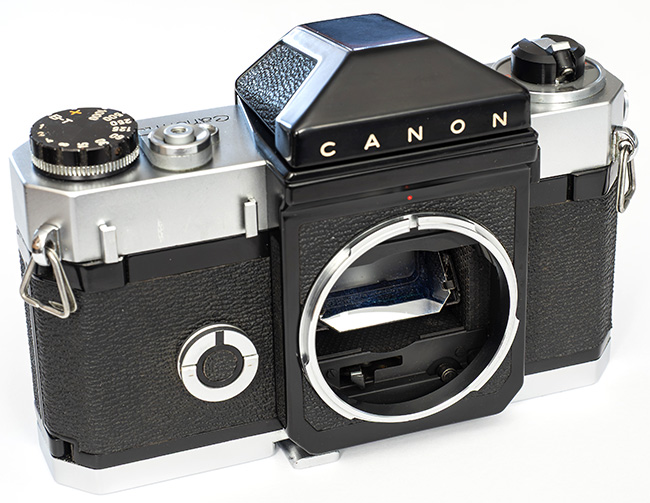
The signature circular self-timer was an attractive design flourish, but instead of being able to simply push it with your finger without looking, the top half has to be folded out and then used like a key to operate it:
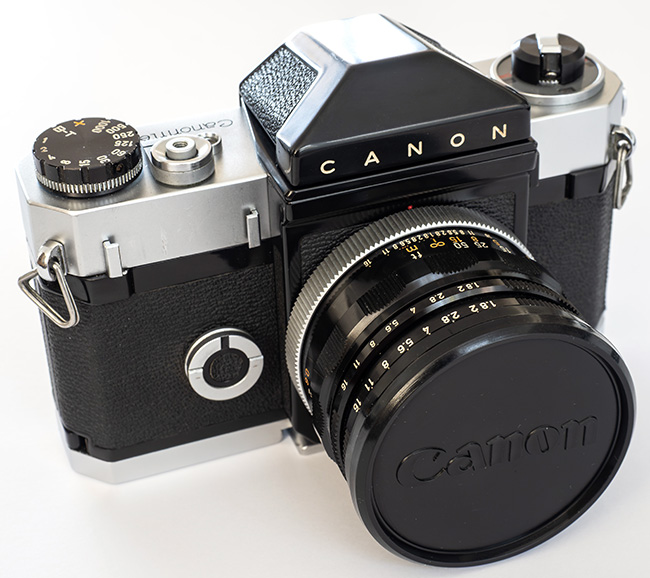
With hindsight, Canon missed a trick by not offering interchangeable focusing screens to go along with the removable pentaprism. Canon did offer an optional waist level viewer (see further below) and the engineering of the sliding to remove design is considered superior to the Nikon F's design. However, there was no mirror lock-up either. The only standard lens offered was the fully automatic aperture Super-Canomatic R 50 mm f/1.8 (later models could be paired with the 35 mm f/2.5 and an optional 58 mm f/1.2 appeared during Canonflex RM production). In the Canonflex brochure, Canon claims, “the front part of the Super-Canomatic Lens R serves as the sun shade eliminating the use of extra attachment” (although Canon did offer an accessory lens hood too):
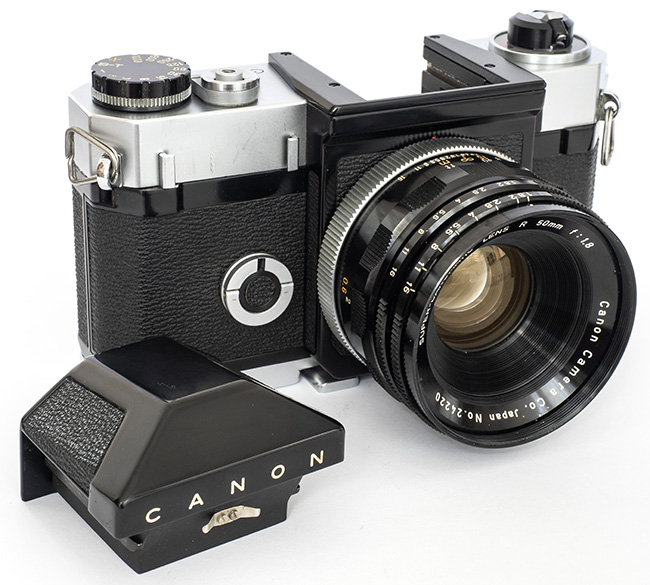
The R mount bayonet tabs and flange. The lens is lined up against the mount and held there without rotating whilst the breech lock ring at the base of the lens is turned to lock the lens in place, in principle, similar to the X-Ray cameras. Although requiring two hands to do three things, the claimed advantage was the absence of wear to the mating surfaces that plain bayonet mounts could experience:
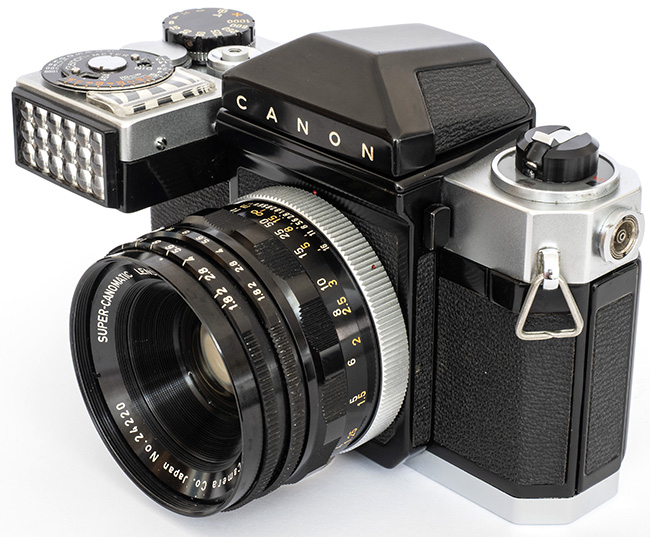
Optional Canon-Meter R mounted, details further below. The end of the top plate features a bayonet flash mount connector for Canon's Flash Unit Model V and Speedlight Model V, the same as found on the contemporary rangefinders. At this stage, most camera makers hadn't figured out how to add an accessory shoe discreetly to the prism cover and relied on accessory clip-on types instead, often relying on the Viewfinder bezel as a mounting point. Providing the user was happy going with Canon's flash units, it was simply a more stable solution and the offset flash had photographic advantages :
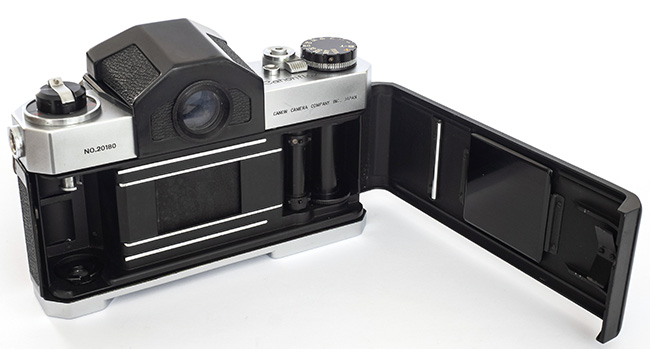
The film path is typical Canon of the time:
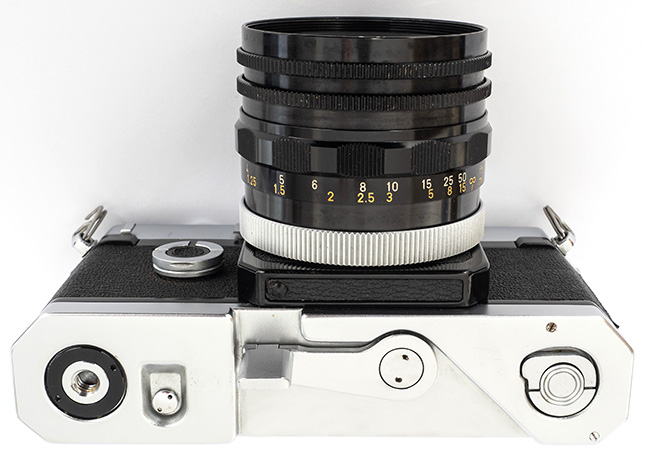
The most polarising feature was the film advance. The 1954 Leica M3 popularised right thumb operated lever film wind, Nikon embraced it with its Nikon S2 in December of the same year, Canon rejected it with its linear travel bottom trigger on the 1956 VT. Although it then offered lever wind alternatives of each model until the end of VI-T production in 1960 when lever wind finally triumphed, you can tell that there were people at Canon who continued to think that bottom wind was superior and customers would surely agree if they only gave it a chance. Some people claim to like it, even prefer it for their use cases, but clearly the majority didn't agree.
The Canonflex implementation of bottom winding is very different to the rangefinders, instead of linear travel, ideally in combination with the accessory grip (“Handle-bar” initially or “Pistol Grip”) it is a 130 degree swing, more like a traditional lever, but centered on the bottom instead. It features a hinged tab which pivots down for use and is operated by the middle finger of the photographer's left hand with a claimed shooting rate of up to 3 frames per second, theoretically matching the Nikon motor drive. Although its operation was much improved over the rangefinders, it suffered similar downsides with the typically bigger and longer SLR lenses making it worse. It made a big camera taller and made use on tripods, copy stands etc. cumbersome. The tripod mount is offset to one end, a design legacy of the original bottom loading rangefinders but necessary with this camera because of its winding mechanism. To effectively use it mounted requires the Camera Holder R, or R2, which puts the tripod mount back in the middle. Ergonomically, the trigger was more difficult for many people. Instead of the photographer's right hand operating the film wind and shutter button and the left free to focus and hold the camera, or support the lens, depending on preferences and lens, the left hand of the Canonflex user now had to support the camera and lens, focus and operate the film advance, often all at the same time. The longer the lens, the less natural and more difficult it becomes.
Usefully, the bottom plate still includes the key type bottom lock which allows the continued use of Canon's film magazine:
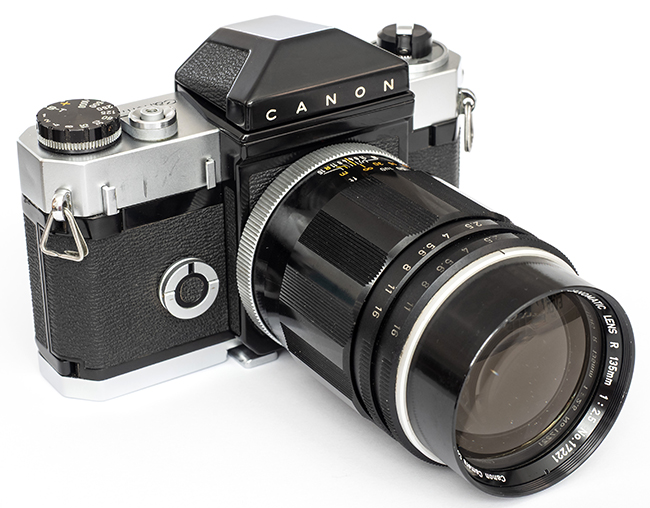
With Super-Canomatic Lens R 135 mm f/2.5 mounted:
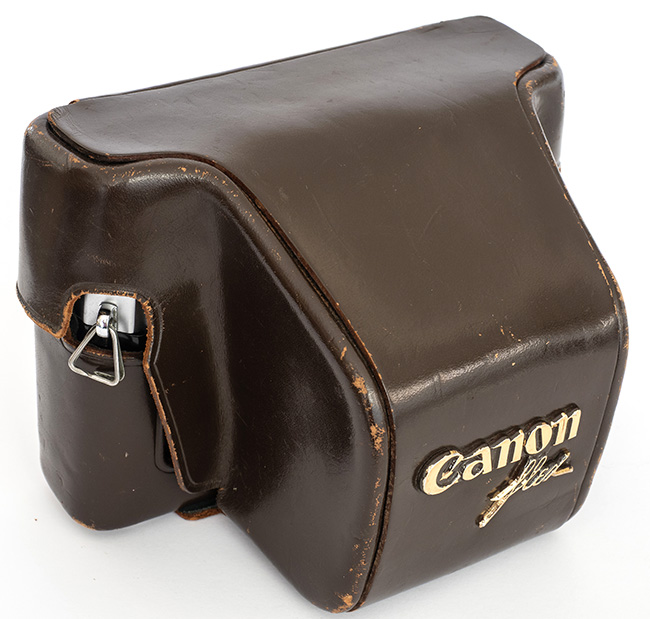
Canon made some petite ever-ready cases, this is not one, but it does provide good protection:
Rather than sitting over the shutter dial like the Canon Meter mounted on the Canon VI-T, VI-L and P, and meters on other brand SLRs such as Nikon and Minolta, the optional Canon-Meter R coupled to the shutter dial via a toothed gear wheel under the dial. This pushes it quite far out and it feels a little less solid and more vulnerable than the others, but with a spring loaded latch on the back, it is relatively quick and easy to mount between the two minimalist rails on the front of the top plate. It's important to ensure that the same shutter speed is set on the meter as the camera before the teeth are engaged:
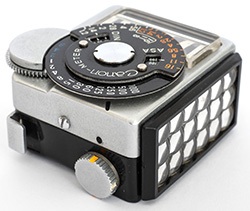
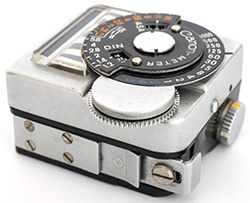
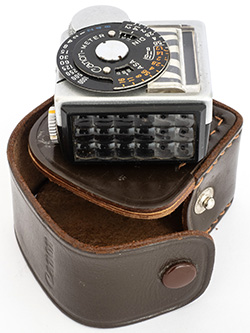
The Canon-Meter R was supplied with its own leather case and an incident light attachment was also provided, but is unfortunately missing on this example:
The Canon waist-level viewer provides a magnified view, useful for microphotography and copy stand work. It interchanges with the removable eye-level pentaprim:
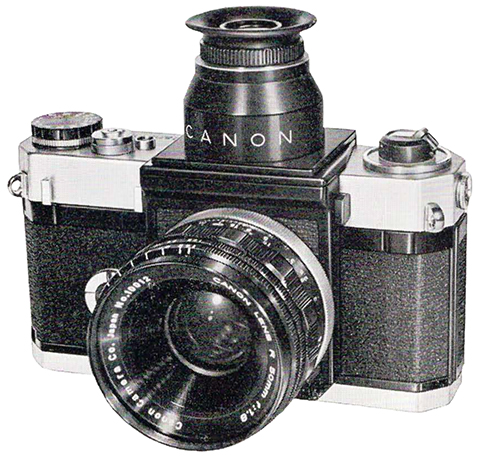
(Image from Canon brochure)
Canon R Mount
The Canon R mount has a flange to film plane distance of 42 mm and throat diameter of 48 mm. There are a number of elements to a typical SLR lens mount. One is the physical connection holding lens to body. The Canon R mount on the Canonflex body features a flange with three raised bayonet tabs. The lens has an alignment pin at the 12 o'clock position and matching slot openings in the rear of the breech lock ring at the base of the lens. As noted above, the lens is positioned and held stationary against the body whilst the ring is rotated to lock the lens in position. The mounting flange on the body of Canon SLRs remained the same until the introduction of the EF lens mount in 1987. The other elements are the mechanical linkages between body and lens for various aspects of aperture control and in late models, automatic exposure lock. There are three major versions of the Canon breech lock mount, R, FL (allowing stop down metering) and FD (allowing full aperture metering), based on how the linkages work (during the FD period, the lenses lost the breech lock ring and changed to twist to mount like normal bayonet mount lenses, referred to as New FD). At a minimum, automatic lenses of all three mounts are capable of automatically stopping down the aperture during exposure and then quickly returning to fully open for viewing, but note, because they operate differently, there are compatibility issues with R mount lenses and they cannot operate automatically on the later mounts. The move from R to FL mount was Canon's admission that it had got the automatic aperture operation wrong. Here, we are only concerned with the R mount.
Canon R Mount Lens Types
Canon offered three categories of R mount lenses plus a means of utilising some longer rangefinder lenses:
Super-Canomatic Lens R
Super-Canomatic R lenses feature fully automatic aperture operation, most of the time. They are designed to have fully open apertures when at rest and use an internal spring to snap down from fully open for viewing to the preset aperture when the shutter is tripped and then the aperture returns to fully open again. Unlike with later FL and FD mounts, in addition to the aperture release pin, there is also a charging lever that physically tensions, or “charges” the spring as the camera's film wind lever is being wound on. Rear of Super-Canomatic Lens R 50 mm f/1.8 lens with alignment pin at top, aperture release pin on left and charging lever on right:
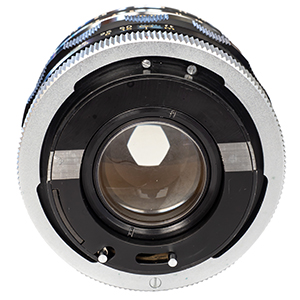
This is very similar to how semi-automatic lenses, which predate the fully automatic type, work. The main difference is that once semi-automatic lenses are tripped, they stop down and stay there. If there was a full step forward from semi-automatic to automatic aperture operation, Canon had only taken half a step by simply making the default rest position fully open. The problem is that if the charging lever is not pre-charged before mounting the lens on a body with shutter already cocked, the automatic diaphragm mechanism will not operate for the first exposure which will then be overexposed without the photographer being aware of it.
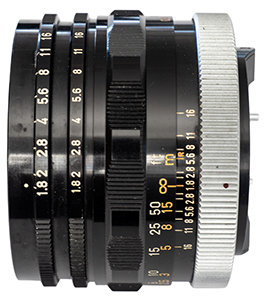
The Super-Canomatic lenses don't feature a depth of field (DoF) preview button or switch, instead there are two aperture rings. The outer one is called the “Pre-set Aperture Ring” and that is used for setting the desired exposure f stop. The inner one is called the “Visual Aperture Ring” and is used for previewing the DoF. Before the shutter is released, the Visual Aperture Ring must be returned to the fully open position. Super-Canomatic R 50 mm f/1.8 lens:
Super-Canomatic Lens R 135 mm f/2.5:
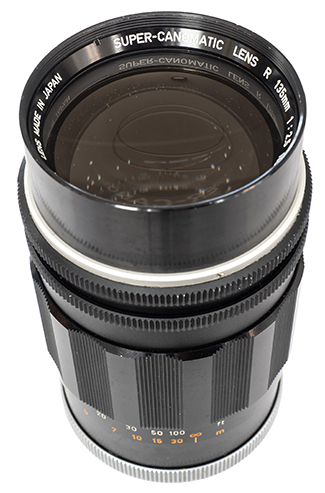
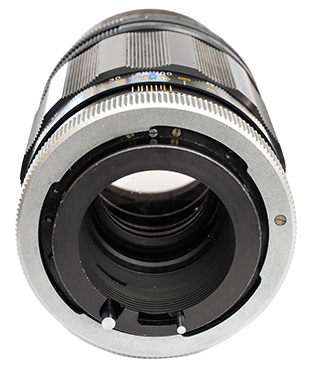
Canomatic Lens R
The name was reserved for semi-automatic R mount lenses, however there is only one R mount lens with the Canomatic Lens R name, the 200 mm f/3.5. It is the longest of the helical focusing R mount lenses and according to Canon, it was introduced in May 1959. Peter Dechert notes that it “had a tendency to lose its diaphragm leaves.” A Canon R lens brochure/manual explains the semi-automatic operation:
“The lens aperture can be pre-set to a desired F-stop by turning the pre-set aperture ring. When the shutter is released, the lens aperture stops down to a pre-selected F-stop. It re-opens when the charge ring is turned manually. The Canomatic system can be released manually by pressing the pre-set release button.”
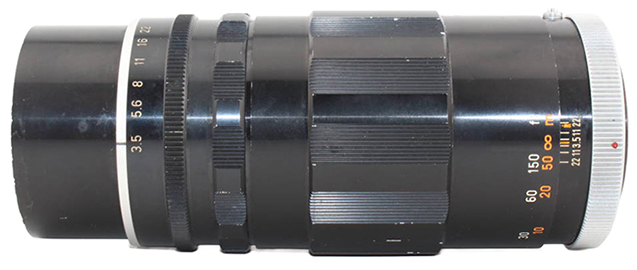
(Web image)
The pre-set ring is the front one similar to the Super-Canomatic lenses. The charge ring is the narrow scalloped ring between the pre-set ring and the wide focusing ring. The pre-set release button is the small chrome button near the base. At the rear of the lens is only the aperture release pin as charging is done manually with the charge ring. Basically, at rest, the lens is closed down to the pre-set aperture (the opposite of the Super-Canomatic type). For wide open viewing, the aperture spring has to be charged manually with the charge ring. When tripped by either the shutter, or the DoF button, it will close down to the pre-set aperture and stay there until manually charged again. Using the DoF button before shooting requires charging twice.
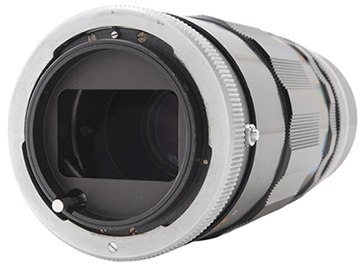
(Web image)
Canon Lens R
This type includes two different manual sub-types, both with no linkages between camera and lens; pre-set and full manual aperture lenses.
Canon Lens R with Pre-Set Aperture Control
Canon R mount lenses with pre-set aperture control are the 100 mm f/3.5 and 135 mm f/3.5 lenses. With these, the front silver ring is the pre-set ring for setting the desired shooting aperture and the black ring behind it is the aperture set ring which is turned to close down to the pre-set aperture before shooting. After the shutter has been tripped, it is turned back to open up for viewing. Canon Lens R 100 mm f/3.5:
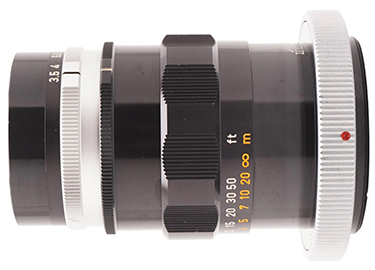 (Web image)
Canon Lens R 135 mm f/3.5 showing rear free of any aperture control pins/levers:
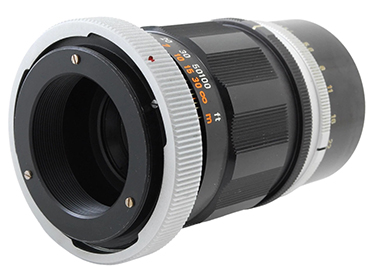 (Web image)
Canon Lens R with Full Manual Aperture Control
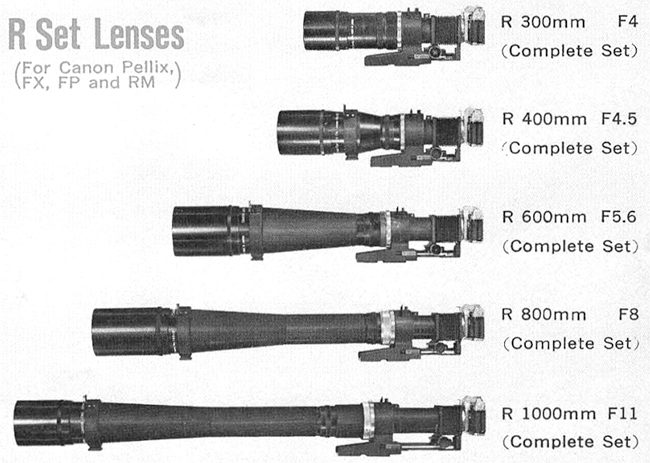
The manual lens in its most basic form, turn the aperture ring in one direction to open the aperture, and the other way to stop down. The Canon R 85 mm f/1.9 is the only helical focusing Canonflex in this category. The other full manual Canon R mount lenses are what Canon calls its “Extra Long Telephoto Lenses” (sometimes splitting the shorter end into “Long Telephoto Lenses” which may include the Canomatic R 200 mm f/3.5). These are 300 mm, 400 mm, 600 mm, 800 mm and 1000 mm lenses (plus one more, see below), which instead of a helical system, use the Bellows R for focusing. They were released in January 1960, and in 1961 were shared with the new Canon 7 rangefinder model. As part of the connection between lens, lens supporter, Bellows R and camera, there was also a connecting tube, which apart from the Mirror Box 2 also required for the rangefinders, appears to be the only part which is different between the rangefinder sets, and the Canonflex R sets; the “Intermediate Tube” and “Intermediate Tube R” respectively. These were different lengths to accommodate for the different distances from Mirror Box 2 flange to film plane of the rangefinders and flange to film plane of the SLRs.
Because there are no linkages to worry about, the manual lenses can mount to any version of Canon's breech lock style mount and the Canon R Extra Long Telephotos could still be found in catalogues and brochures featuring FL mount lenses.
This image of the lenses is adapted from a 1965 Canon lens catalogue:
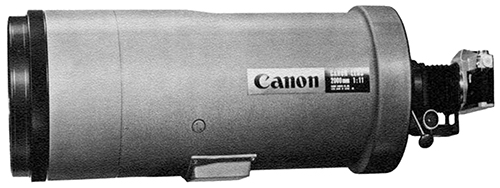
As alluded to above, there is one more Extra Long Telephoto, although that description hardly does it justice. On the R mount page of the Lens Hall in Canon's online Canon Camera Museum is the TV2000 f/11 catadioptric, or mirror, lens released in September 1960 (discontinued in 1975). Focusing is also done with a bellows but not the general purpose Bellows R used for the shorter lenses (it looks like the Bellows R rail would be the problem). As the name suggests, its main purpose was mounting on TV cameras, but it did also come with an R mount and is listed in at least one Canon SLR catalogue. The photo on the Lens Hall page seems to show it mounted to a Canon FX, note the label which clearly names it “TV Lens”:
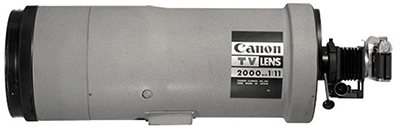 (Canon image)
This variation of the lens has a different label which just says “Canon Lens”:
 (Web image)
Canonflex Lenses in Release Order
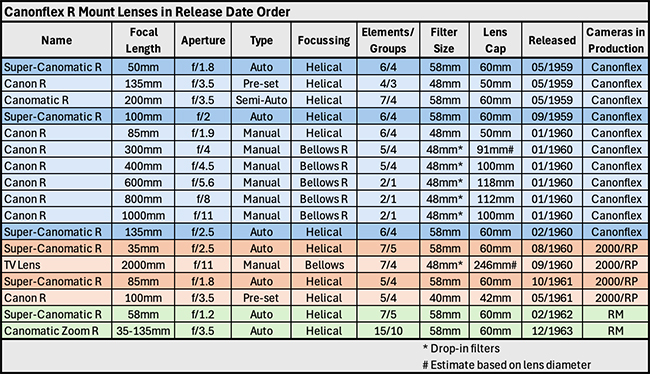
Below is a table of Canonflex R mount lenses in release date order with Super-Canomatic fully automatic lenses highlighted in a darker shade. It's done this way to highlight Canon's slow roll out, particularly of automatic lenses. Most of the manual lenses were based on rangefinder designs. When the Canonflex was released in May 1959, only the standard Super-Canomatic R 50 mm f/1.8, the Canomatic R 200 mm f/3.5 and the pre-set Canon R 135 mm f3.5 were available. That is probably the worst debut portfolio of any SLR, let alone one that purported to meet professional needs - it may have been equalled by the failed 1960 Yashica Pentamatic but one of the Yashica's three debut lenses was a wideangle. The only wideangle type offered by Canon was the 35 mm f/2.5 Super-Canomatic R released in August 1960 when the original Canonflex had already ceased production:
Using Rangefinder Lenses
Offering a number of options for adapting rangefinder lenses was a win-win for Canon, but a two edged sword as well. Given the Canonflex's meagre R lens offerings during 1959, the rangefinder lenses made the portfolio look more respectable. It probably also helped retain loyal rangefinder customers looking to move to an SLR, or looking for an SLR to add to their exisiting gear. However, on the minus side, there were use case limitations with some options and the fact that by design rangefinder lenses are fully manual simply drew attention to the slow and inadequate roll out of automatic lenses compared to some other brands.
Focusing Adapters
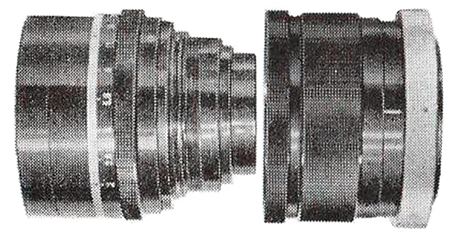
The lens heads of some shorter Canon telephoto rangefinder lenses can be unscrewed and mounted in a special focusing adapter allowing them to be used like manual Canon R mount lenses. There are two such adapters, the RA and the RB. The following is the list of lenses that can be adapted:
Focusing Adapter RA
85 mm f/1.9 chrome mount below serial no. 79000
100 mm f/2
135 mm f/3.5 chrome mount below serial no. 62999
Image of 100 f/2 head and Focusing Adapter RA from Canonflex user manual:
Focusing Adapter RB
100 mm f/3.5
Lens Mount Converters
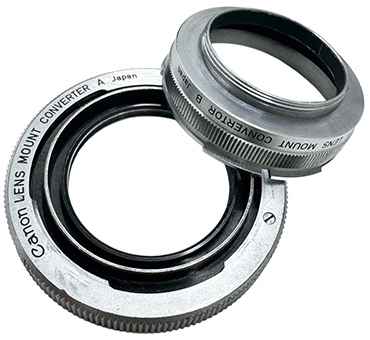
The Canon Lens Mount Converter A allows LTM rangefinder lenses to be mounted on the Canonflex and the Canon Lens Mount Converter B allows Canonflex lenses to be mounted on LTM rangefinder cameras. Converter B pictured at top, Converter A below:
 (Web image)
Rangefinder lenses mounted on the Canonflex cannot focus to infinity but can be used for close-ups and copy work.
Canonflex lenses mounted on rangefinder cameras do not rangefinder couple and therefore manual focusing techniques such as measurement, zone focusing, using the lens hyperfocal distance etc. will be necessary whilst preferably stopping down further than may be usual.
The two converters used together will act as an extension tube to which an actual extension tube can be added for macrophotography.
Tele-Coupler R
The Tele-coupler R was intended for Canon's telephoto rangefinder lenses which used the earlier Mirror Box between camera and lens. The Tele-coupler R replaced the Mirror Box when the lens was used on the Canonflex instead. It can't be used with the updated Mirror Box 2 lenses introduced for the Canon 7 in 1961.
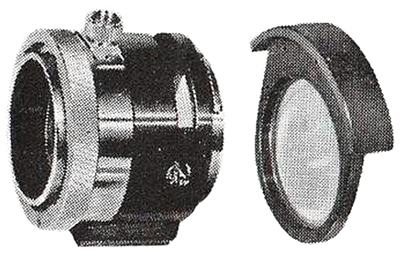
There is a drop-in filter ring into which screw 40 mm filters and a tripod mount which can be rotated from landscape to portrait, or vice versa, by loosening the thumbscrew. Image of Tele-coupler R from Canonflex user manual:
The Rest of the Canonflex Range
The Canonflex had been released in May 1959 and was discontinued 12 months later in May 1960 with a little over 16,000 produced. It was replaced by an upgraded version, the Canonflex R 2000 and a cheaper model with fixed prism but similar specs to the original, the RP. Both started production in June 1960 and were marketed in September 1960 and both ended production in January 1962 with about 8,800 of the R 2000 model and over 30,000 RPs made. The final model was the more amateur focussed Canonflex RM with built-in selenium cell exposure meter and film advance lever moved closer to the top plate, but not there yet. Production commenced around February 1962 and it was marketed in April 1962. Production ended in March 1964 with over 71,000 cameras being made. At that point, the Canonflex and its R mount era were over, although the R mount Long Telephoto and Extra Long Telephoto manual lenses from 300 mm to 1000 mm would continue through the FL mount reign.
Canonflex R 2000
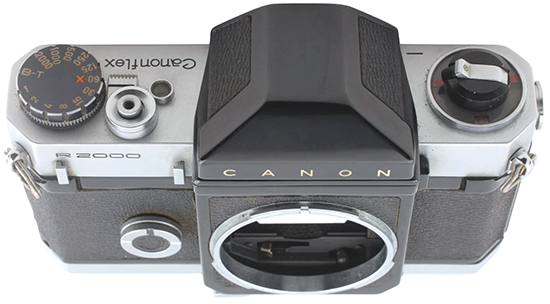
The Canonflex R 2000 looks very much like the original, the only obvious difference is the “R 2000” name on the front of the top plate above the meter mounts. It reflects the headline feature which is the 2000 top shutter speed. Peter Dechert and some others say that this was the first SLR to achieve that but that is not correct. The first was the Konica F introduced in February 1960 and it used a predecessor of the vertical travel metal blade Copal Square. The Canon used a development of the horizontal travel rubberised cloth curtains version of the typical Leica type almost ubiquitous amongst 35 mm camera focal plain shutters. According to Peter Dechert, it had a “tendency to slow down after a little hard use”, but like the ambitious Zunow before it, the Konica failed and was discontinued because of chronic unreliability.
Other changes were minor. The “X” position on the shutter dial was dropped to make room for the extra speed and the “60” of the original Canonflex became “60-X”. A special version of the exposure meter was made for the R 2000 with the extra speed included. A seemingly unrelated and strange change was from split image to plain ground glass focusing with a fresnel surround. According to Pacific Rim Camera, a small number of all black ones were made but are very rare and hard to find. So far, I have not seen one.
(Web image)
Canonflex RP
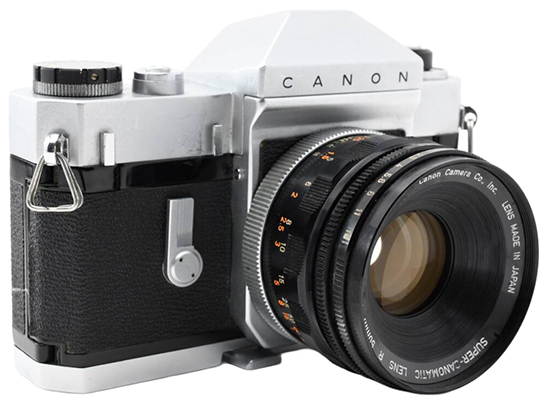
Basically the original Canonflex with a fixed pentaprism for photographers who didn't need a removable one. One minor downgrade was removal of the shutter button time exposure lock and associated “T” setting on the shutter dial. The signature and sexy circular self-timer key was replaced by a more traditional but easier to operate lever, effectively a neutral change depending on point of view. It also inherited the new ground glass type focusing screen from the Canonflex R20000, whether that is a plus or minus depends on preferences. A definite improvement was that the fixed pentaprism housing viewfinder eyepiece was designed for easy removal to allow use of eyepiece correction lenses, unlike with the removable prism bodies. The rest of the camera remained the same including the original camera's split image focusing screen and the base plate and the bottom lever wind:
(Web image)
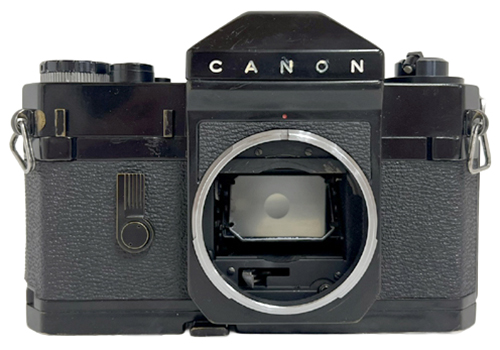
Fairly rare black version, a matching black Canon-Meter R was also available:
(Web image)
Canonflex RM
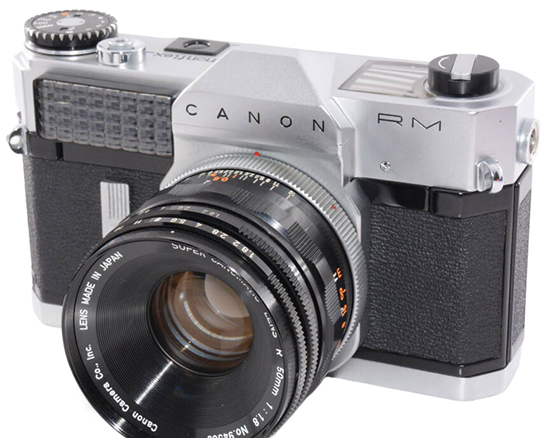
The last hurrah and by production numbers, the most successful Canonflex model, although these days, probably the least loved. Whilst appearance wise it looks unrelated to the others, it is still very much the same camera except for two major changes, well really three, one is a consequence. A shutter coupled selenium cell exposure meter is now built into the raised camera top plate in much the same location where the previous clip-on meter mounted. Unfortunately it has given given what was already a large and chunky body, which some might nevertheless call handsome, a Quasimodo-like appearance. Canon finally got the memo and the other change was the move of the film advance lever from the base plate to almost the top plate, actually in a slot at the bottom of the top plate. Rather than a reluctance to capitulate fully this was almost certainly to avoid having to re-engineer the camera to move the shutter dial from its usual position on Canonflex models. Appearance of the lever on top of a tall body may have been a secondary reason, it's almost certainly cosmetic reasons that Nicca went down this very same route with the Nicca III-L in 1958 (retained by the Yashica YF redesign).
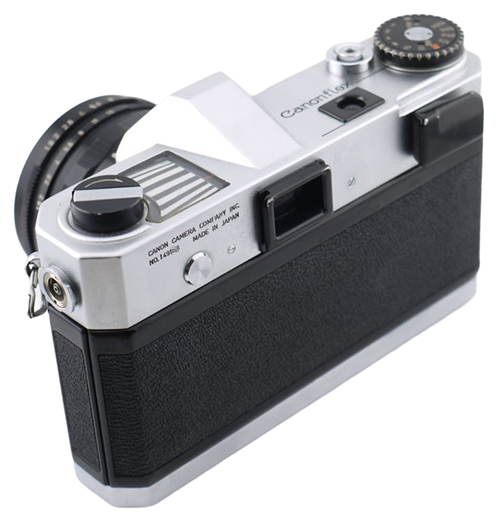
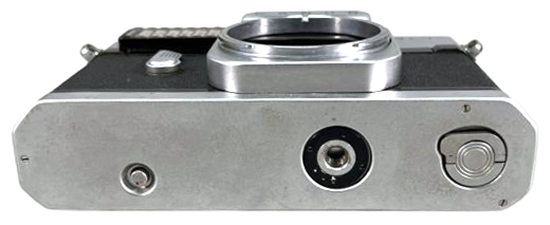
The move of the film advance enabled the bottom plate to be redesgned and the tripod mount, whilst still slightly offset, was far more central and was now unobstructed by other requirements. As can be seen in the rear photo below, the the viewfinder eyepiece frame is now rectangular and the plastic frame has vertical channels to allow fitting accessories such as eyesight correcting lenses and a 90 degree angled viewfinder for waist level viewing.
Apart from these changes and inclusions related to the meter, such as the meter display window and linked film speed indicator in a window on the shutter dial (dial lifted for setting), everthing else stayed much the same. The self-timer was the Canonflex RP type and like that model, there was no shutter button time exposure lock, but the focusing screen reverted to the original split screen type.
Most Canonflex RMs are found with the 50 mm f/1.8 Super-Canomatic lens which was the only standard lens available on previous model, however, an optional 58 mm f/1.2 Super-Canomatic lens was released at a similar time as the RM and the camera was also offered with the 35 mm f/2.5 lens as well as body only. With the typical 50mm f/1.8 lens:
(Web image)
Rear of the camera showing the new plastic covered thumb operated film advance lever on the right and to the left of the viewfinder, a circular cover for the meter zeroing adjustment which requires a special tool to remove but was not generally available to owners:
(Web image)
Much improved tripod mount accessibility and position, although still not on the lens centre line:
(Web image)
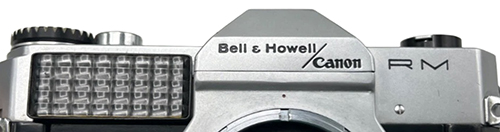
In late 1961, an agreement was entered into for Bell & Howell to take over distributing Canon cameras in the USA. Many, but not all, RMs sold in the US feature Bell & Howell co-branding as did Canon 7 rangefinder cameras:
(Web image)
A small proportion of Canonflex RMs were painted black:
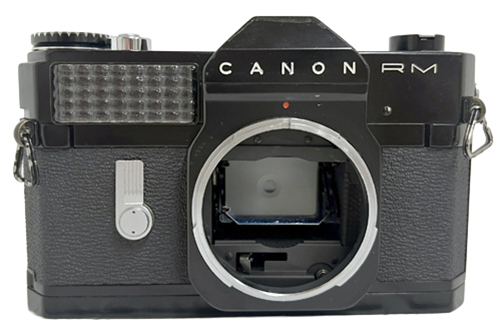
(Web image)
Canonflex Accessories
The Canon-Meter R, Waist Level Viewer and various lens adapters and converters have been covered earlier. The following accessories are some of the other ones usually identified in user manuals and brochures.
Lens Hoods
The long and extra long telephoto lenses that feature bellows focusing were supplied complete with special lens hoods (sizes in lens table above). For all the other lenses, including the 35 mm f/2.5 wideangle and the 50 mm f/1.8 that was described as not requiring one, lens hoods were optional extras. They are the same clamp on type as that used for the rangefinders. Except for the Canon R 135 mm f/3.5 lens with a 50 mm bezel and Canon R 100 mm f/3.5 with a 42 mm bezel, all the other hoods have a 60 mm mounting diameter, i.e. they will be marked “W-60” for wideangle, “S-60” for normal and “T-60” for telephoto lenses. The correct hood for the Super-Canomatic R 50 mm f/1.8 and 58 mm f/1.2 lenses:
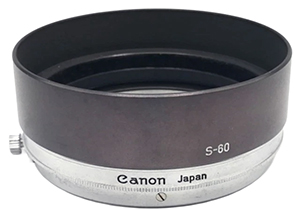 (Web image)
Filters
The long and extra long telephoto lenses that feature bellows focusing use 48 mm filters screwed into a drop-in drawer in the lens supporter. All other lenses use front mounted screw-in filters, mainly in the 58 mm size, the exceptions being the Canon R 135 mm f/3.5 with a 48 mm thread and the Canon R 100 mm f/3.5 with a 40 mm thread. Canon offered 6 filters specifically for B & W photography plus Skylight and ND 4 and ND 8 fliters plus Colour Conversion filters A and B. The B & W filters were:
Canonflex B & W Filters |
|||
Filter |
JIS Name |
Factor |
Description |
UV |
SL 39.3C |
1 |
Ultra Violet |
Y1 |
SY 44.2C |
1.5 |
Light Yellow |
Y3 |
SY 50.2C |
2 |
Yellow |
O1 |
SO 56.2C |
3 |
Orange |
R1 |
SR 60.2C |
6 |
Red |
G1 |
MG 55C |
3 |
Green |
Note, the JIS name is the Japanese Industrial System classification. It was introduced by Canon in maybe 1964 or 1965
Two similar Japanese brochures feature the B & W filters in a stackable set of colour coded cases like introduced for the rangefinder models earlier but the English user manual and brochure and later Canonflex model documentation all feature clear cases. They could be bought individually, or in a set. This 58 mm set features clear cases, a bit scuffed unfortunately, and doesn't include the green:
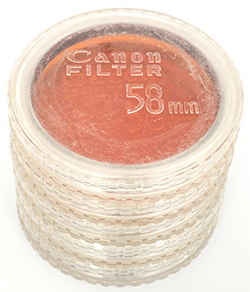
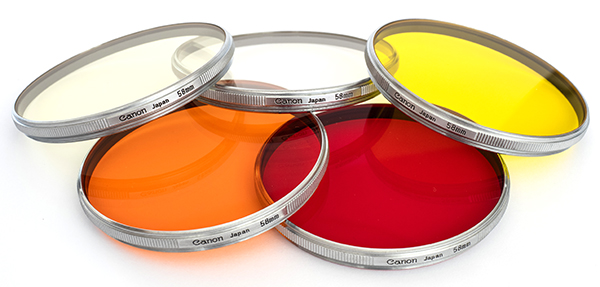
Close-Up Lenses
Canon offered a 58 mm Canon close-up Lens for the normal 50 mm f/1.8 Super-Canomatic R lens in two different focusing ranges. The range for the 450 (R1) is 55 cm to 33 cm and for the 240 (R2), it is 33 cm to 26 cm. They screw in just like a filter and were supplied in a similar case. In the first Canonflex user manual, the longer focusing range version is marked “R-1”, but in later manuals, “450” is used instead:
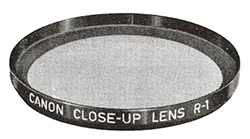
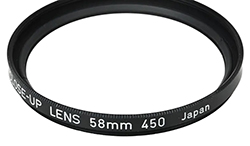
(Web image on right)
Lens Caps
The soft plastic lens cap below seems to be the standard type across all Canonflex models and lenses other than the long and extra long telephoto lenses. Whilst the Canonflex and Canonflex R 2000 user manuals don't display any lens caps, both the Canonflex RP and RM manuals show this type of lens cap being removed. According to Peter Kitchingman, it was first introduced on rangefinder camera lenses with the August 1958 update of the 85 mm f/1.9 lens update followed by the May 1959 135 mm f/3.5 update when a Canon R Canonflex version of the lens was also introduced (along with two other Canonflex lenses). 58 mm version:
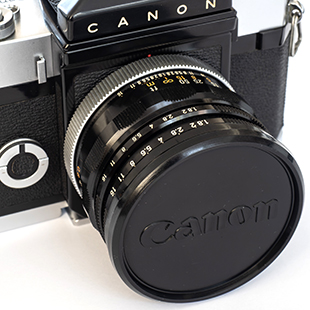
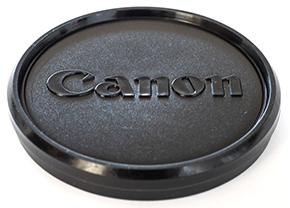
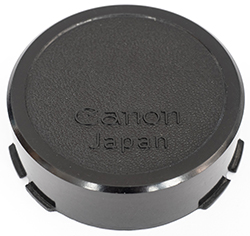
Typical breech lock secured rear lens cap with “Canon Japan” marked:
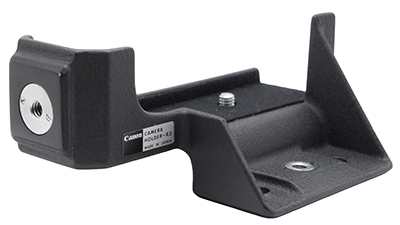
Camera Holder R
The Canon Camera Holder first appeared in around early 1951 and was a very useful accessory which effectively moved the tripod mount from under the film take up spool spindle of Canon's Leica inspired bottom loading rangefinder cameras, where the inside of the mount supported the spindle, to a central position and there was also a mount on the vertical end piece for portrait shooting. The hinged back rangefinders could have changed to a central mount except that Canon's priority was to offer bottom trigger advance models. Same with the Canonflex and being a bigger, heavier camera with bigger and heavier lenses, the useful accessory became virtually essential for any sort of mounted use, although Canon's descriptions focus on copy work (note, Canon's Bellows R focusing long lenses included the lens supporter with its own balanced tripod mount). Over the life of the Canonflex models, there were three versions.
Camera Holder R
This is the photo in the Canonflex brochure and was the first one released, maybe (see R2 below):
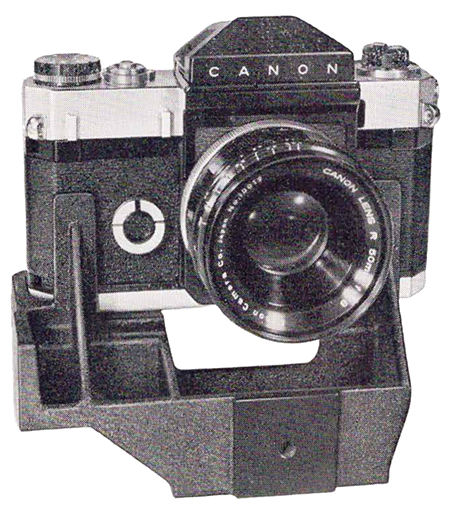
It's quite a large multi-purpose item.
Camera Holder R2
Curiously, the same image appears in both the first Canonflex user manual, where it is identified as the “Camera Holder R”, and also the Canonflex R 2000 and RP user manuals, where it is identified as the “Camera Holder R2”. Rear view from the Canonflex user manual:
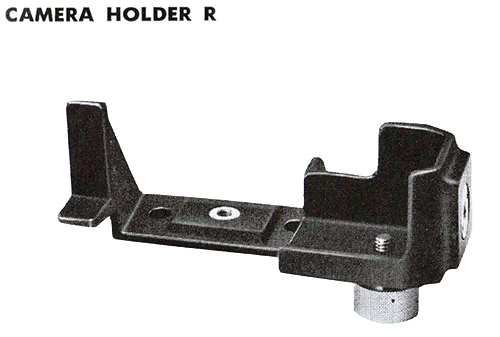
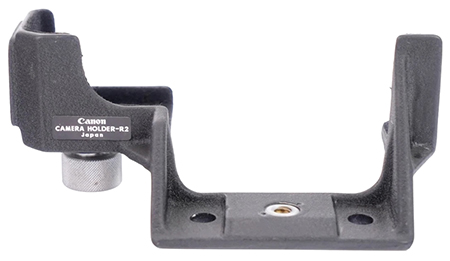
Regardless of the name above it, I'm certain that both this one and the production version below with the R2 name on the front are the R2. Although from this angle it may not look like it, the rear view of this one (not shown) confirms that it is identical to the three user manual examples except that it has rounded strengthening fillets added between the bottom panel and its sides:
 (Web image)
What I am guessing happened was that the original R never went into production, or was replaced very early on in production, by the R2 but it may not have been named that, or the user manual name was not updated but the picture was. The fillets may have been added between pre-production examples and production, or some time later.
Camera Holder R3
The R3 is specific for the RM model only. The RM with a clear baseplate and more central tripod mount, albeit not on the lens centreline, had a more limited requirement for a camera holder and therefore the main use case for the R3 is for portrait shooting and copy work.
Flash Units
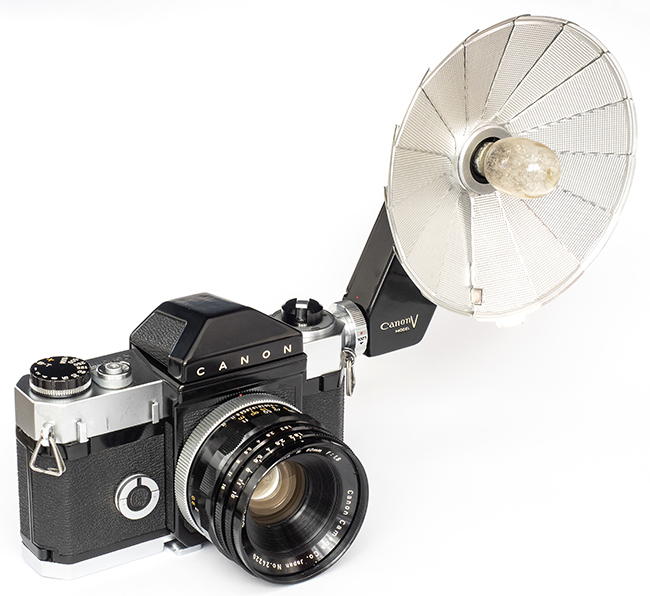
Each of the top plate ends of the four models features a bayonet flash mount connector for Canon's matching flash units. These are the Speedlight Model V electronic flash and the bulb Flash Unit Model V which feature in the Canonflex, Canonflex R 2000 and Canonflex RP user manuals and brochures and the bounce head V-2 which was launched later and replaces the V in the Canonflex RM user manual. See For Canon Bayonet Mount Cameras and Canon Speedlights for Rail and Bayonet Mount Cameras.
Canonflex with Flash Unit V mounted:
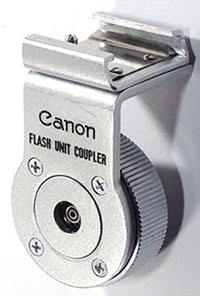
Appearing as both a Canon 7 accessory and in a Canonflex RM brochure is the Canon Flash Coupler which allowed accessory shoe mounting of non-Canon, or later Canon, flash units. It features a breech lock for the Canonflex flash socket bayonet mount and a PC pass through plug on the side:
 (Web image)
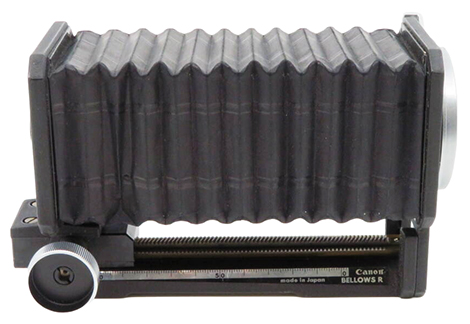
Bellows R
The Bellows R was a jack of all trades. It was part of the 300 mm to 1000 mm telephoto lens sets, used for close ups, copy work, macrophotography, microphotography and more:
(Web image)
Copy Stands
The Canonflex, Canonflex R 2000 and Canonflex RP user manuals all feature the “Copy Stand R”. The Canonflex RM user manual features the “Copy Stand R3”. I can't find any mention of an R2 and am presuming that the R3 was named that because it is the Canonflex version (R) of the similar “Copy Stand 3” which was the final rangefinder type. R on left, R3 on right:
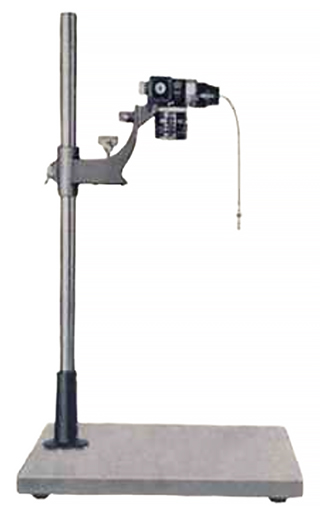
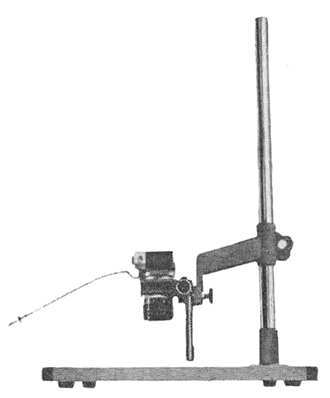
These required the respective camera holders and could be used for copy work and teamed wth the Bellows R and connecting tubes, extension tubes etc, could be used for microphotography and macrophotography.