Canon X-Ray Cameras
Contents Page 4
(Scroll down or click on Links)
The Canon Pages
Page 1 Canon
Page 2 Kwanon Prototypes
Page 3 Canon Models
Page 4 Canon X-Ray Cameras
Page 5 Canon Lenses & Accessories
Page 6 Canon Flash Units
Page 7 Canonflex
35 mm X-Ray Camera
From the perspective of our Leica copy narrative, the X-ray cameras are a footnote to the main story but they are relevant to the development of the company and the first Serenar lenses. Peter Dechert covers the 35 mm versions on pages 164 to 170 of his book and Peter Kitchingman has a picture of one and details of the R-Serenar 5 cm f/1.5 on pages 84 to 85 of his book. Serious collector Kirk Thorsteinson features his post-War Circa 1948 6 x 6 cm version and several others on the Canon page of his Flickr site and provides detailed notes and variation history which I have relied on for the larger version of the camera.
Development of the Seiki Kogaku X-ray camera began around 1939. It was intended for recording fluoroscope images rather than direct imaging. According to Hayato Ueyama, there was considerable demand for a Japanese version of an indirect recording camera like featured in overseas medical articles. Leitz did something similar but it was based on the Leica Standard body. Initial Seiki Kogaku prototypes used the Canon J body before settling on a unique design said to be based on the Carl Zeiss Tenax body which used a 24 mm x 24 mm film format. The camera was basically a light tight box with film transport. There was no shutter, a dark slide being used instead. The camera featured an external bayonet mount, somewhat similar to the later Canon 7 models, with the lens screwing into a breech lock mount which itself screwed onto a metal cone (later ones used screws) for attaching to the pyramid shaped timber fluoroscope hood. Whilst the whole lot could be easily disassembled, it was designed so that breech lock could release the body by itself, leaving the cone with attached lens in situ on the hood. Typical assembled setup as attached to fluoroscope, note that the camera is not the Canon X-ray model and unlikely to be a Canon J based prototype as described and pictured by Hayato Ueyama in his book:
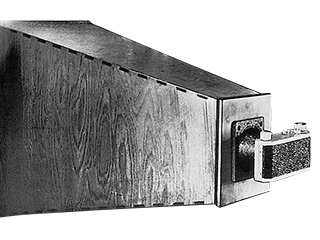 (Web image)
The Canon X-ray camera used 35 mm film with the Tenax image format of 24 x 24 mm being settled on for maximum economy. Hayato Ueyama continues:
“It was delivered to the Navy through Colonel Seijiro Yokokura, the chief orthopedic surgeon at Naval Yokosuka Hospital. Yokosuka Hospital had about 20 Zeiss-Ikon Sonnar lenses 5cm f1.5 brought from Germany by submarine, so the original Seiki X-Ray camera was used with them.” and: “ The lenses were later changed to Nikkor 5 cm f/2 and f/1.5 and then Seiki Serenar 5 cm f/1.5.”
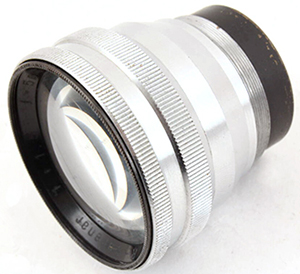
Production commenced in early 1940 and in 1942, deliveries began to the Army Medical School. Ueyama says that this version was fitted with the Serenar 5 cm f/2, later replaced by the f/1.5 version which he says was developed from the f/2 (the designer is said to have claimed that the result was closer to f/1.6). Note, as mentioned elsewhere, apart from Ueyama's book, I have found no other references anywhere to a pre-War Serenar 5 cm f/2. A pre-War Nikkor 5 cm f/1.5 is just as elusive, although Peter Dechert speculates that prototypes of the X-ray camera used a Nippon Kogaku made 5 cm f/1.5 lens but he is more certain that Nippon Kogaku supplied 50 such lenses for the first production cameras. Ueyama does also mention it (see above quote). The Nikon Museum has displayed a Regno-Nikkor 5 cm f/1.5 lens with the year shown as 1944. Although other items on display suggest that is the year of release of the lens, it is still a little unclear whether it might not be just that version, or even the year of the particular lens itself (“Nikon Museum Special Collection 2”, 29 September 2020 to 30 January 2021 - see Red Book Nikkor site). It seems unlikely to me that Dechert and Ueyama can both be correct.
There were only minor changes until production ended in 1957. Initially only engraved with the Kogaku Seiki eagle logo, from 1947 it was named “X-Ray Canon 35” and from 1951 or 1952, “X-Ray Canon CX-35”. Early 35 mm type with Seiki eagle, missing both front leatherette and chain usually attached to the film winding knob which enables winding on remotely:
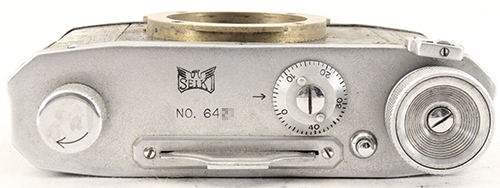 (Web image)
Typical War-time R-Serenar 5 cm f/1.5:
 (Web image)
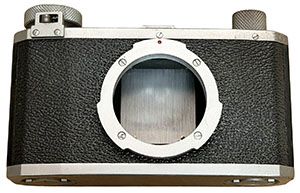
Below are the basic components of a post-1951 CX-35 set normally supplied in a timber box; camera body, lens and lens mounting cone. Note that unlike the normal Canon rangefinder cameras, the body tapers slightly before ending in the typical hexagonal shape. This example also is missing the winding on chain:
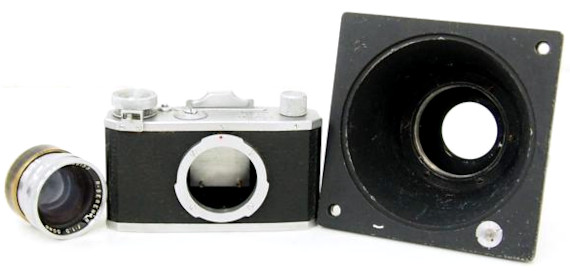
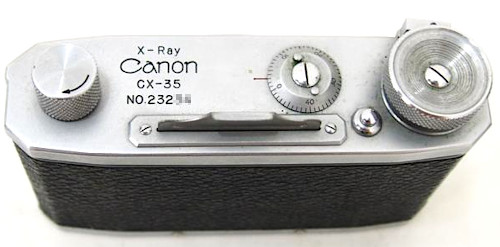 (Web images)
The winding on chain on another 1950s CX-35:
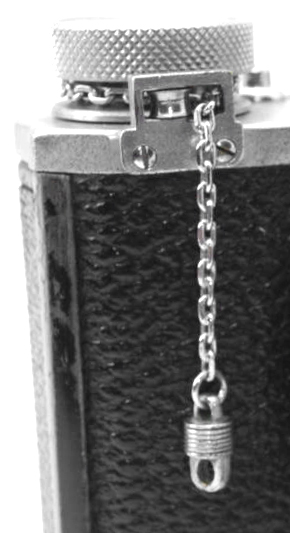 (Web image)
More CX-35 detail, this one owned by correspondent Greg Harp:
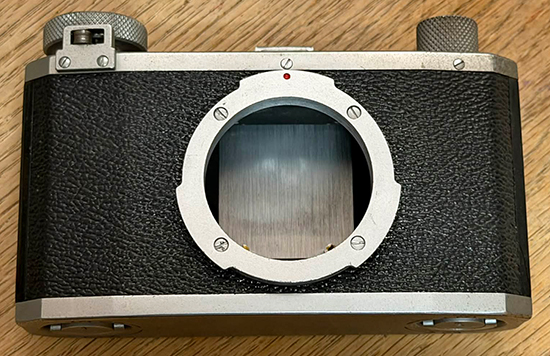
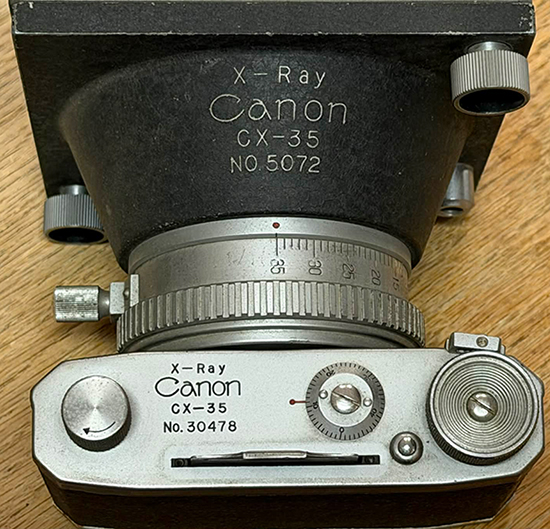
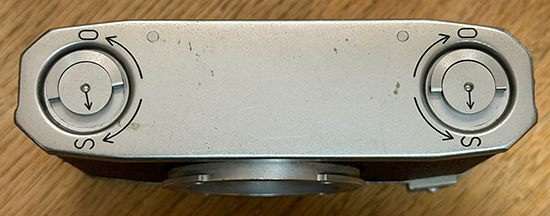
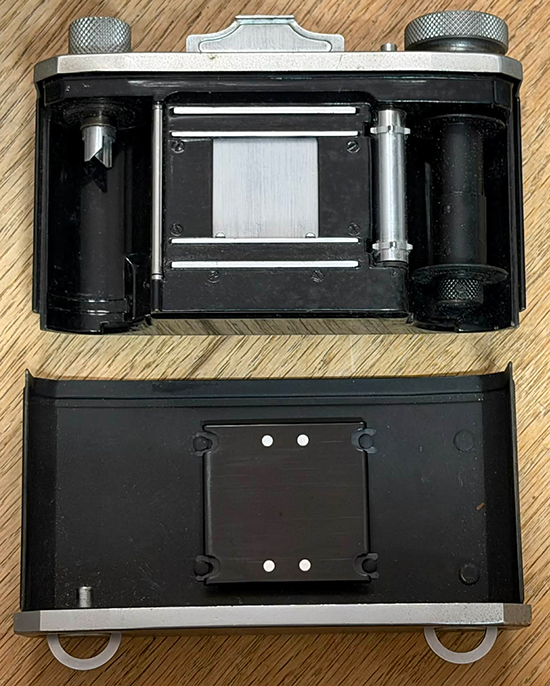
(Images, including image at top of page, courtesy of Greg Harp)
Peter Kitchingman tells us that the R-Serenar ended production in 1946. What immediately replaced it is not clear. The rangefinder camera's quite different design Serenar 50 mm f/1.5 didn't arrive until October 1952 and one month later, it was already renamed “Canon Lens”. All the CX-35 examples I have seen have been fitted with Serenar (only one, the example below), or Canon, 50 mm f/1.5 lenses, I understand using the same lens block in the X-ray camera's non-focusing barrel. According to Peter Kitchingman, the serial numbering is part of the normal 50 mm f/1.5 range. Serenar version of the new X-ray camera lens:
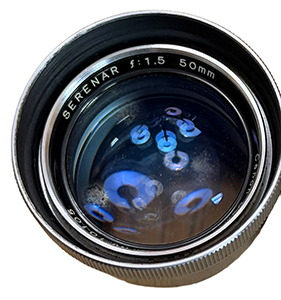
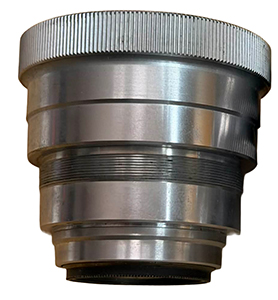
(Images courtesy of Greg Harp)
6 x 6 X-Ray Camera
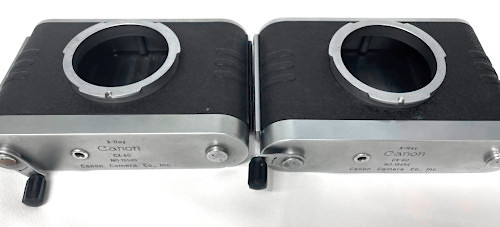
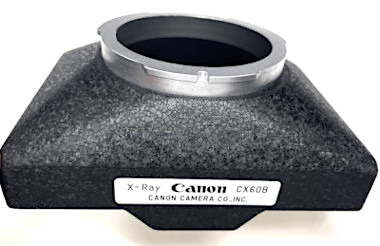
The larger 6 x 6 cm 120 roll film camera was released in 1946 (from 5th version Canon user manual) and is engraved “X-Ray Canon 6x6”, becoming “X-Ray Canon CX-60” in Circa 1950. These cameras underwent more significant development than the 35 mm version, by the fourth version, the body also losing its hexagonal ends in favour of rounded ones. The 6 x 6 camera didn't retain the winding chain feature. Five versions have been identified, by the third, the boxed kit included the roll film body, lens and cone plus 6 cut-film holders and a second “body” for use with the film holders. Kirk Thorsteinson calls this an “adapter” but whilst the roll film camera is simply a light tight box with film transport built in, this is also a light tight box when the cut-film holder is mounted, even though it looks like a shallow rectangular funnel with a lens mount at its mouth. It is in effect a second camera even though it doesn't look like one. Canon also treats it as a second class citizen, a fifth version one is named “CX60B” without serial number. Probably from the fourth version, the kit also included a second roll film body.
Initially, the 8 cm f/2 lens was named as a “Seiki Kogaku Serenar”, this soon changed to “Canon Serenar” and then “Canon X-Serenar”. A new 100 mm f/1.5 “Canon R-Serenar” lens was introduced in 1949 (Kirk Thorsteinson research) or 1950 (5th version Canon user manual), becoming the “X-Canon Lens” when the Serenar name was dropped. Below is Kirk Thorsteinson's early 2nd version X-Ray Canon 6x6. See his site for higher resolution photos and his research into the x-ray cameras:
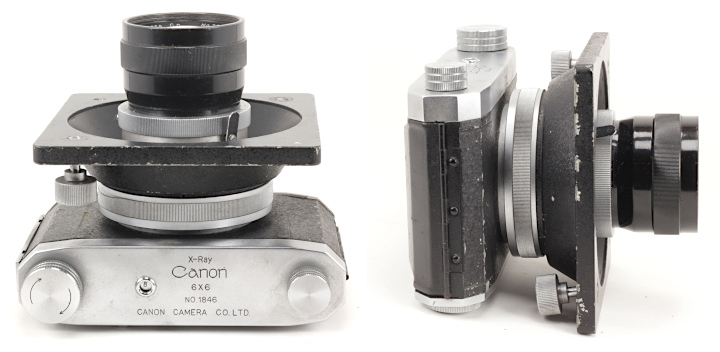
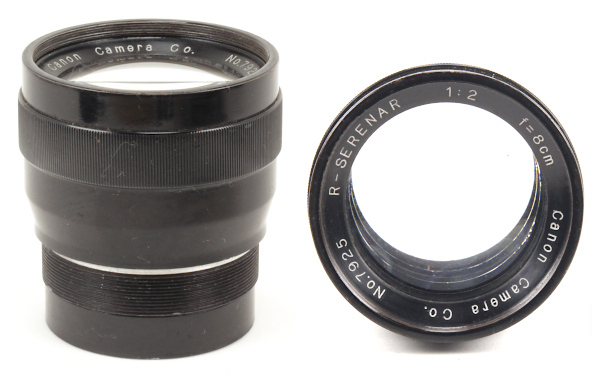
(Images courtesy of Kirk Thorsteinson)
Below are images of a fifth version set without its timber kit box, note the cut-film holders and their “camera body”:
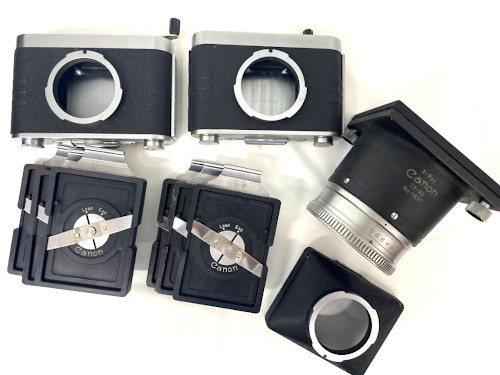
(Web images)