Canon Flash Units
Contents Page 6
(Scroll down or click on Links)
Flash Unit B
Flash Unit B 1 (or B-1)
Flash Unit B-I
Flash Unit B-II
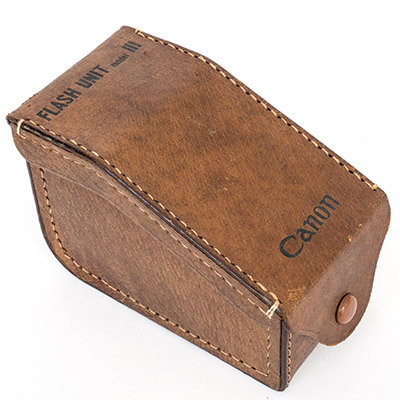
Flash Unit B-IIIFor Canon Rail Mount Cameras (bottom loading)
Flash Unit X
Flash Unit X Without Micro-Sync
Flash Unit Y
Flash Unit IIIFor Canon Bayonet Mount Cameras (hinged back)
Canon Speedlights for Rail and Bayonet Mount Cameras
For Canon 7s
The Canon Pages
Page 1 Canon
Page 2 Kwanon Prototypes
Page 3 Canon Models
Page 4 Canon X-Ray Cameras
Page 5 Canon Lenses & Accessories
Page 6 Canon Flash Units
Page 7 Canonflex
Canon Flash System
Before attaching a flashgun to a camera, it is necessary to understand how the flash synchronisation works and what the limitations are. The Canon options are more complex than they might at first seem. Typically, Canon used high shutter speed synchronisation (FP sync) for FP bulbs, slow shutter speed synchronisation (M sync) for M and F bulbs and X sync for electronic flash. In some user manuals, M sync maxed out at 1/8 or 1/15, in others at 1/125 and even 1/250 (Canon VT and Series VI models). As an example, below is my summary of the flash sync options from the Canon 7s user manual:
“FP sync from 1 to 1/1000 plus B and T, except 1/30. M sync from 1 to 1/15 plus B and T, also from 1/60 to 1/250 where only the central part of the picture is necessary. F bulbs 1 to 1/30 plus B and T. Electronic flash at X, B, T and 1 to 1/30 positions”
There are summaries for each of the relevant models on the main Canon page (under the first table for each model) but it is recommended that for flash use, the appropriate camera manual be sought out. Manuals for most sync'd models are available from one or the other of the sites in Links to the Good Stuff. Notable exceptions are the Canon II-F (there is a Canon addendum included in the II-F section) and the Canon IV-Sb2 and its derivatives, however, the tables and notes in the late Flash Unit Y user manual further below provide a guide to both these and the earlier models.
For convenience sake, it is easiest to break up Canon's flash systems into a number of groups. First, there were flash units for unsynced bottom loading models, which were largely overlapped by the second group. Second, there were flash units for the rail mount models. Third, there were flash units for the hinged back bayonet mount models. My choice is to only focus on bulb type units in those categories and then consider Canon Speedlights/Speedlites for both rail and bayonet as a separate fourth group because of similarity and lack of detailed information. I have also added a fifth group which is a brief overview of both a bulb type flash and two more modern compact Speedlites for the Canon 7s which did away with Canon's proprietary fittings.
I am a big fan of Canon's flash systems. Anyone familiar with Leica's flash contraptions before it finally added flash sync to the Leica IIIf in 1950 will appreciate the simplicity of the Canon solution for unsynced cameras, although the long D cell battery pack added to the bottom of the camera looks both ungainly and handles accordingly.
To me, the rail sync solution was genius. In 1950, there were multiple connectors and connection methods in use in various countries and the coaxial 3 mm PC sockets didn't exist by that name, if at all. The 1951 Synchro-Compur is the first use of the design that I am aware of. The “P” in PC stands for “Prontor” and the “C” stands for Compur, two famous German shutter makers by then both owned by Zeiss. It wasn't until 1953 that Zeiss standardised the design of the connectors on both its brands using the “PC” nomenclature and it took a number of years before it became almost universal.
It also has to be remembered that the main use of accessory shoes was accessories which for a rangefinder camera meant most commonly, accessory viewfinders. Shoe mount flashguns were available, e.g. the Minolta 35 had debuted in 1947 with both a shoe mounted flash gun and hot shoe sync. And there was also Canon's own B series units for unsnynced models. However, more serious flashguns and probably most professional units, which Canon certainly saw their's as being, were bottom mount on usually some type of base plate bracket. None of them ever feel really secure, although the early Nikon type was probably the best of them. On the other hand, the Canon Flash Units X and Y are completely secure and stable, are more compact with the camera and easier to hold without bracket bits getting in the way. They are very fast to attach and remove and the hot sync built into the rail means that there are no cables to bother with. Simply a better solution for 1950s photographers, although I accept that it's a bother for anyone wanting to use modern electronic flash these days, mainly because the required accessories are hard to find. Also, the rails can be annoying for anyone that didn't/doesn't use flash.
The change to bayonet mount was forced on Canon by the 1956 Canon VT and subsequent models with hinged opening backs. I don't feel that these are as good to hold with an original flash mounted as the rail models but they are still quick and secure and it is possible to use flash with an accessory finder attached. Plus the mounts are less physically and visually obtrusive. The hot bayonet mount doesn't have to be used, simply mount a generic flash in the accessory shoe and plug it into the PC socket inside the bayonet - the best of both worlds.
Note, metal bodied bulb type flashguns from the unsynced B-II to the rail mount Flash Unit Y are all serial numbered, as are some other parts including e.g. the Flash Unit X Synchroniser and some Unit X flash heads. Earlier flashguns are not numbered. The serial number ranges for each of the flashguns start with similar low 4 digit numbers and tick over to 5 digits, the Flash Unit Y becoming significantly higher because of the larger number made.
For Unsynced Cameras
These are the “B” series flash units, all featuring approx 5" reflectors (135 mm). The Flash Units B, B 1, B-I and B-II are designed for using D cell batteries only. Although the B has more basic features, all four units are very similar in appearance and operation. The B and B 1 user manuals are available for download further below and the B-II manual is available from Flynn Marr. Each one has a separate camera bottom mounted tubular chromed brass battery case for two D cells. Except for the B, a provided short extension can be added for a third cell for firing “three or more flashbulbs” (B 1 instructions), i.e., main and two or more sidelights. Each can use Medium bulbs, i.e Edison Screw (ES) base, but was supplied with a “Midget Bulb Adaptor” for bayonet mount bulbs and the supplied test bulb.
The B-III is a later, one piece, self-contained battery-capacitor type for bayonet bulbs only but operates much the same way. The B to B-II operate by cocking the lever on the photographer's left, the B-III by squeezing the two levers at the top of the back, and when the lever on the right over the shutter button is pressed (the “trigger”), the flash fires and the bottom pad of the lever (the “hammer”) strikes the shutter button after the correct delay.
Interestingly, the quoted shutter speed sync range varies quite a bit; 1/60 to 1/500 for the B, 1/40 to 1/500 for the B 1 and 1/60 to 1/200 for B-II and B-III (B-II instructions and B-II and B-III exposure guides). Unlike the rail mount model X and Y flash units from a similar time, the B series didn't offer a variable delay adjustment so the flash units were limited to speeds which would successfully work with most flash bulbs of the day.
Flash Unit B
The B is quite hard to find and I suspect was only made in quite limited numbers. It's the only model for unsynced cameras that clearly predates the release of the rail mount Flash Unit X as that and the B's successor are from a similar time (see further below), i.e. the B is from sometime in 1950. A C. R. Skinner brochure from April 1950 mentions the availability of two “Flash Attachments”, one of US manufacture, the other a Canon factory item. That would almost certainly have been the B.
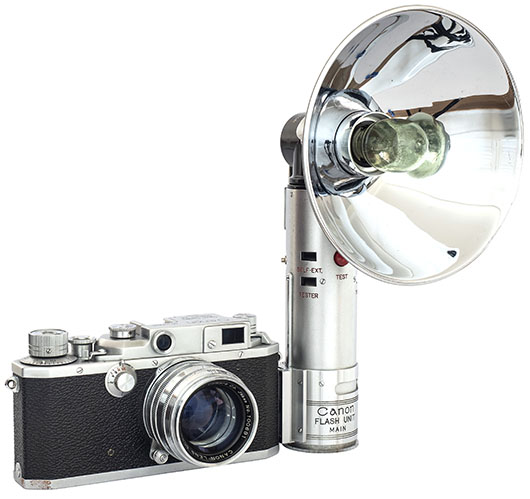
Two versions of the B have been found. The first type, almost certainly older, only featured the “Canon” engraving without the model name, however, its carry case is marked “Flash Gun Type B” (future models were called “Flash Unit”). My example of the second version, found with an instruction sheet, adds “Flash Unit - B” below what looks like a slightly smaller Canon name. Mine also includes an updated Midget Bulb Adaptor, but that is clearly not original, see 3. below, otherwise it appears identical from a casual glance at photographs. However, that is not the case. Peter Kitchingman has examples of both bodies and has discovered a number of small improvements. According to Peter, the Battery Cases are the same but the later reflector features an improved chrome finish and higher quality black paint on its reverse. The carry cases appear to be the same.
The main differences of these two compared to the subsequent B 1, B-I and B-II models are:
1. The B has three equally spaced coaxial connector sockets on the Battery Case for choice of “convenient” (per the instructions) location of the flash head coaxial plug which features twisted pair wiring. The flash head leads of later models are plaited and feature a three pin plug and there is only one three pin socket on the battery case as the position of the battery case can be adjusted with a lock nut.
2. Unlike the B, later models offer the ability to add additional Side Light Units, likely as a result of the development of the Flash Unit X. To support this, their Battery Cases feature 2 x 2 rectangular prong sockets, one each side of their three pin socket for the flash head.
3. Neither the bulb ejector button on the flash head nor the ejector lever on the Midget Bulb Adaptor are yet present on either the first, or second, B.
4. The Additional Battery Case of later models is not included because there is no provision for connecting Sidelights yet.
Example without model name. Note, instead of one pair of bayonet slots and an eject lever to release its bulbs, the Midget Bulb Adaptor has 3 pairs of slots providing 6 segments to friction grip the bulbs:
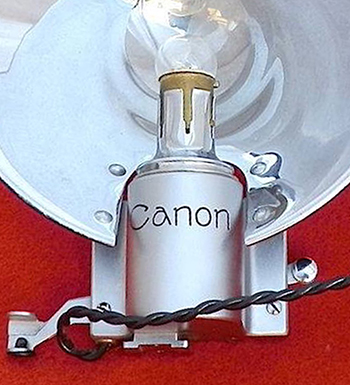 (Courtesy of Peter Kitchingman, portion of image posted on Canon Historical Society Facebook page)
With model name:
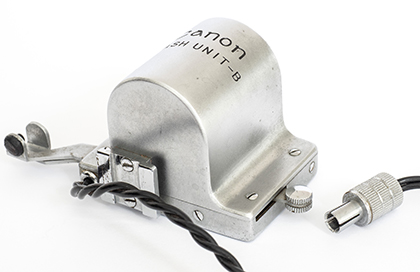
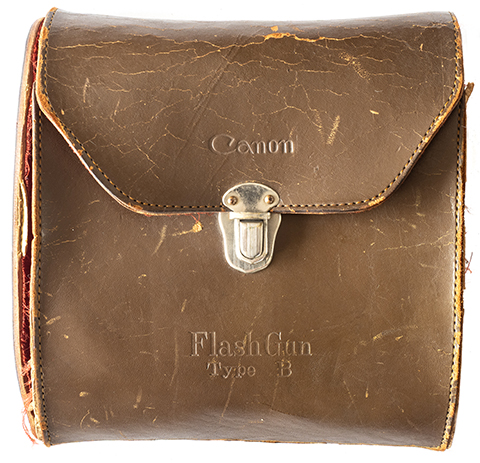
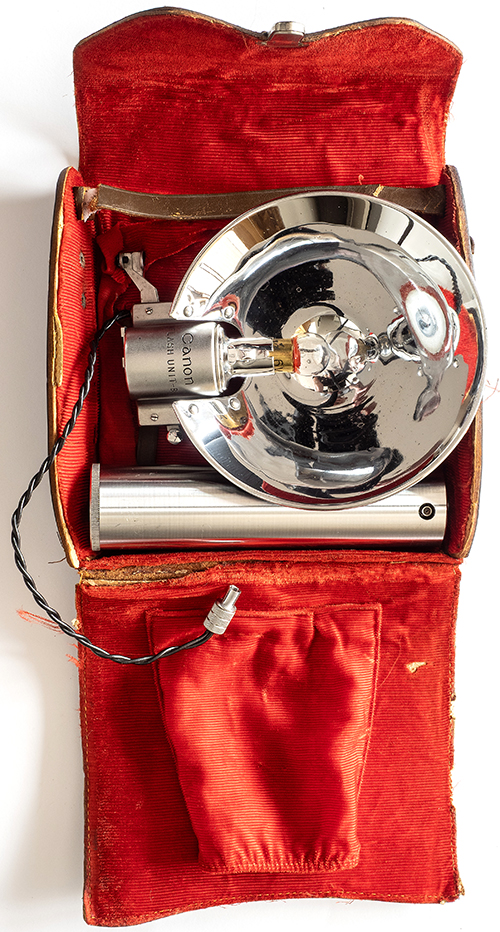
The closed cases look similar to the B 1, B-I and B-II cases, but internally, the components are laid out horizontally. Unlike later cases, the strap from one side of the case to the other is to support its shape only and is normally riveted permanently at both ends. Mine is torn at both ends and my attempt to use tape to secure it for the photo was not very successful. The direction of the fine ribbing of the velour lining material is also horizontal whereas it is vertical in the later cases and the pocket on the lower flap is unique to this model:
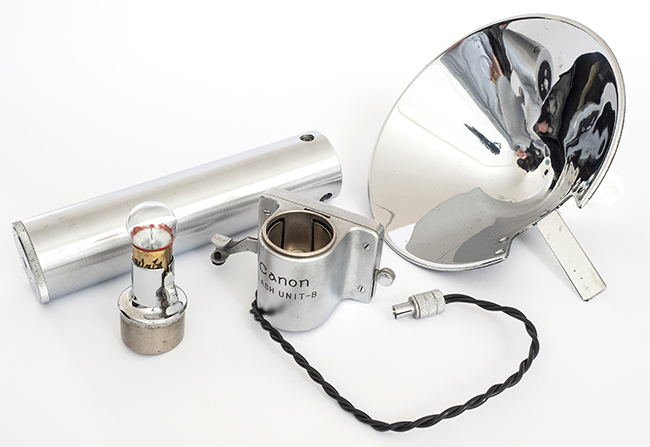
Note, Peter Kitchingman has confirmed that both the first and second type B utilize the same Midget Bulb Adaptor without ejector lever. I believe mine, shown with Test Bulb inserted, is from a later B-I or B-II (B 1 is a little cruder):
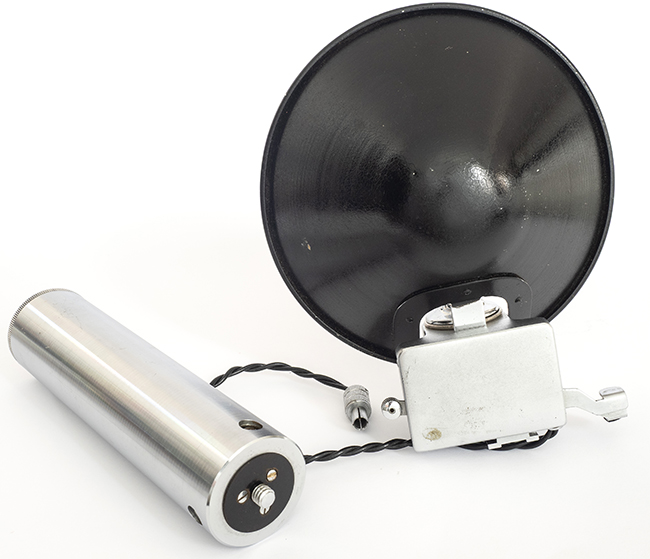
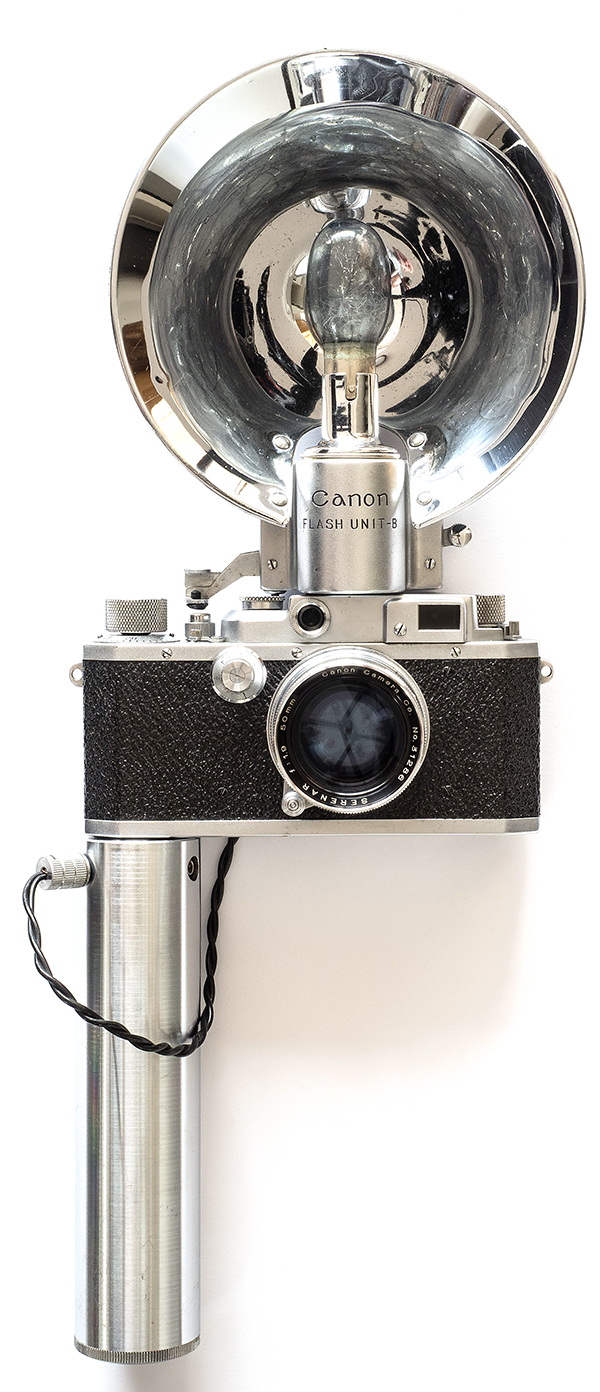
Mounted on a Canon II B camera, ready to use:
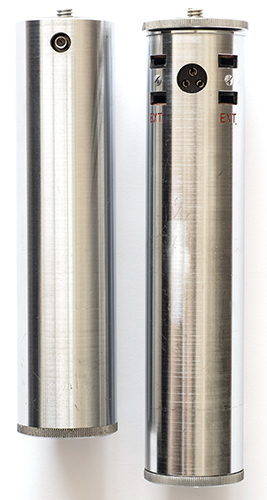
Two comparisons between B and B-I (much the same as B 1 and B-II). The first is the Battery Cases. The B-I adds the sockets for Side Lighting Units and the lock nut for adjusting case rotation and is about 18 mm taller, including the lock nut, than the B:
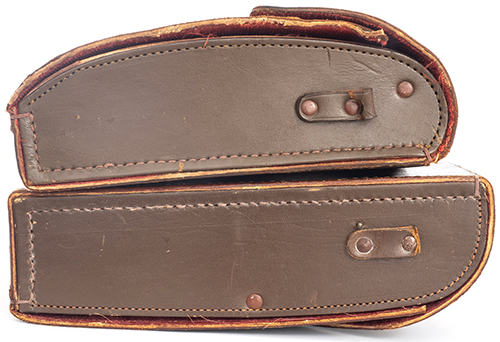
The second is between the carry cases. They are the same width, but when standing up, the B-I case is about 20mm taller. They also have different side profiles:
Found with the second flash is a typewritten two page instruction sheet in English on fragile rice paper which may well be 75 years old (plain white paper inserted between for scanning). Whether this served as the English instructions at the time, or it has been copied from the original, the wording seems to be in the authentic Canon style with a healthy dose of marketing thrown in, somewhat similar to the B 1 user manual, but not the same. Note, there is no Canon letterhead, date or anything similar to help authenticate it and by this time, Canon was already, producing user manuals and brochures in English, however, it is typed on similar stock to the example with Canon letterhead in the Flash Unit X section. Also found with it is part of the packaging torn from a vintage packet of Sylvania FP26 flashbulbs with the exposure table and an old hand drawn exposure table in English with more wide ranging information for different bulbs etc. Together with being acquired from the USA, its history is perhaps consistent with a US military exchange store bought item:
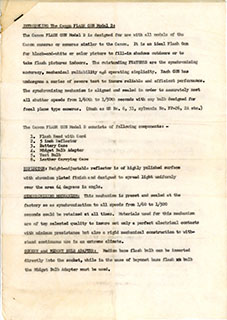 (click on instruction sheet for PDF version)
Flash Unit B 1 (or B-1)
The B 1 uses the Arabic numeral “1” in the name and no hyphen between them on the flash body (written as “Flash Unit - B 1”), but it is there in the user manual and on the ever-ready case. Below is the complete set as supplied, including the extension tube to add an extra D cell when using two, or more, Sidelights. The ability to fire Sidelights is new. There is now a knurled locknut on top of the battery case so it can be rotated to any position convenient for the plugs (see B-I model below). Note the new two rectangular prong extension sockets on the D cell battery case (not labelled yet) and 3 pin flashgun to battery case plug with plaited wiring and also the flashbulb/adaptor ejector button on the flash body and ejector lever for bayonet bulbs on the Midget Bulb Adaptor:
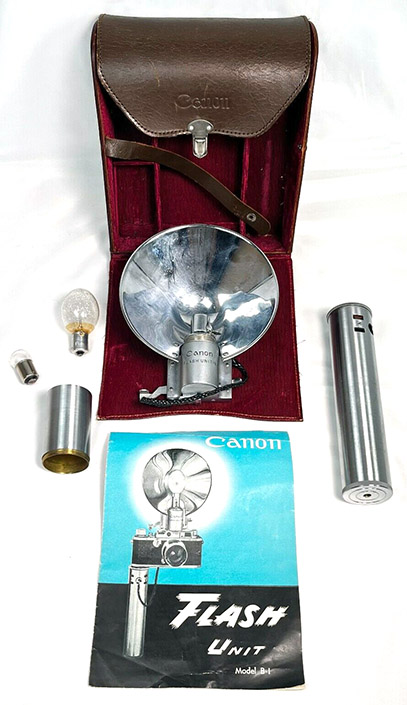
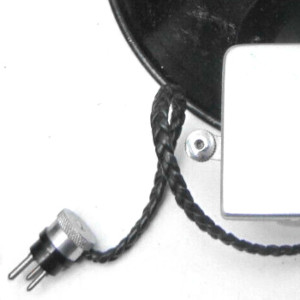
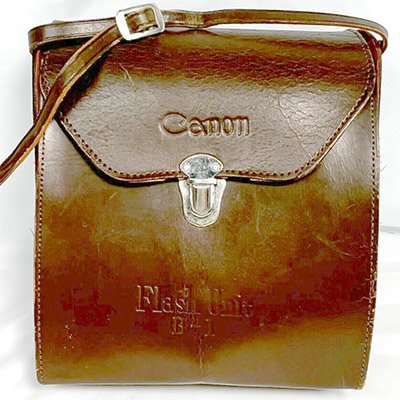
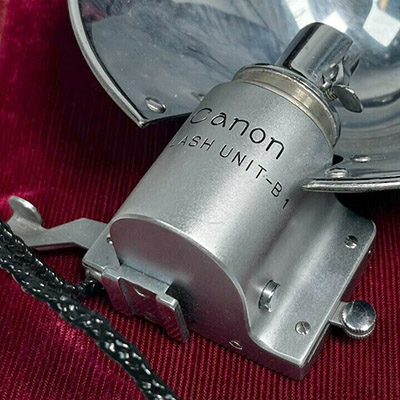
(Detail from larger web images)
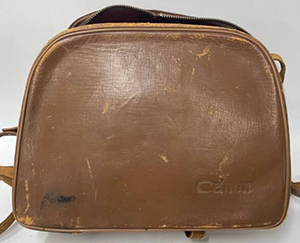
The great majority of examples of the B, B 1, B-I and B-II flash units are found with leather kit cases similar to the above and almost certainly these, and the DeLuxe Flash Unit X kits, were supplied with the cases as standard.
The date on the back of the user manual is December 1950 which is one month later than the first user manual for the flash sync'd Flash Unit X produced in time for the trial series Canon IV (what Peter Dechert originally called the “Canon 1950”), see Flash Unit X below. I suspect that the B 1 updated the B based on development of the X.
Below left is the B 1 packing slip listing the set contents and on the right, the user manual. Both have the December 1950 date (note, the manual is for the B 1, even though Canon's usage on the manual makes it look like the following “B-I”):

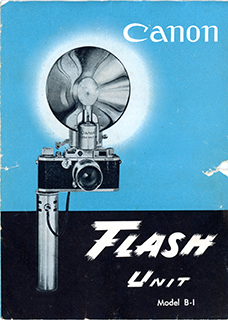 (Click on packing slip for larger image, click on manual cover for PDF of manual, the original of which is a double sided 3 panel sheet)
The Side Lighting Unit in the B 1 user manual is simply referred to as a “Canon”, but given that the B 1 and the Flash Unit X seem to have been released at a similar time and the addition of similar extension sockets, it is almost certainly the Side Lighting Unit, Model X, as named in the B-II user manual.
Flash Unit B-I
The B-I uses the Roman numeral “I” in the name. To the casual observer, it looks the same as the B 1, but according to knowledgeable collector, Peter Kitchingman, includes a number of small improvements including to the Midget Bulb Adaptor - the B 1 adaptor body featured a groove for the release mechanism to grab, the B-I is smooth and relies on a pressure plate and the lever on the adaptor is a little different. The B-I battery case extension features 4 threads instead of the earlier 2 and the semi-cylinderical part of the flash head now has two screws in the bottom. Two subtler changes are a slight change in the position of the eject button on the body and a slightly larger diameter for the knurled head of the power plug:
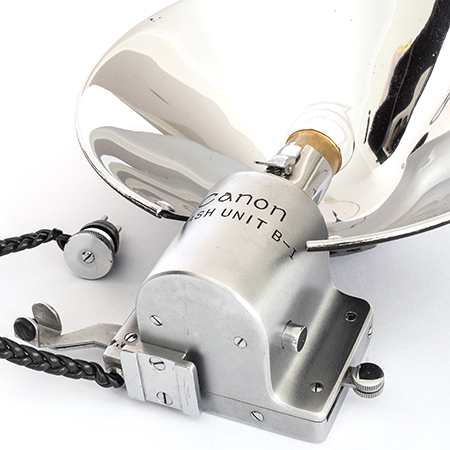
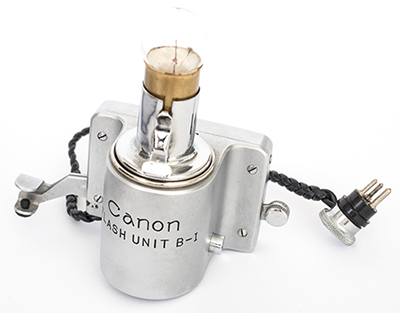
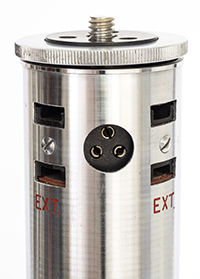
Below is the flash head with the adaptor and test bulb inserted and the top of the Battery Case with the extension sockets now engraved with “EXT.”, also note the knurled “lock nut” first introduced by the B 1:
All the B-Is I have seen continue to use cases marked “B-1”, but there are a couple of early-late variations. My B-I set in the “B-1” marked case, only the Additional Battery Tube (case extension) is missing:
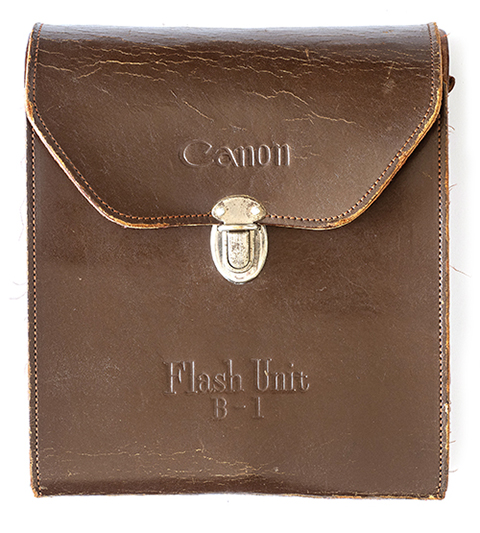
The securing strap across the flash is two piece with a centre press stud, same as the later B-II case. The case for the B 1 flash above is one piece with a press stud on the right end. Generally, B 1 cases for B 1 flash units are single strap types and some B 1 cases for the B-I are two piece. Also, my case has an oval backing plate for the saddle, more like the B-II, but the cases for the B 1 and most other, but not all, B-Is have a shape similar to the B case. I'm guessing that the oval style was a fairly late change.
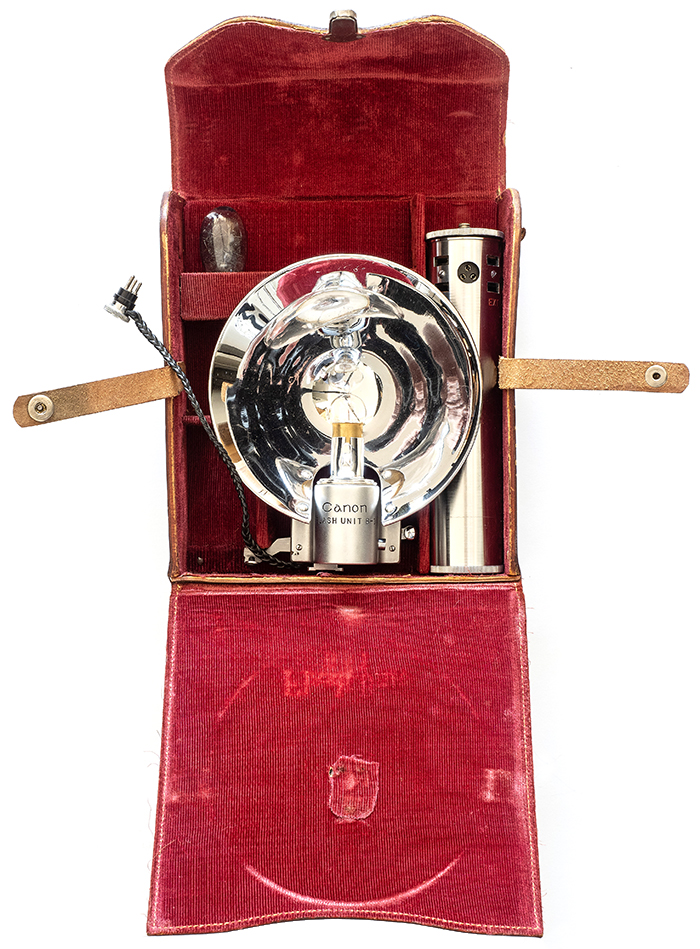
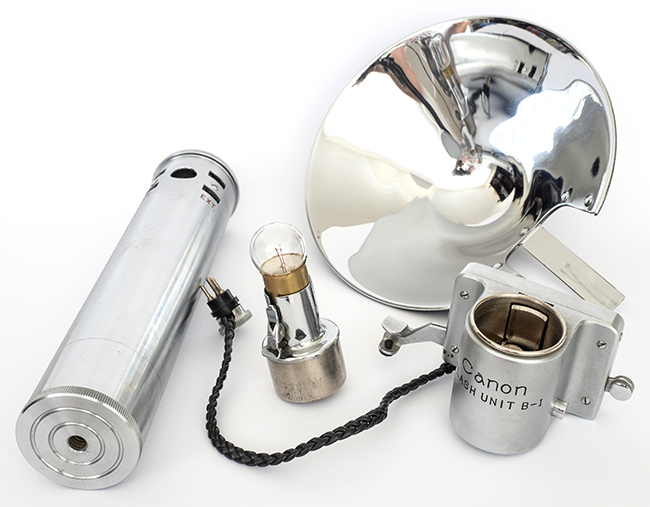
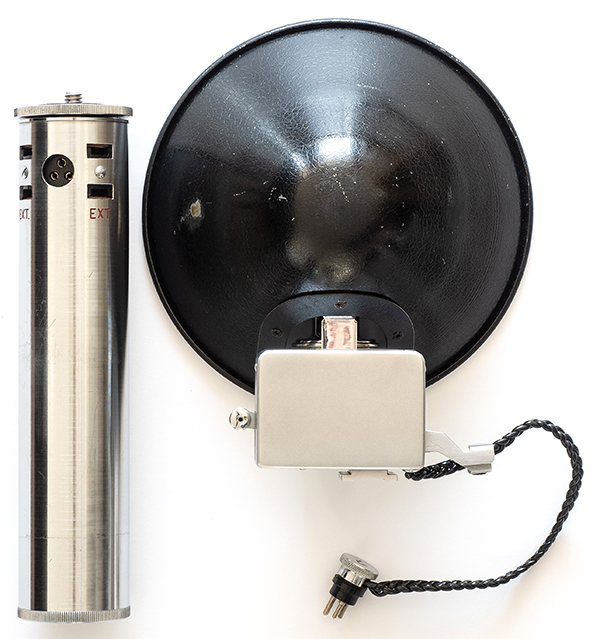
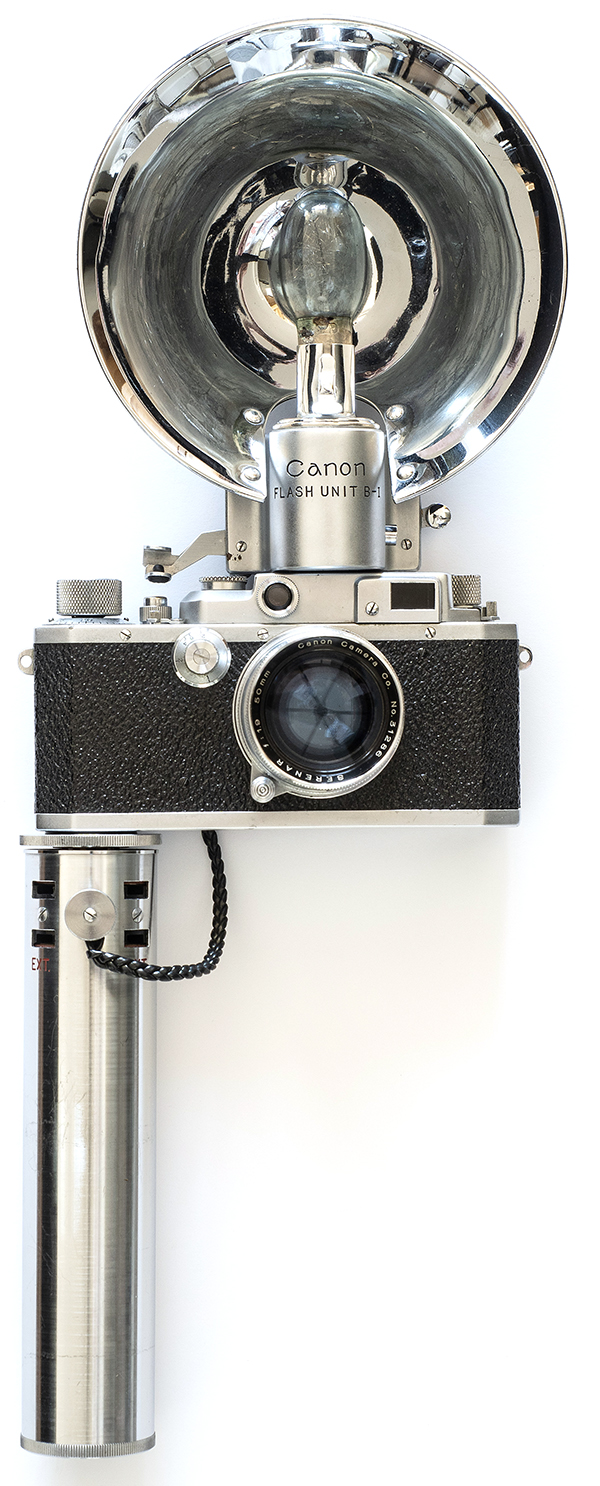
Mounted on a Canon II B camera, ready to use:
Both ends of the B-I Additional Battery Tube missing from my set:
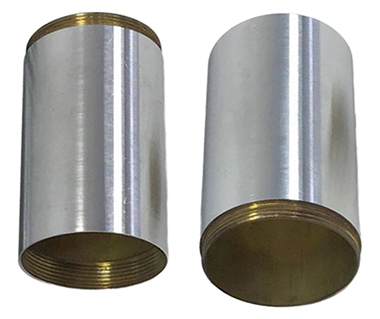 (Web images)
I have yet to find a dedicated user manual, but like the case, I doubt that there is one. Manuals found with B-I units are typically still the B 1 version. The one above that looks like it could be for the “B-I” (mine above, was bought separately to my B-I) is originally for the B 1 (Canon was not consistent with its dashes/hyphens, see flash name marking on photo inside and battery tube without “EXT.” markings) and is commonly found with either flash. In any case, operationally the two flash units are identical. The B-I is another rare example and couldn't have lasted long given the B 1 user manual date of December 1950 and a reference already to the new B-II flashgun in a March 1951 Canon III brochure.
Flash Unit B-II
Similar to earlier types, standard B-II kit case and contents (the body and reflector have been placed upside down and hence the case is shown upside down, the Midget Bulb Adapter is missing):
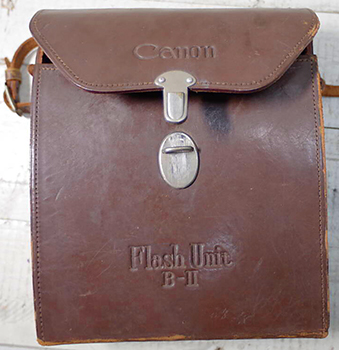
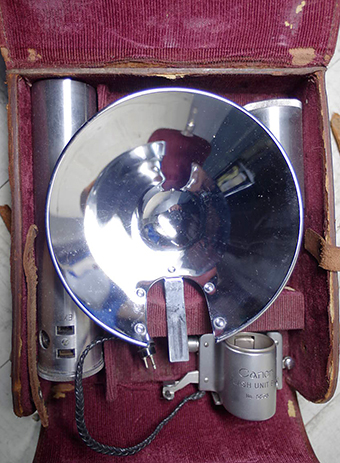
(Web images)
There are at least two user manual printings for the B-II, dated August 1951 and December 1952, but as noted above, it already appeared in a March 1951 Canon III brochure. The user manual, 1952 version available from Flynn Marr, helpfully tells us that its new features include provision for using a self-timer (or cable release) via a new shutter button on the right side (requires use of a Canon self-timer, or “Leica nipple” connector/adapter) and a guide number table on the back of the body:
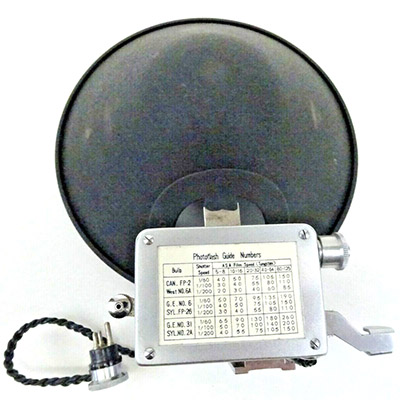 (Web image)
The user manual also demonstrates the connection of the Side Lighting Unit designed for the rail mount Flash Unit X. However, one change not noted in the manual, nor is the feature explained, is the addition of a two prong socket on the rear of the battery case marked “Test”, presumably for the “Flash Tester” introduced by the Flash Unit X. Front of battery case on left, rear of case on right:
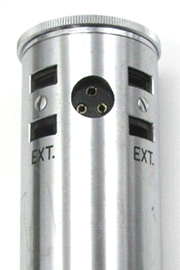

(Web images)
The B-II also introduced serial numbering for the first time with the number under the model name. The numbers in my database run from 348x to 1053x.
Flash Unit B-III
This is the final model of the unsync'd flashguns. Pacific Rim has a Japanese language user manual dated October 1953. Whether this is from near its release date, or a later printing, is unknown. The featured camera in the user manual is named as the Canon II-D and it has a Serenar 50 mm f/3.5 lens mounted - for this lens, the name change to “Canon Lens” occurred in December 1952. The B-III continues to appear in 1955 and 1956 Canon product brochures.
The B-III looks different because it is mainly a rethink of the power system, replacing the the D cell battery case tube of the previous models with a battery capacitor system incorporated into the main body of the unit, using the same Matsushita made 200 mfd capacitor as the battery capacitor version of the rail mount Flash Units X and Y, but a physically smaller 22.5 v battery with square cross section like/similar to those in the rail mount Flash Unit III and bayonet mount V and V-2. Unlike earlier and rail mount models, there is no provision for connecting extension units, or using ES bulbs:
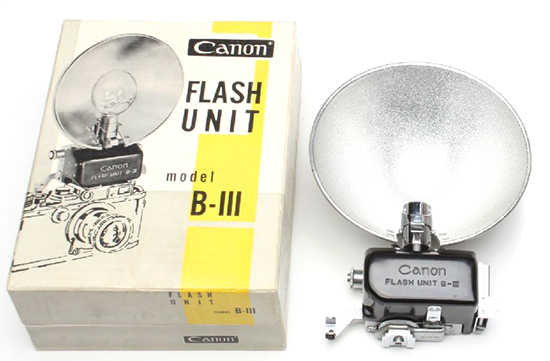
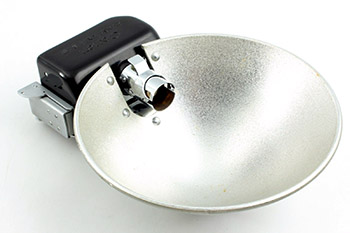
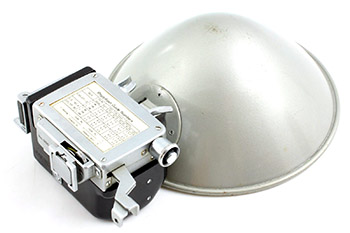
(Web images)
The serial number is located underneath, next to the mount. The numbers in my database run from 215x to 1055x.
Below left, power supply compartment, only the capacitor is present, not the 22.5 volt battery. On the right, demonstrating the unique fold-out accessory shoe for mounting accessory viewfinders (image mimics user manual photo):
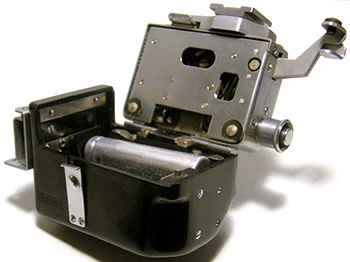
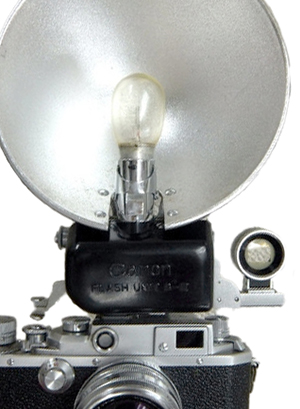
(Web images)
This Japanese version of the user manual, copied from an auction site, is a double sided foldout sheet (a higher resolution version is available for download from the Pacific Rim site):
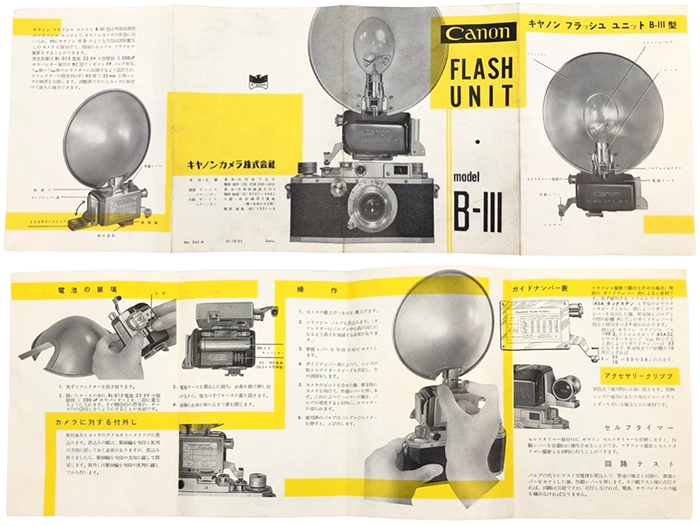
The presentation box replaced the standard carry case found with earlier models. Like the Model Y box, the B-III is accommodated on its back on a fitted yellow satin lined insert:
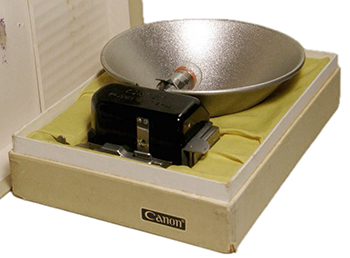 (Web image)
However, a high quality, hard leather carry case was offered as an optional accessory (I have seen one only). The March 1955 Canon Product Guide has this to say about it (page 34):
“CARRYING CASE for above Flash Unit, B-III Catalog No. M-24109
Top-grain reinforced cowhide leather carrying case for Canon Flash Unit, Model B-III. Velvet lining, adjustable shoulder strap with shoulder pad.”
For Canon Rail Mount Cameras (bottom loading)
Flash Unit X
It might be assumed, and as claimed by Canon, that this arrived with the release of the 1951 Canon IV, first Canon mainstream model with flash sync and side mounting rail, however, it debuted with the model Peter Dechert calls “Canon 1950” (an earlier trial series for the forthcoming Canon IV which made it to the US in small numbers). The camera and flash are pictured in an ad by US importer C. R. Skinner in the February 1951 edition of US magazine Photography (camera called II C by the importer because it was unnamed as yet by Canon and followed the II B). In that context, the date on the back cover of the early user manual further below, November 1950, suggests that the flashgun was ready in its final form well before the Canon IV was officially released (Peter Dechert says produced from April 1951).
In fact, development of the camera's flash sync mechanism and rail mount may have already begun as early as in 1949. In the Canon II B section, I mention that one of the earliest found Canon II Bs, serial number 25002, was a Canon testbed for developing both the mechanism and rail mount. Presumably, prototype flashguns were being developed too.
The Model X was at the heart of an ambitious flash ecosystem which was probably unmatched by any other camera maker of the day. Many optional accessories designed for the Model X continued to be available/suitable for its successor, the Model Y, and some could also be used with the unsync'd B 1, B-I and B-II models. Originally, the “basic” kit already seemed to include many items which might be considered as optional extras to enhance flash photography rather than being essential to the process, particularly for more casual photographers. It was impressive and expensive, as can be seen in some price comparisons below.
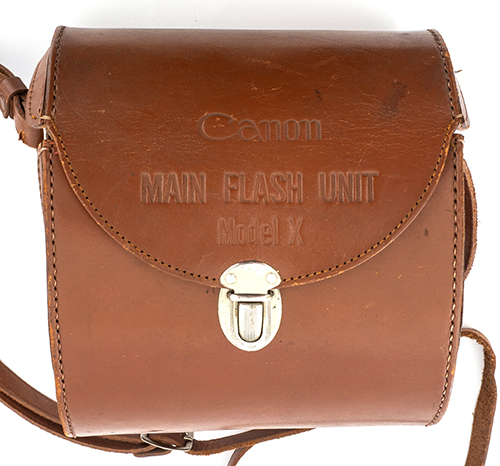
User manuals and the late box further below describe the flashgun as “Flash Unit Model X” whereas the bottom mounting bracket of the actual flashgun calls it “Flash Unit Main” - that is because it is the “main” flash unit and not the optional sidelight. That also causes a lot of seller confusion these days and makes Internet searches more difficult. The leather kit carry case, similar to the B series ones in style, but not layout, combines both names into “Main Flash Unit Model X” (based on both significant numbers found and price list descriptions, like the earlier B series before the B-III, I suspect the X units were most often supplied with these until later when different kit options were introduced):
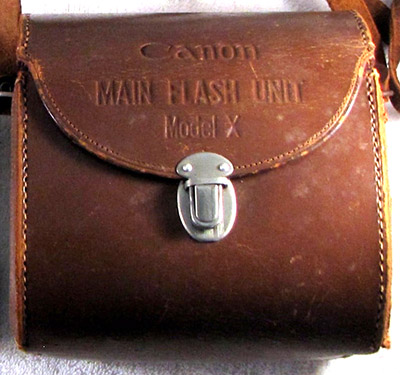 (Web image)
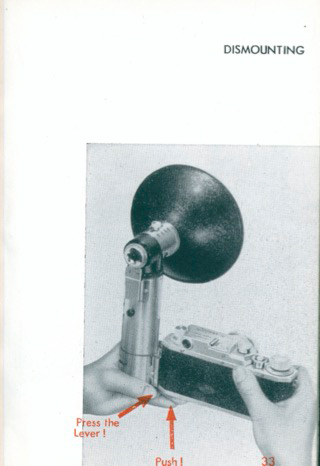
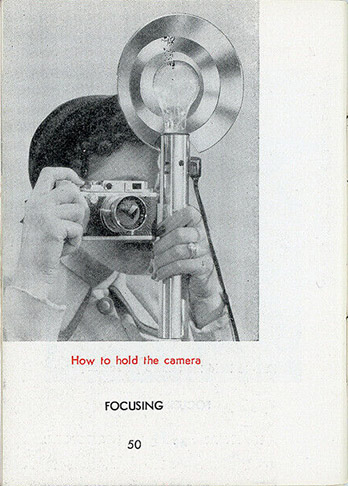
Select pages from November 1950 user manual, a complete version of this manual is downloadable from the Pacific Rim site:
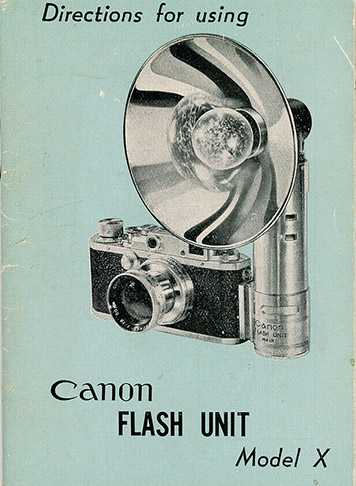
Below are various optional flash system components, but not all, some of which were included in the DeLuxe kit. The Self Extension Adapter is also an option with the Flash Unit Y (as are other bits). It mounts to the camera's rail in place of the flash and enables off-camera flash with an extension lead:
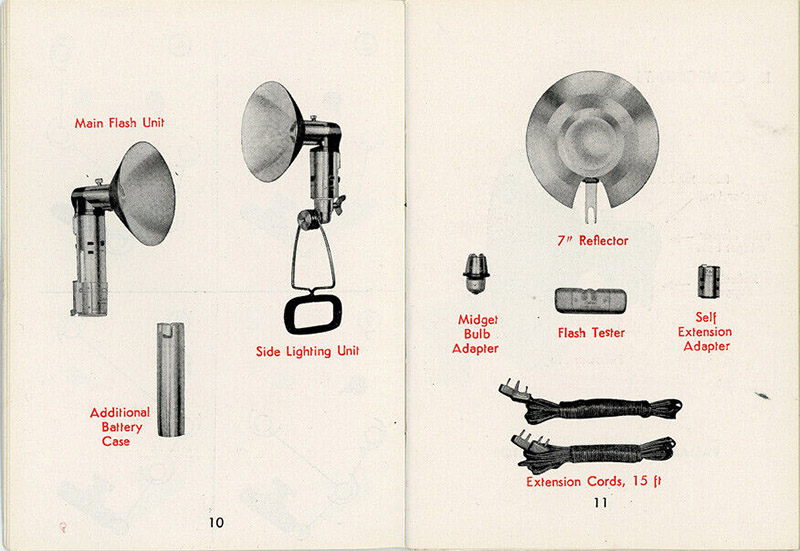
Note, there are no pictures, or description, anywhere in this early manual of the separate “Micro-Sync” synchroniser that this model is associated with. The two images below clearly confirm that there are no provisions for mounting it as there are on later bodies:
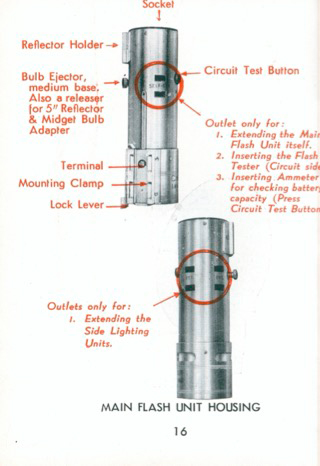
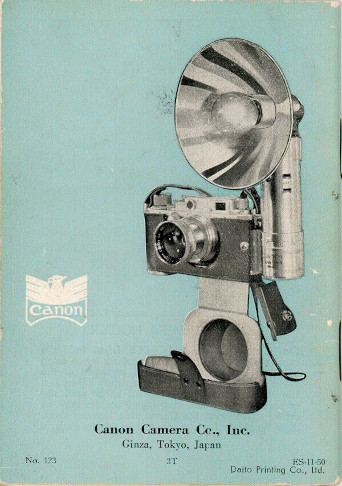
Flash Unit X with D cell extension case and 7” accessory reflector for use with large ES flashbulbs. Note the November 1950 date on the back cover:
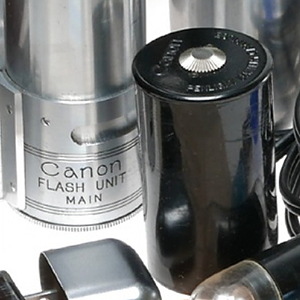
Whilst the body/battery case looks like it is meant for D cells, it is but it isn't. The upper part of the tubular body contains the connector sockets and internal flash circuits, in standard form, the lower part contains a cylinderical holder for four penlight (AA) batteries side by side called the Penlight Battery Cartridge. The Additional Battery Case allows the use of D cells instead of the penlight batteries (one in the main body and two in the extension, this was later called the “A” case when the shorter “B” case was introduced). Below is a typical black plastic Model X Penlight Battery Cartridge:
 (Web image)
Neither the November 1950 nor August 1952 user manuals mention an optional battery/capacitor pack for the Model X and it's not mentioned in a comprehensive list of flash accessories in a C.R. Skinner 1 October 1951 price list, however, later evidence (further below) suggests that the “Capacitor Cell”, as Canon called the chrome plated brass battery/capacitor holder, became available for the Model X at about the time of the Model Y release which Canon says was 1953 (the earliest Model Y box is dated September 1952 so I'm guessing early 1953 at the very latest).
Note, no one company is credited with development of the battery/capacitor flash system with the time frame given usually being 1950-51. Heiland Research Corporation of the US was acknowledged as a leader and one of the first to release one commercially which was sometime in 1951. It would have to have proven itself in the market place before widespread interest. Canon was not a flash specialist so late 1952 to early 1953 feels about right to me.
Earlier brochures and price lists usually refer to the Model X as a “DeLuxe” set with “leather case” without optional packaging versions, although the various components of the kit, including the body, plus additional items could be purchased separately. The DeLuxe set usually includes body, 90 degree head for midget bulbs, reflector, Micro-Sync, 15 feet Extension Cord A, Self-Extension Adapter (not always mentioned but usually there - the extension cord would be useless without it), Additional Battery Case, Flash Tester, Penlight Battery Cartridge and sometimes a holder for two spare Flash Tester bulbs (I haven't seen the holder and spare bulbs listed in DeLuxe kits but they are often there and maybe were typically supplied with the Flash Tester). I have yet to personally see any evidence that the DeLuxe kit was ever offered with the Capacitor Cell until maybe 1954. A Canon USA price list effective from 1 July 1954 lists the Flash Unit Y as well as a “FLASH UNIT, Deluxe - includes main flash housing, which houses the Canon B-C Capacitor Cell, and 22½ Volt Battery, or Penlight Battery Case.” The listed inclusions and $80 price confirm that this is the Model X DeLuxe but whereas the inclusions list the Penlight Battery Case, they do not mention the Capacitor Cell. Obviously, from some point in the model's life, owners could certainly add one themselves.
Typical cased DeLuxe set. The reflector and head would normally be secured with an elasticised strap:
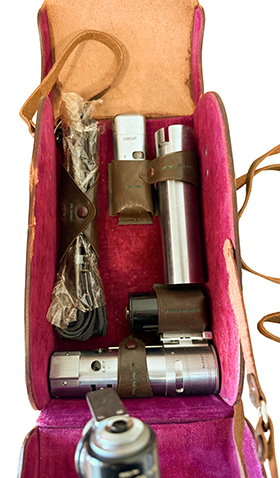
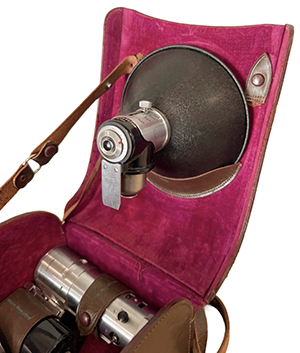
(Web images)
Example on left shows correct positioning of the retaining strap. Some items from a similar set show the Penlight Battery Cartridge (bottom view this time), Self-Extension Adapter, Micro-Sync and the sometimes found two spare Flash Tester bulbs in their holder (front right):
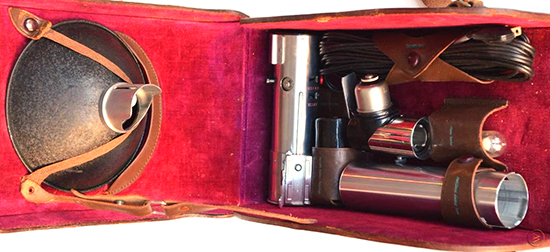
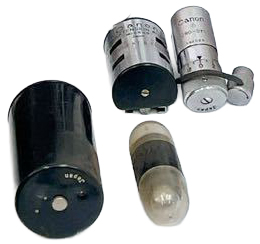
(Web images)
The original kit case was quite large with a secure place for everything (the Self-Extension Adapter and Micro-Sync live in separate named pockets under the inverted reflector). As you can imagine, it was relatively heavy and unwieldy, not to mention pricy, if all you wanted was a simple working flash unit for casual photography. So it is not surprising that Canon eventually introduced some other configurations. The earliest hint that I have seen is in a Canon Camera and Serenar Lenses brochure with distributor Jardine Matheson & Co.'s name at the end. It is undated, but there is a handwritten annotation indicating that it is from March 1952 which sounds about right. Next to a picture of a Canon camera with Model X flash unit attached is the description “FLASH UNIT MODEL A SET” and at the end, “Also available B, C and D sets.”
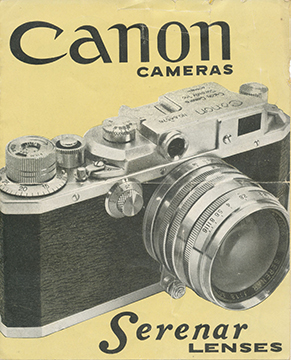
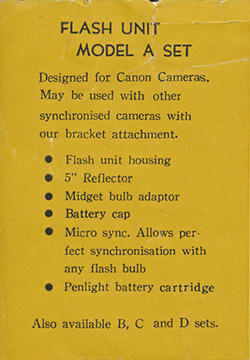

(Details taken from full brochure provided courtesy of Peter Kitchingman)
I have not seen that description of available sets anywhere else and I have no idea what B, C and D sets comprise. Set A is not a Deluxe set, it doesn't include the Battery Tester, Self-Extension Adapter, Extension Cord or Additional Battery Case, nor is there any mention of a leather case. Without the 7” reflector, I'm guessing “Midget bulb adaptor” is referring to the 90 degree head which only takes midget bulbs rather than the item identified by that name in user manuals but I can't be certain.
I'm not sure of the exact timing but around the end of 1952, early 1953, is when we first see evidence of four new kit variations with some detail about contents. The other kits I will come to later but the first one I want to mention is the Flash Unit Model X-K.
The top half of the Japanese ad below is for the new IV-Sb, with Serenar 50 mm f/1.8 lens still, making it circa December 1952 meaning that the Flash Unit Y must have been in the process of being released. The ad is titled “Two Announcements” and Canon's name and address is at the bottom (Shimomaruko, Ohta Ward, Tokyo), so it is official Canon advertising, not a distributer interpretation:
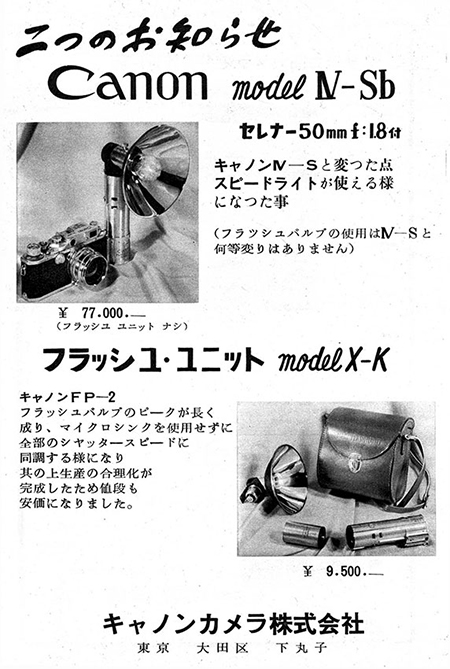
The translated announcement in respect of the flash unit is:
“Flash Unit model X-K
Canon FP-2 The flash bulb peak has become longer and it can synchronise at all shutter speeds without using the Micro-Sync. In addition, the price has become cheaper because production has been streamlined.”
There are some things to note about this ad. The first is the timing with the Model Y in production, if not released (see Flash Unit Y below). That means that if there wasn't an earlier Capacitor Cell available, there was now. Another is the “X-K” name. I have not seen that used before by Canon, or since, this is the only time, but I am convinced that X-K kits exist. In later user manuals at least, the new Flash Unit Y was called the “Model Y-K” when fitted with the battery/capacitor power pack instead of the 4 penlight (AA) batteries when it was called “Model Y-L”, this X may be the same. Note the power pack in the ad is silver, not black, presumably it is the “Capacitor Cell” holder for the battery and capacitor. The writing on the side of the Capacitor Cell further down seems to match the layout in the ad (unreadable).
I initially took the claim, that the Canon FP-2 flash bulb can sync at any speed without using the Micro-Sync, at face value, but could the ad be implying, “if you use the FP-2 bulbs, you don't need the Micro-Sync and therefore we have made the Flash Unit X cheaper by removing it from the kit”? At least from this version of the set? Note, there is no Micro-Sync, or other accessories, pictured and the leather case is much less tall (when upright) than the typical DeLuxe case (see further above). I believe that there is one, and possibly at least four such kits in my database, all with the small case and all from near the end of my database with body numbers 8852 to 10323, the last being mine. Whilst mine does have a Capacitor Cell, power packs are not shown with three of them, but two are each pictured with the typical 22.5 volt battery used in conjunction with the capacitor. None have a Micro-Sync and whilst there is the odd accessory, e.g. mine has the Additional Battery Case, there is no dedicated place in the case to store them (there is one proviso, see my example further below) and I assume that these are extras added by owners. There are also two other possibles with Micro-Sync included, which could also be owner added, one with unknown power pack, the other, 7715, with Capacitor Cell. Late body 9909, confirmed to have a capacitor cell, is just the basic body, head and reflector like the others but was found with a box instead of the case. It may be a version of the X-K sold without the case, or it could originally have been a variant of one of the other kits.
The announcement of the XK (that's what I'm going to call it for convenience and consistency with other names, Canon sometimes used dashes/hyphens and sometimes not) dovetails with Canon's offical availability date for the Capacitor Cell. The actual Google translation of the cover text on Peter Kitchingman's Canon accessory book below is “Accessory Data Collection (Counterman's Document - V) 1986” and at the bottom, “Canon Camera Service Management Department”:
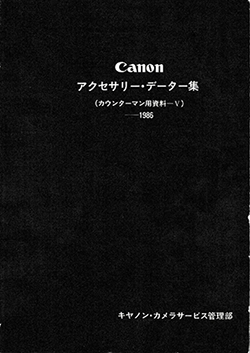
Peter Kitchingman translated the names of individual accessories and their release years into tables which he posted on the Canon Historical Society Facebook page. The dates range from 1948 to 1986. Most accessory items are listed, but not all. The Model X and its accessories, apart from the Additional Battery Case (there in the October 1951 user manual), are listed as 1951 releases. There is no mention of the Capacitor Cell until 1953, same year as the Model Y release.
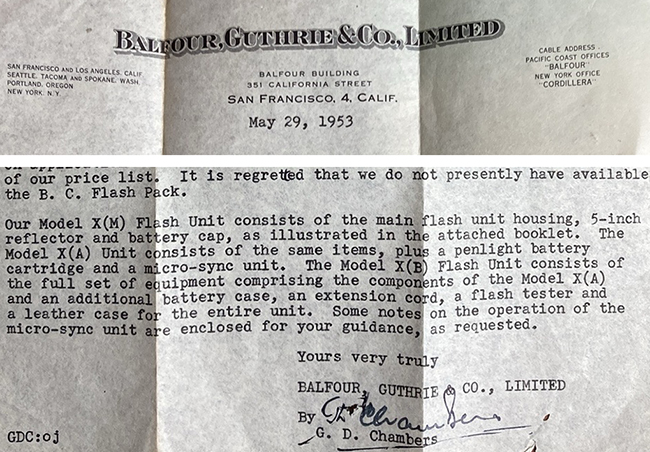
There is an earlier flash unit with a Capacitor Cell, 6472, in my database than the XK examples. It is the last in my database with a black back reflector and is featured in the documents found with the letter below. The kit's contents and serial numbers are listed on the back of a 1955 US Customs document and match what is expected in a DeLuxe kit, except for the Capacitor Cell instead of the battery holder, although the presence of the leather case is an unknown. The camera body is an IV-S2 with serial number 77937, probably from early 1953. This is the letterhead and relevant portion of the letter from US Canon distributer Balfour, Guthrie & Co., Limited, dated 29 May 1953 in response to the owner's enquiry:
(Web image)
The letter says that “it is regretted that we do not presently have available the B. C. Flash Pack”, but between the letter and sometime in 1955, it seems that the owner acquired a DeLuxe version of the kit, by serial number closer to 1953 rather than later, and also a Capacitor Cell. I think that is not atypical. Peter Kitchingman has five DeLuxe sets from very early body 1298 to middling 5990, all with both Penlight Battery Cartridge and Capacitor Cell. As no Canon document before the end of 1952 mentions capacitors as a power source, I'm inclined to think that the presence of two power sources, three if you include the Additional Battery Case, is an indication that the Capacitor Cells may have been added later. Mind you, I am relying on English language sources rather than Japanese.
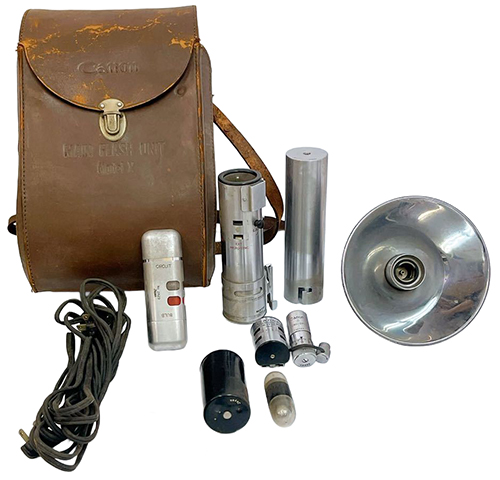
The letter also offers some actual packaging insights. The “Model X(M) Flash Unit” is a bare bones model without Penlight Battery Cartridge (a later price list does include it, but both the 1953 and 1955 Model Y user manuals note that number 2 of the their 10 power source options is a single 6 volt cell in “D” size). The X(A) adds the Penlight Battery Cartridge and the Micro-Sync and the X(B) includes everything so far plus an Additional Battery Case, an extension cord (typically the 15 feet Extension Cord A), a Flash Tester and a leather case for the full kit. Not mentioned is the Self-Extension Adapter, but without it, the extension cord is of no use and presumably was an oversight by the writer. The X(B) is what most other documents, including those put out by Balfour, Guthrie & Co., usually call “DeLuxe”. The set below includes all the typical contents of the X(B)/DeLuxe kit, plus the usually/often included spare Flash Tester bulbs:
(Web image)
Peter Kitchingman posted two very similar Balfour, Guthrie & Co. price lists on the Canon Historical Society Facebook group forum. Courtesy of Peter, I have extracted the relevant sections below. The first features the Canon IV camera released in April 1951 and the second features the Canon IV-S2 released December 1952 (IV-F and IV-S models in between). The first only offered the Model X as a “DeLuxe” unit with leather case:

The second describes three options; the Model X as simply “DeLuxe, with case”, i.e., equating to the X(B) in the letter and the Model XA and cheaper Model XM presumably as described in the letter:
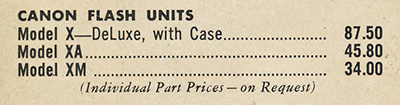
Whilst prices of most other accessories had remained steady, the price of the DeLuxe version of the Model X had dropped considerably, possibly due to the arrival, or imminent arrival, of the updated Model Y.
Unexpectedly, a 16 March 1954 price list issued by Canon Sales Co., Inc., 67 Wall St New York, still lists prices for various Model X kits as well as the new Model Y released in late 1952. This time the XM includes the Penlight Battery Case but it is interesting that the XA kit with Micro-Sync is priced at $44, slightly less than the earlier Balfour, Guthrie & Co. price, but still significantly more expensive than the equivalent new Model Y with built in synchroniser at $36 (the DeLuxe kit with case is down to a still substantial $80). The Capacitor Cell is also listed as an individual item without being specified whether for the X or Y, so presumably for either.
In summary, the Model X seems to have started out as a single model but by towards the end of its extended life, there were at least 5 variations based on what was included in the set; the US price lists' XA, XB/X Deluxe and XM descriptions, Canon Japan's XK and the plain bodies without Micro-Sync provision mentioned further below (any of these may have applied across all markets, or possibly not, the XK and plain bodies may have been Japan only based on advertising and where most have been found in more recent times, but there is nothing conclusive). Plus just about any item could be purchased individually.
The flash head and 5” reflector is removable on the Model X to allow for direct vertical mounting of ES press type flashbulbs with a 7” reflector, as on page 50 of the user manual above. Peter Dechert's book has two photos of the flash unit, one mounted with the 7” reflector for ES type bulbs and one displaying “all parts” including Flash Tester and importantly, the plug-in synchroniser. However, his example has an optional vertical bayonet mount flashbulb head for mounting on top of the body called “Bulb Adapter” in the book, i.e. the “Midget Bulb Adapter” referred to in the user manuals, with no standard 90 degree head shown, so it is complete but not a typical DeLuxe unit as they were marketed. Also, if we are to believe the early user manual above, clearly the synchroniser was not part of the original design BUT, it is possible and even likely that the design changed before the Model X became available for sale.
The new Flash Unit Y featured a built-in synchroniser, i.e. variable delay, whereas the X typically featured a separate synchroniser, called “Micro-Sync” by Canon, which mounts into the side of the main body and plugs into a connector socket. The idea behind the synchroniser on the flash unit is similar to the variable delay Leitz built into the flash synchronised 1950 Leica IIIf body.
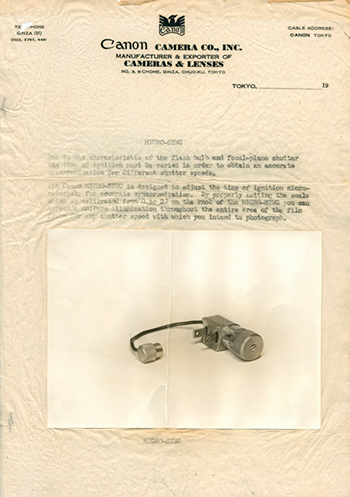
Another thing that makes me believe that the Micro-Sync is a later addition is that Canon issued a three page letter on rice paper, with attached photos, explaining the purpose of the Micro-Sync, how to mount it and operating guidelines. The sort of thing that normally belongs in an instruction manual. I'm aware of four such letters, all unfortunately undated. One is in the Pacific Rim Camera Canon Reference library, the first page of which is shown small below:
(Peter Kitchingman also posted a higher resolution version on the Canon Historical Society Facebook page)
It is a fact that there are three Flash Unit X bodies in my database without provision for attaching the Micro-Sync, but they are a complicated story so I am going to deal with them as if they are a separate model, “Flash Unit X Without Micro-Sync”, further below. Spoiler alert, the bodies are among the earliest three found in the wild (one is the earliest), BUT the Model X with Micro-Sync in the photograph attached to page 2 of Canon's letter has the earliest number of all, 1011, and Peter Kitchingman has a body with Micro-Sync that falls between the the earliest and second earliest plain bodies, 1298. Canon may have initially decided to reuse the serial numbers of the plain bodies as if they didn't exist. All three plain bodies have the last type heads and reflectors and there is an offical Canon box from 1954 suggesting that they are an official factory mix of unused early bodies, possibly not previously released, and the latest heads and reflectors selling as a lower tier flash unit, maybe in Japan only.
Typical Flash Unit X Micro-Sync showing its rectangular pins for plugging into the right rear socket (viewed from the front) and the inside of the connector plug:
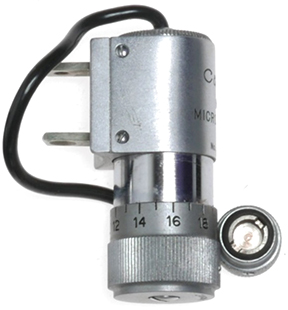 (Detail from larger web image)
And mounted:
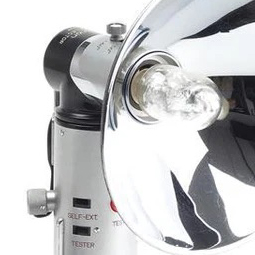
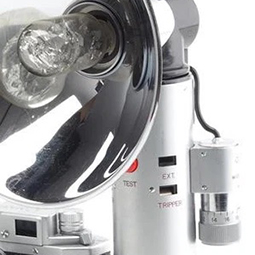
(Web images)
As well as not being included in some basic kits (XM and probably XK), the synchroniser is easily lost, or sometimes separated and sold separately. It's not uncommon for Flash Unit Xs to be offered for sale as a bare handle/head/reflector assembly as was this one below still with first type black backed reflector:
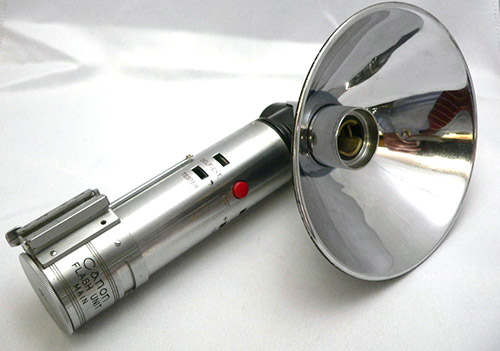
It was without power source either and could be an early XM, or the power source is simply missing:
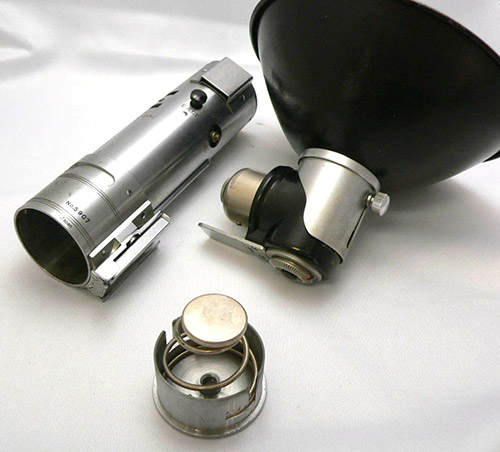
(Web images)
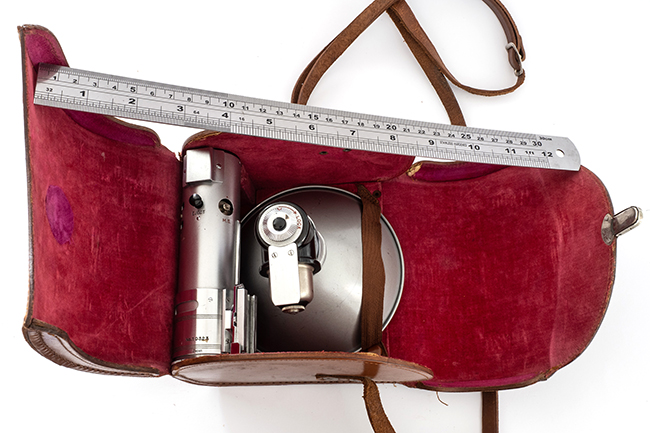
Below is my kit featuring high body serial number 10323, which I believe is the Model XK in Canon's ad. Typically for a late example, the body is satin chrome, the head has no serial number, the 5” reflector back is grey and “Japan” is marked on both body and head. The reflector may, or may not, be the same as the early shiny chrome version of the Model Y but the mounting thread diameter (my rough measurement is 35 mm) is slightly smaller than the later satin textured version finish (see Model Y). The leather case is considerably smaller than the DeLuxe version:
Only the head/reflector and body with assembled power source have fitted spaces:
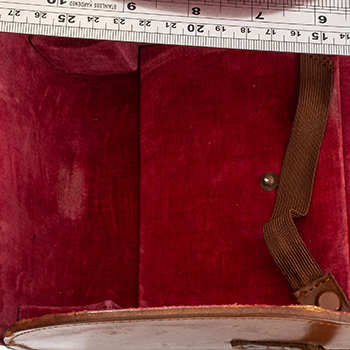
Underneath where the head sits, next to the elasticised strap in the photo, is a single press stud, function unknown. In two of the similar sets is a hard leather pouch, which may, or may not, mount to the stud, or they may not even be an original part of the set, although with two, that is unlikely. The photos didn't provide any clues about what the pouch may have held, although it is next to a 22.5 volt battery in the photo below (no extras in the kit, the other set did include several loose extras including Micro-Sync, Self-Extension Adapter and extension lead):
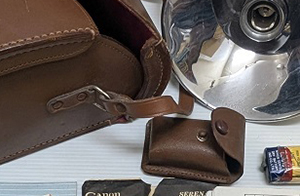
(Right is web image)
Mounted on Canon IV-Sb:
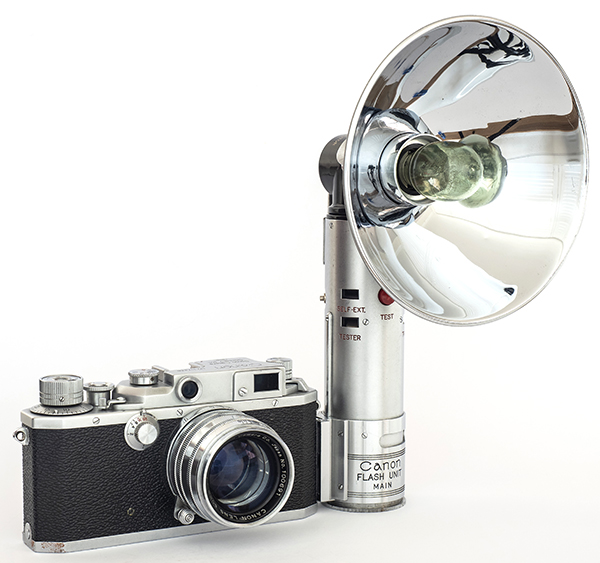
The flash head is adjustable for angle of coverage by loosening the thumbscrew and sliding the reflector mount collar forward or backward:
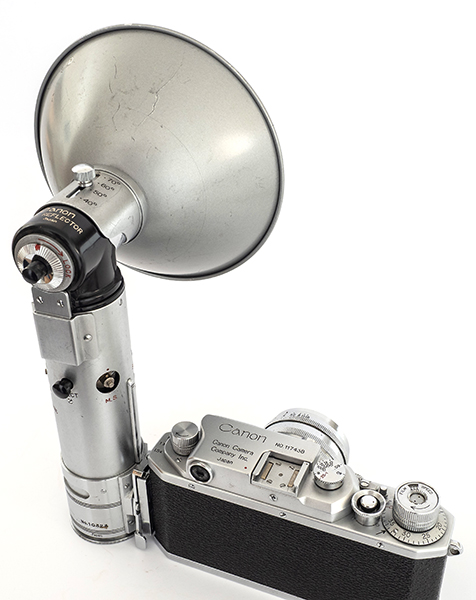
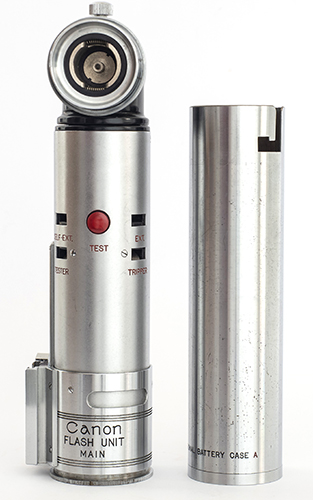
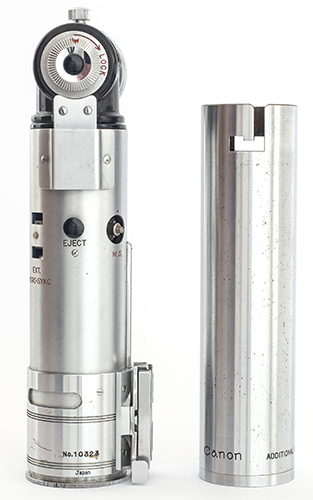
Front and rear views of the body next to an Additional Battery Case A which allows three D cells to be used instead of the Capacitor Cell. It was included in the case, but was separately wrapped and packed on top of the reflector so clearly was not part of the original set:
The component parts of the XK kit in the carry case:
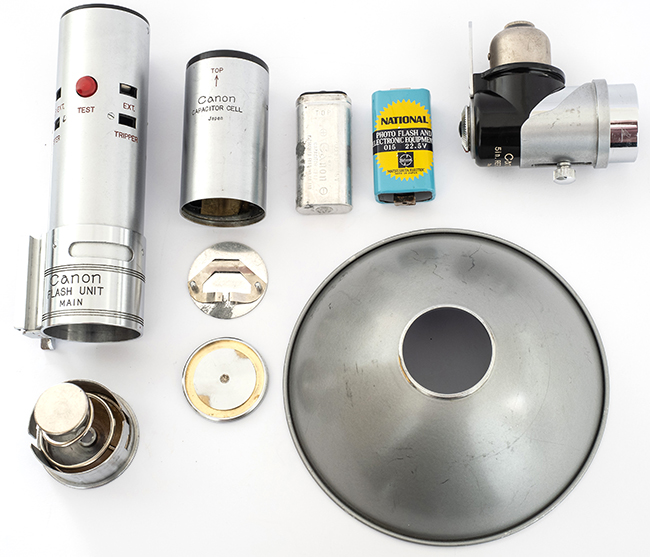
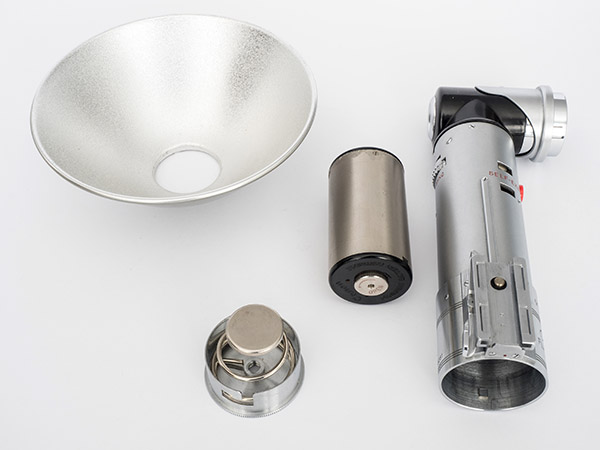
The battery and capacitor sit next to each other in the Capacitor Cell, the circular disc with locating pins sits under them and the threaded bottom cap secures the assembly. Below are bottom and top views of the Capacitor Cell and an inside view showing the locating pin holes:
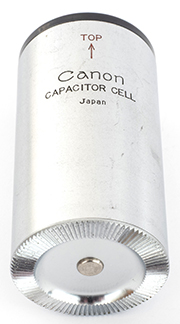
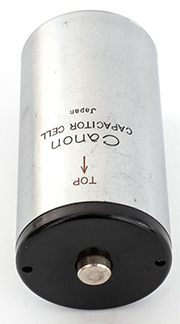
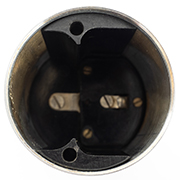
It is identical to the Capacitor Cell in late boxed example serial number 9909. Capacitor Cells found with the Model Y usually have the knurling along the outside edge of the bottom cap instead of the wide, but more difficult to use, ring on the bottom. Earlier Capacitor Cells were serial numbered.
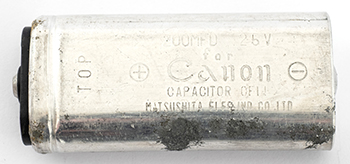
The battery type with rectangular end shape is used for both the Model X and Y and is different to the smaller square end type found with Canon's other early battery/capacitor sets including the B-III. The 200 mfd capacitor was made for Canon by Matsushita Electric Industrial Co., Ltd., these days known as Panasonic Corporation, and is shared with the Model Y and B-III flash units:
Below is a Flash Tester for testing the in-built flash synchroniser, flash circuits and flashbulbs. Originally part of DeLuxe sets, they could be purchased individually along with most flash bits and pieces. Most/all are serial numbered, Peter Kitchingman's collection spanning from 1133 to 6710:
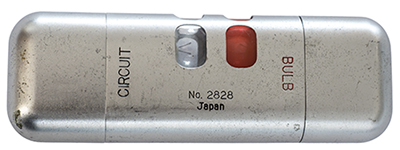
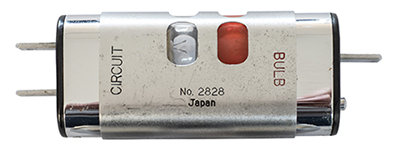
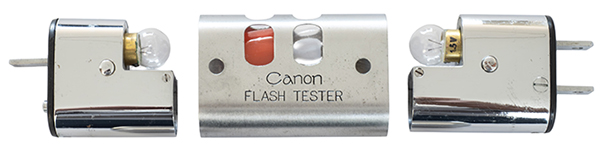
As noted earlier, Flash Testers in DeLuxe sets were usually/often supplied with two spare bulbs in a capsule shaped plastic holder but these were listed separately as well. Both early and August 1952 Model X user manuals mention the use of the Flash Tester but it does not appear in the October 1955 Model Y user manual, although it is still listed as an available flash accessory in a 1956 Canon product catalogue featuring both bottom loader and Canon VT accessories.
The type of presentation box below appeared quite late in the Model X's life and appears to have only been used for kits without the Deluxe, or the XK type carry cases (presumably, the cased sets were retailed in some type of box, probably considered disposable by most owners). I have found it only with the third last and last X units in my database, 9909 and 11142 plus another late example with body number not visible (grey reflector back and no head serial number). Peter Kitchingman has one late XM example, 9772. There is also the 1954 box with different lid image in the Flash Unit X Without Micro-Sync section below. It is possible that the box below was only used for the XA and XM kits described in Balfour, Guthrie & Co.'s letter and price list above, or similar. Although one of the examples in my database has the Capacitor Cell, and another a Self Extension Adapter, none of them, including Peter Kitchingman's example, has a Micro-Sync nor other accessories. Whilst the construction and graphic design is similar to the B-III and Y boxes, it is more cube shaped rather than flat and there are no fitted inserts or lining material, relying on internal boxes and packaging instead (flexibility to allow for variable kits?). Also, unlike the other two, it still features the Canon Eagle logo:
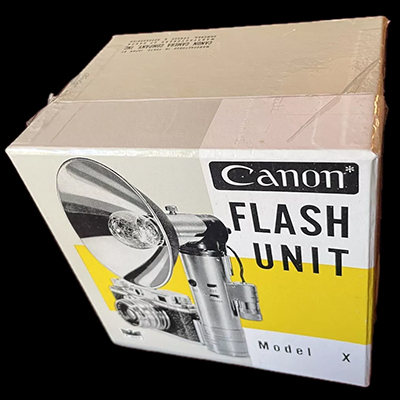 (Web image)
Below left is the cover of a Japanese user manual. On the right is a downloadable English user manual with August 1952 date on the back cover. Note, whilst the box and these manuals show the Micro-Sync mounted, unlike the original user manual, the English version is still too early to reflect any other power source options than the Penlight Battery Cartridge and the Additional Battery Case A for D cells:
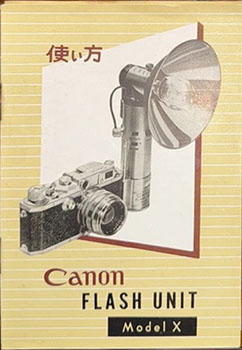
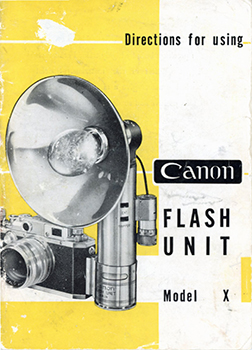 (Click on right cover for PDF manual)
The Model X side light, simply marked “Side Lighting Unit”, features a spring mounting clamp and is similar to the later Flash Unit Y version further below except that like the Main units, the head of the X (same head as Main unit) is removable for mounting the 7" reflector whilst the Y head is fixed, and the X body is a little taller (see also both early and late user manuals above). Front and rear view, minus the reflector and extension lead weirdly plugged in upside down from socket to socket:
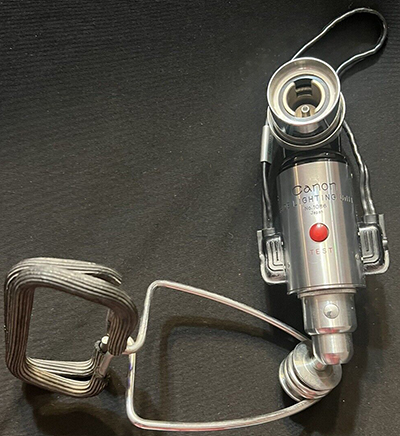
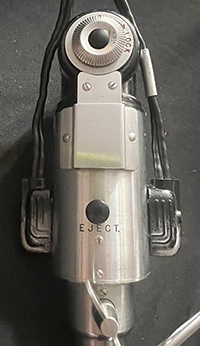
(Web images)
Below is a Canon flyer, printed in March 1951, found with an unsync'd Flash Unit B-I. The Side Lighting Unit is shown with both 5" and 7" reflectors mounted:
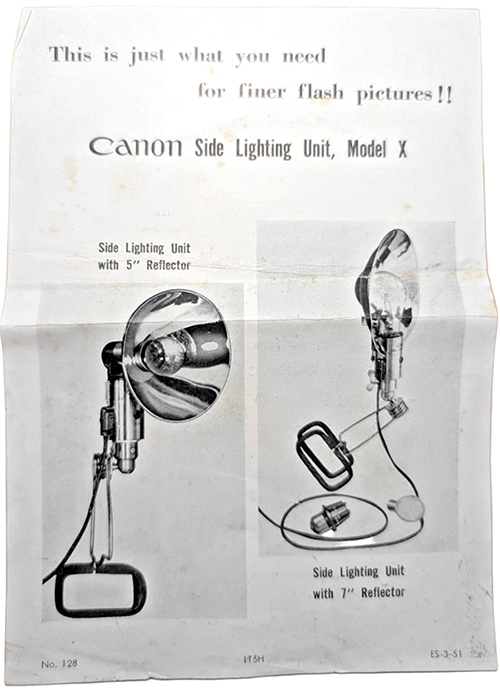
Whilst also named as the side light in the instructions for the unsynced Flash Unit B-II, it is almost certainly the unnamed side light in the earlier B 1/B-I instructions (the Model X and its Side Lighting Unit were released at a similar time to the B 1 and uses the same connector sockets). Model Y user manuals and 1954 price lists suggest that it continued until at least mid-1954 as the side light for the Model Y before being replaced by the fixed head version.
Flash bodies are numbered on the back, near the base. The earliest serial number in my database is 1011 in the Canon Micro-Sync photograph mentioned earlier, then 1093, 1380 and 1428 on the three further below without Micro-Sync provision and the rest range from 3100 to 11142. However, Peter Kitchingman has also recorded four low serial numbers from 1298 to 2040 with Micro-Sync, so either the plain bodies are mixed in with Micro-Sync bodies, which seems unlikely based on the evidence, or Canon re-used the numbers already allocated to the plain bodies, likely if in 1951 it was not planning to market them several years down the track.
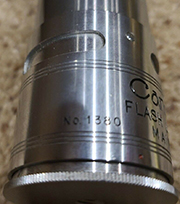
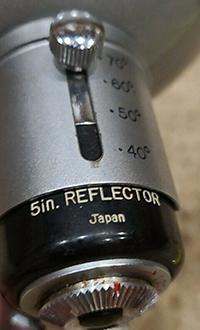
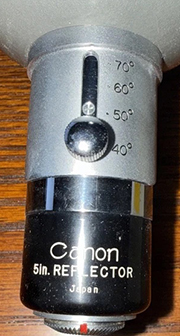
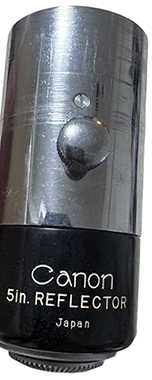
Peter Kitchingman advises that early 90 degree flash heads are unnumbered, certainly up to body 1677. Late heads from body 9237 are also unnumbered. On heads, if numbered, it is on the top between “5 in. Reflector” and “Japan”, although note that “Japan” is not there on earliest examples of the head, or body. In my database, “Japan” first appeared on body 4339 and head 1344 which are part of the same set - it would have to be an incredible coincidence if these were not an original matched pair. The earliest head number in my database is 1110 on body 3100, The highest head number is 1101x (body number unknown). Serial numbers are rarely featured in photos and too often, where I have a body number, I can't see the top of the head and vice versa. The pair below are from different sets but appear to be of a similar age:

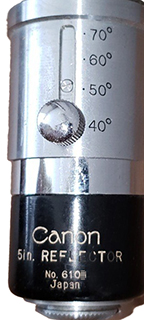
(Web images)
Other parts were also serial numbered. The Micro-Sync featured in Canon's letter is numbered 1005, the highest number I have recorded is 12068, although the next lowest is 470x. The Self-Extension Adapter, Flash Tester, 7” reflector, Midget Bulb Adapter and the Side Lighting Unit body were also serial numbered as were the earlier Capacitor Cells. All appeared to feature serial numbering starting from 1001.
Flash Unit X Without Micro-Sync
I've already mentioned that the Micro-Sync is not featured in the original user manual, so it follows that I would expect any examples of Flash Unit X bodies found without provision for attaching the Micro-Sync, to be early ones. Yes and no, based on clear, conflicting evidence.
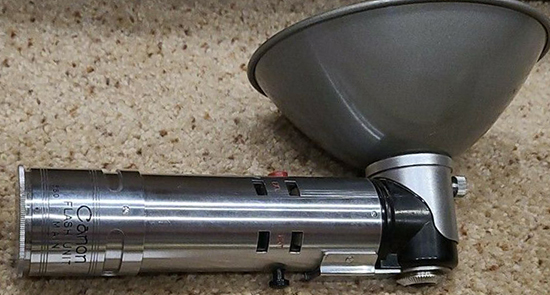
The first found was body serial number 1380, the earliest in my database at the time. When viewed front-on, most Unit X bodies have one set of rectangular socket pairs on the left front, one set on the right front and one set on the right rear plus a round coaxial socket on the left rear for the synchroniser connector to plug into. The right front sockets are labelled “Ext.” and “Tripper” and the right rear are labelled “Ext. Micro-Sync” where the synchroniser body mounts. The round left rear connector socket is labelled “M.S.”. On the body of 1380, both the right-side socket pairs are simply labelled “Ext.”, but more significantly, there is no coaxial rear socket for the Micro-Sync connector. First image shows 1380 body without the socket (normal position is to the picture right of the black eject button), second shows it with right rear (from the front) sockets marked “Ext.” and third image is of a later Flash Unit X body with Micro-Sync connector socket and right rear sockets marked “Ext. Micro-Sync”:
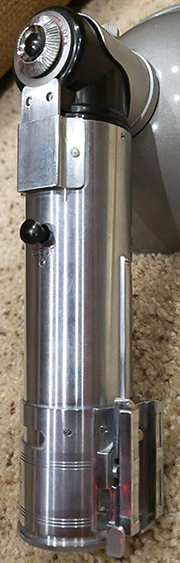
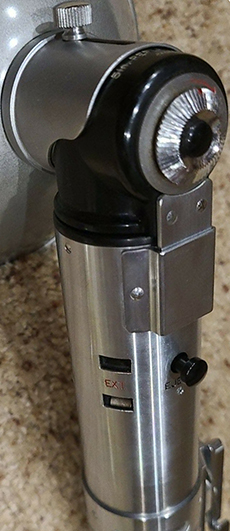
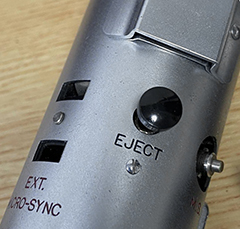
(Detail from larger web images)
Note that 1380 features a shiny chrome body, like at least the first half of my database, but the later Model X bodies appear to be more of a satin chrome, like the example next to it.
That seemed to be clear cut support for my theory. For full disclosure, I noted that 1380's reflector with grey hammertone painted back was almost certainly a later replacement together with the flash head. I expected the original reflector to have been painted black like the one further above and as it also appears in both the November 1950 and August 1952 user manuals. The last 3rd, or so, of production is grey. Also, I noted that the head is marked “Japan”, whereas there is no such marking on the body - typically, the marking is not there on either early bodies, or heads, but is on both for later ones. On the other hand, most examples have separate serial numbers for the head and the body, this head didn't have a serial number, just like those that belong to three of the last four late bodies in my database. Job done, or so I thought.
First, there is another interesting oddity with 1380, as it turns out, not unique, although it is probably totally irrelevant to the rest of the story. The 1st photo below shows that the serial number ends just to the left of the “Canon Flash Unit Main”. The whole lot is twisted to the right (viewed from the front) so that both the serial number and name are on the right side of the body, clear in the 4th photo. Normally, the name is centred on the front and the serial number is on the back, to the left of the mount. Note, on 1380, there is no gap between the serial number and name for the mount to fit and therefore it is an engraving difference rather than the attachement ring somehow being inadvertently rotated during assembly. The second photo confirms the early serial number and that “Japan” does not yet appear under it. The third photo is of the late head unit featuring the “Japan” marking, but with serial number no longer appearing:
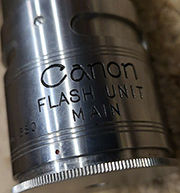
(Web images)
There is one other like it, but before before I provide details, I found another Flash Unit X just like 1380, except without the engraving anomaly. This changes the narrative from someone's fiddling to maybe an offical Canon release.
The second one, serial number 1093, is even earlier. It too has a later head with the same late features, i.e. no serial number but with “Japan” marked, and grey reflector. In summary, what we have are the two earliest bodies by serial number (or so i thought at the time), both without the later “Japan” marking, both with a shiny chrome rather than Satin chrome finish and neither with provision for Micro-Sync but both seemingly retrofitted with late heads and reflectors, i.e. late 1950, or early 1951, bodies with 1952, or later, flash heads and reflectors.
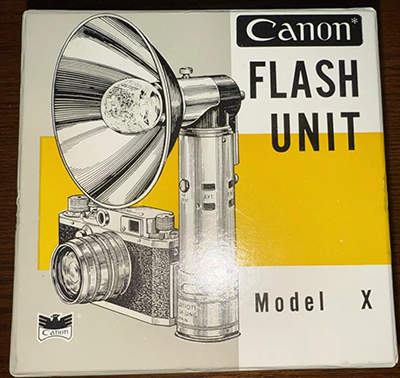
Coincidences do happen, except not in this case. 1093 came with both its presentation box and outer delivery box. I mentioned previously that the last Model X flash units were supplied in a presentation box, rather than the earlier carry case, with one pictured further above, complete with a photo on the lid with Micro-Sync mounted. The box for 1093 is almost identical, except instead of a photo, it has a line drawing - there is no Micro-Sync and we can see that the right front and rear sockets, when viewed from the front, are both clearly marked “Ext.” instead of the front being labelled “Ext.” and “Tripper” and the rear labelled “Ext. Micro-Sync”, i.e. it matches the flash body 1093 (and 1380). To me, this box style and graphics is much later than the original user manual and more in keeping with the age of the head than the body. The drawing of the camera on the front features a rigid Serenar/Canon f/1.8 rather than the collapsible Serenar f/1.9 on the first manual cover:
 (Web image)
Front and rear views of body and sockets:
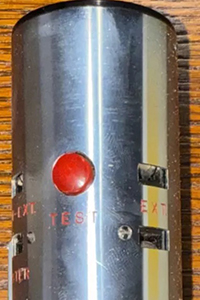
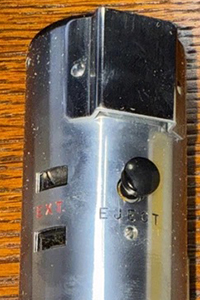 (Web images)
Of course, I could be wrong about the age of the box. But then there is the outer delivery box (both boxes in excellent condition) which, as always, fits like a glove. It has a Canon label that says “FLASH UNIT model X” with a date that indicates March 1954, i.e. well over 12 months after the release of the model Y (found model Y boxes range from September 1952 to April 1956):
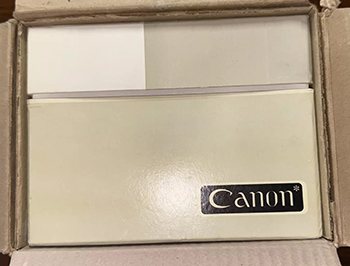
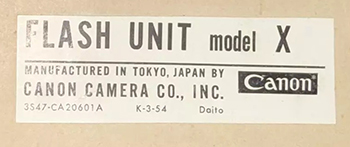 (Web images)
The left image confirms that this is an early body with no “Japan” below the early serial number (clear enough in the original image), right image confirms the flash head's late status by the addition of “Japan”, the omission of a serial number and grey reflector:
 (Web images)
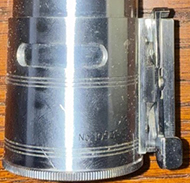
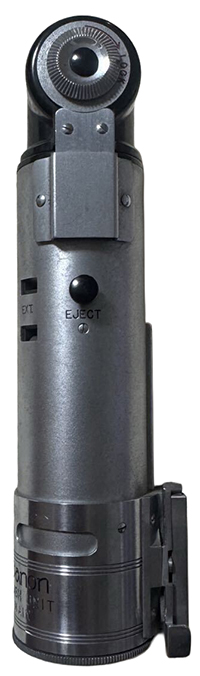
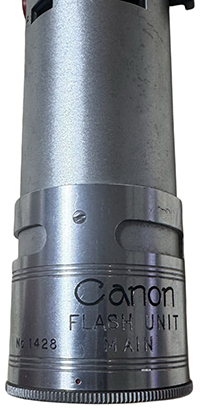
There is now a third body without Micro-Sync sockets, serial number 1428, the highest so far. The body doesn't look like shiny chrome but I suspect that it is in reality, satin finish bodies didn't arrive until later. There is no reflector, but like the other two, the head is the late type with the “Japan” marking and no serial number. It also features the sideways rotated name engraving of 1380, this must have been a conscious change for a short period before reverting to the earlier style which we now regard as “normal”:
(Web images)
Given that I have seen a good number of early X user manuals for sale, and that they should be far more scarce than the actual flash units themselves, I was initially surprised to not have found an original early body without Micro-Sync but with early flash head and reflector. However, I have now come to believe that these bodies were produced without any being released to market at that time. The user manual dates from November 1950 but the first production camera it could be used with, the Canon IV, was not released until April 1951, so it would have been silly to sell the Model X before then, even if it was ready.
My only thought now is that when Canon redesigned the X early on to include the Micro-Sync, they had a supply of bodies left over that they didn't want to release then, perhaps there were serious syncing issues with the earlier flashbulbs with variable quality standards and specifications, but later flashbulbs offered a means of unloading them at a cheaper price than the typical X and new Y. This wasn't radical, or even new, thinking - Canon had already released the budget Model XM and almost certainly also the Capacitor Cell equipped XK kits without including Micro-Sync as standard. Conveniently, there was a ready supply of new Model X flash heads for the Model X sidelight which wasn't replaced by the Y version until at least late in 1954 (see Side Lighting Unit Model Y below). As noted earlier, it seems that Canon may have used the same serial numbers for both body types, perhaps originally not thinking about a later release.
Flash Unit Y
I originally described the Flash Unit Y as a more refined version of the X. I think that simplified is a better description. Whilst it retained the premium Micro-Sync feature and built it in, it made the head non-removable which eliminated the possibility of using large flashbulbs and/or the 7” reflector. Most of the accessories remained the same but none were included in the two boxed kits offered (apart from some vinyl covers). If you wanted the equivalent of the DeLuxe Model X kit, you had to build it yourself by buying one of the boxed sets, depending on chosen power source, buying the accessory kit case and buying accessories one by one. Whilst probably more expensive for a small number of customers, it would have made far more sense for the majority and sales seem to reflect that.
Flash Unit Y serial numbers run from 1215 to 36359. The first third, or so, seem to repeat Flash Unit X serial numbers which run from 1011 to 11142 (there were a lot more Y than X models made). Both presentation and outer boxes in this period were marked on the bottom with their version dates, like user manuals and brochures - the late Flash Unit X user manual above was printed in August 1952, the earliest Flash Unit Y box I have seen is from September 1952, so the changeover probably occurred in late 1952.
As can be seen from the user manual further below, there are quite a few optional accessories, many carrying over from the Model X, although the boxed kits now just included the basics. There are 10 different combinations of battery numbers/types and capacitors. Similar to the basic Model X, this one below and another bare handle I own use four side by side penlight (AA) batteries in the now metal cartridge in the third photo. This seems to be the most common type found. Canon sold the Model Y in two basic forms with separate catalogue numbers; when fitted with the Canon 200 mfd capacitor (for use with a 22.5 volt battery), it was referred to as the “Model YK” (“Model Y-K” in the the October 1955 user manual) with catalogue number CA-20602K, when fitted with the penlight cartridge, it was referred to as the “Model YL” (“Model Y-L” in the user manual) with catalogue number CA-20602L. With extension tubes for the battery holder, D cells could also be used.
Late Model YL boxed set, serial number 35281, its box is dated April 1956:
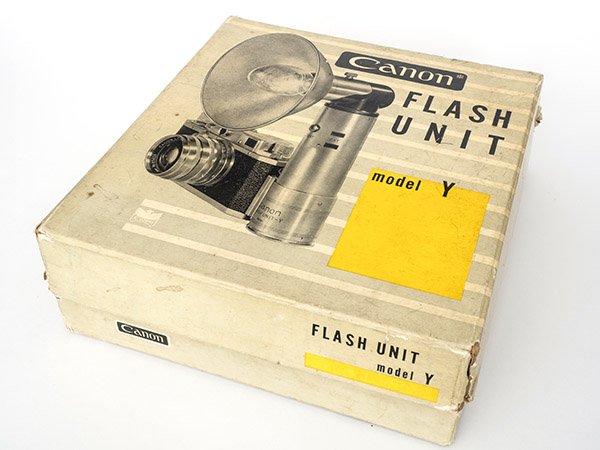
For protection, the presentation box was delivered in a plain cardboard external box, these have rarely survived:
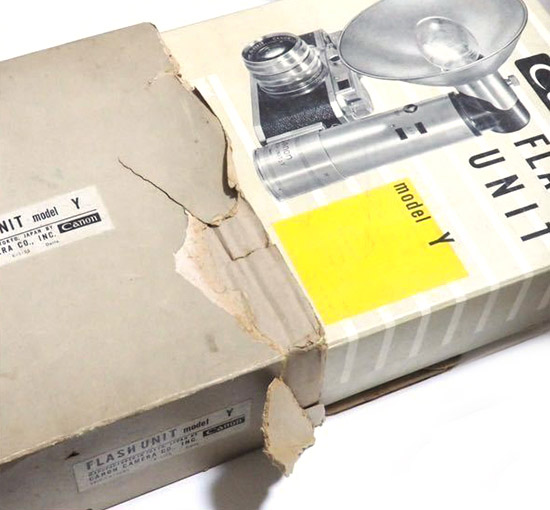 (Web image - dfferent set)
Note supplied soft vinyl cover/diffuser, now somewhat yellowed and brittle (more detail further below). The earliest Y in my database and another early example with the shiny chrome reflector still feature the same type box, but with a red liner instead of yellow, however the September 1952 box mentioned above already features a yellow liner like this one:
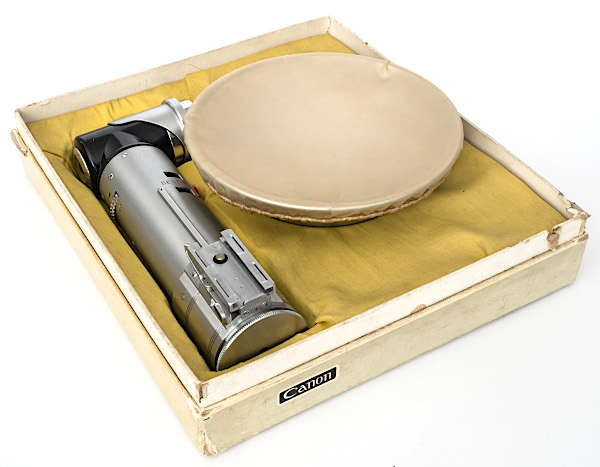
In my database, Flash Units Y from serial number 121x (and probably from the beginning) to 5706 feature the smooth shiny chrome reflectors similar to the Model X whilst those from 6054 to 36359 feature a satin textured finish. This was also reflected by the cover photos of the boxes and user manuals:
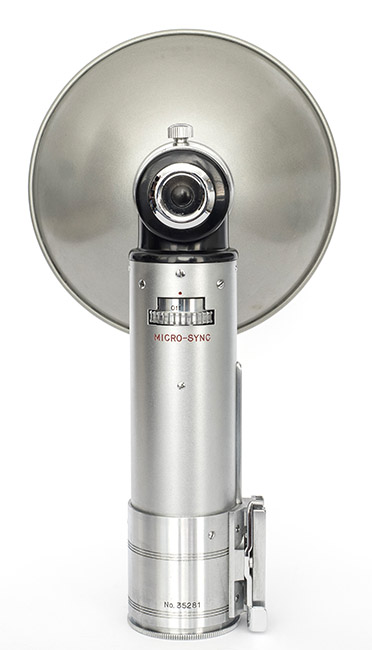
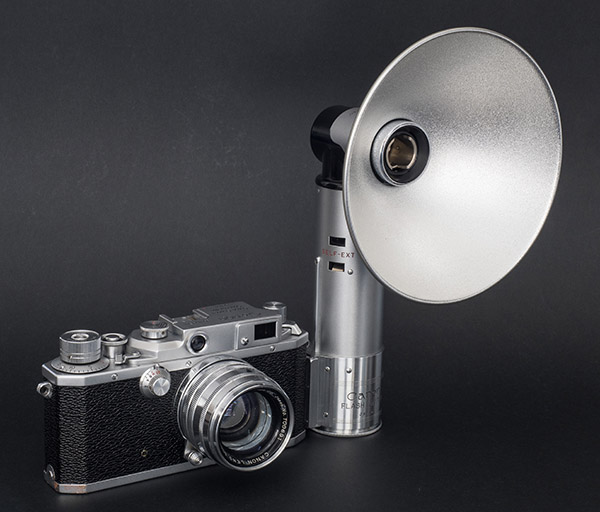
Note, the satin textured reflector features a two part construction visible at the mounting ring and has a slightly larger mounting thread than the shiny chrome grey backed Model X type and possibly the similar early Model Y type (by my measurement, 36 mm vs 35 mm). The X and Y sliding collars have slightly different side cutaway profiles but either will work on either head, they just have to be matched to the correct reflector.
Model YK components, from an otherwise identical late set to the one above, with capacitor and cylinderical battery/capacitor holder together called the “Capacitor Cell”. The 22.5 volt laminated battery (not with set) sits beside the capacitor, the circular disc goes between them and the end cap:
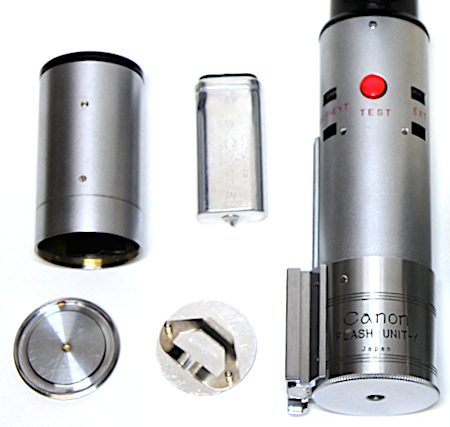 (Web image)
The Capacitor Cell and its components are basically the same as those found with the Flash Unit Model X, except for two things. Generally, the bottom screw-on cover on the Y features edge knurling whilst found X examples have wider but harder to use knurling on the bottom and on the Y, the name on top is usually picked out in white whilst the X uses plain raised lettering. However, these differences may not necessarily be model specific because from at least the end of 1952 to sometime in 1954, they coexisted and in that time both may have used the same version as it developed, I just don't have enough examples to be sure, and also, they could be bought separately. See Model X above for more details.
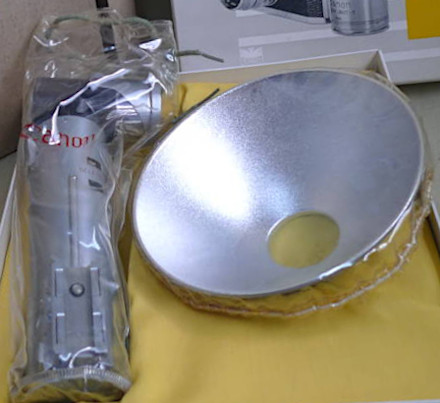
Boxed sets often still include a soft vinyl cover, with elasticised band, over the reflector and sometimes also a draw string bag made of the same material for the flashgun. In many cases, the cover and bag have yellowed, as above. There are two types, a textured one with a fine chequered pattern to the vinyl surface, again as above, rendering it translucent, the other completely smooth and clear. I have seen the reflector cover called both a “diffuser” and “dust cover”, I believe the textured type is a diffuser but whilst both probably serve double duty as a dust cover, their intent is more likely to be a protective cover to contain an exploding flashbulb (I have an original early 1950's MiniCam handle flash with 3 sided sleeve; blue for using clear bulbs with colour film, textured for diffusion and clear for safety use). Clear version of the cover and bag from a boxed set:
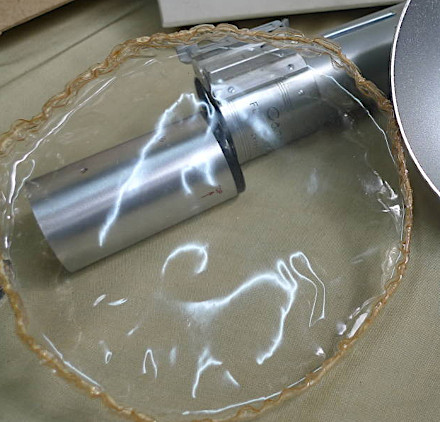 (Details from larger web images)
I have found the clear covers on some shiny chrome reflectors and early examples of the satin textured reflectors. The textured covers (the majority) appear on later examples of the satin textured reflectors.
I have seen nothing in the user manual about it, nor in any other Canon documentation, however, a January 1955 Canon flash brochure (and also a Japanese version of the user manual) lists “Shield Set and Shield Holder” with one of the set of four being “clear for protective use” and another, a “diffuser”. These probably equate to the respective elasticised covers supplied in the boxes.
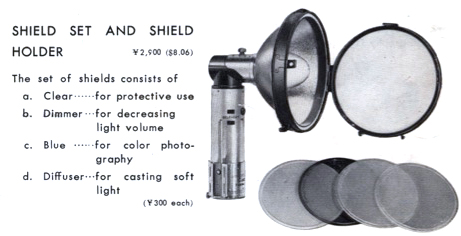
There are a number of user manual versions for the the Flash Unit Y. The earliest I have seen is from November 1953 (downloadable from Pacific Rim Camera) and is in English, cover below left (23 pages). The cover on the right belongs to a July 1954 manual, still featuring the shiny reflector, and is in Japanese (15 pages):
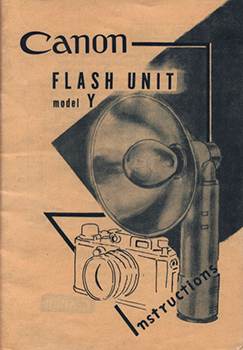
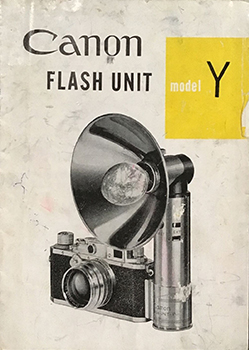
Whilst the paper quality and internal typesetting of the earliest manual is more basic than the rest (more so than the earlier X unit manuals in English), all export manuals seem to share its basic cover design (most have a camera image rather than line drawing) as does the downloadable manual below. This one is quite a late one from October 1955 (contents appear identical to a July 55 printing), matching the accompanying flash unit's late serial number (No. 35281), and featuring separate tables for using Canon IV-Sb, II-S and II-F cameras up to serial number 169999 and over 170000, i.e. IV-Sb type models with 1/25 cross over speed and IV-Sb2 type models with 1/30 cross over speed, noting that the “2” models were not name differentiated back then (31 pages):
 (Click on cover for PDF manual)
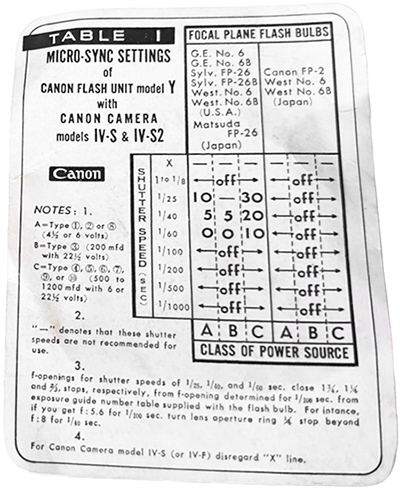
For Micro-Sync settings, the November 1953 user manual refers to a separate card included with the flash unit whereas the 1954 Japanese and 1955 manuals include their own tables. Below is Micro-Sync settings card for the IV-S and IV-S2 found with a boxed Model Y and user manual which seems later than the November 1953 example but is most probably earlier than the Japanese one:
The “Side Lighting Unit Model Y” below is very hard to find. Side lights themselves are quite uncommon these days, but also probably because Canon didn't replace the Model X version of the side light until at least 1954. The Model Y user manuals of November 1953 and July 1954 (Japanese), and also February 1954 and July 1954 price lists, still display the X version:
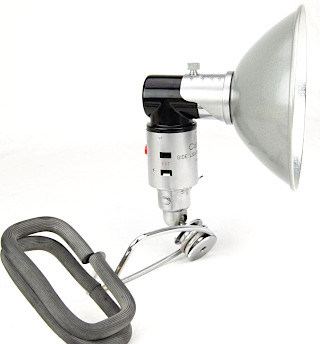 (Web image)
Below is an accessory Canon Flash Unit Y leather carry case, the red and blue arrows pointing to zipper issues. The carry case features softer leather and is quite different to the earlier types and I believe that whilst this was an extra, the earlier flashguns, including DeLuxe kit and YK versions of the Unit X, included theirs as standard. Half as many Flash Unit Ys in my database have been found with cases than with boxes and together, they account for less than half of all found units:
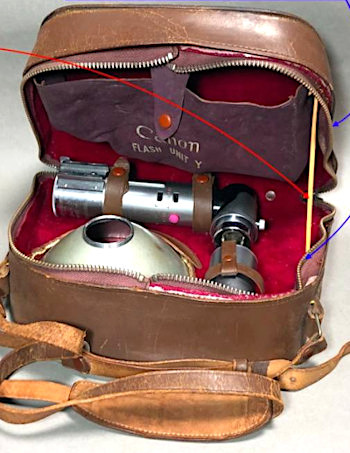
(Web images)
The March 1955 Canon Product Guide has this to say about Flash Unit Y carry case (page 33):
“CARRYING CASE for above Flash Unit Catalog No. M-24208
Genuine cowhide leather carrying case for either Model YK or Model YL. Velvet lining, extra compartments provided for keeping, flash bulbs and other small accessories. All-around zipper closing, adjustable leather carrying strap with shoulder pad.”
There was also a larger “Canon Gadget Bag” designed to hold a Canon body, the Flash Unit Y some lenses and other bits (page 11):
“CANON GADGET BAG Catalog No. M-29901
Genuine cowhide leather case, reinforced with all-round zipper closing, velvet lining, partitioned with tender sheep skin. Holds Canon Camera, Canon Flash Unit Y, Wide Angle Lens (1 pc.), Long or Telephoto Lens (1 pc.), and other small accessories. Adjustable leather carrying strap with shoulder pad.”
Flash Unit III
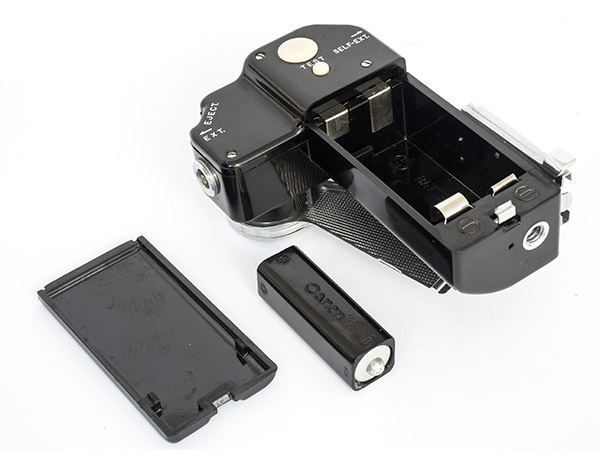
As strobes were becoming more common for professional use, flashbulb flashguns were becoming simpler, more compact and more accessible. The Flash Unit III was Canon's first modern type with plastic body and fanfold reflector. The power source was a battery and capacitor only (BC type). There is a separate proprietary two pin connector for an extension lead between camera and flash. An extension unit, the Canon Side Lighting Unit, Model III, was also available. The socket on the flash body is a PC type but the instructions warn that only the designated sidelight should be used. However, the later Side-lighting Unit V is also suitable for the model III, see further below.
The user manual (available for download from Pacific Rim Camera) shows the model III mounted to an IV-Sb2 era camera and the printing date is October 1955. It still appears in a 1956 Canon product guide featuring the Canon VT already along with its older sibling, the Flash Unit Y. Its price of $17.50 was slightly less than half of the penlight battery powered model Y, which incidentally was the same as the B-III for unsynced cameras:
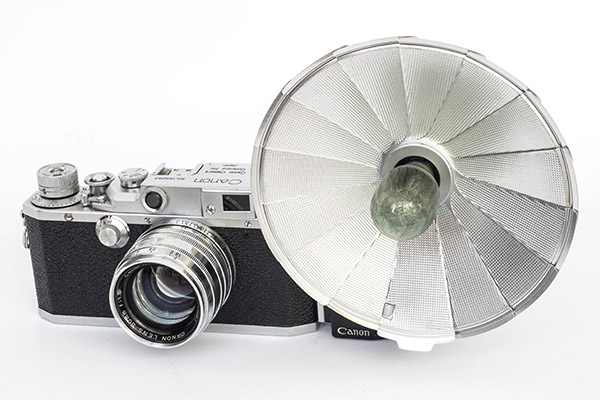
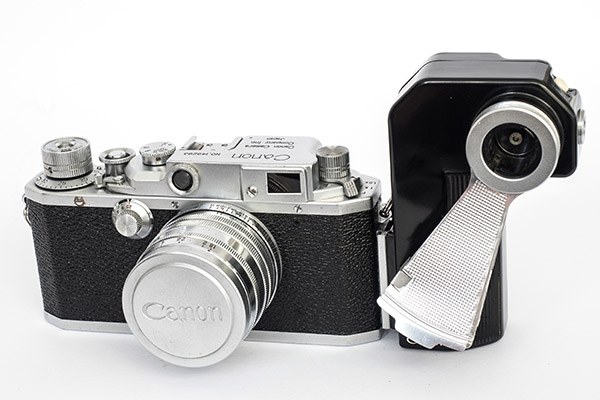
Note the solid construction and coaxial extension socket on the side:
For Canon Bayonet Mount Cameras (hinged back)
The side mounting flash rail was not a practical option for the hinged back models introduced by the Canon VT. The solution was a two tongue bayonet mount on the end of the top plate surrounding a standard PC socket and a matching connector and breech lock on the flash unit. A flash lead could be used for off-camera flash, or using a non-Canon flash.
Flash Unit V
The Flash Unit V was released with the Canon VT in 1956 and remained the standard flashgun until after the Canon 7 was released in 1961. It is a BC type which, with the exception of a tripod socket, has similar features to the model III for bottom loading cameras including a two pin extension lead connector and a PC type socket for the sidelight:
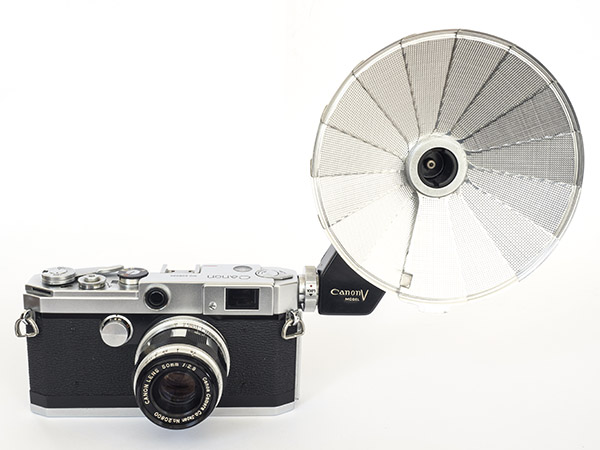
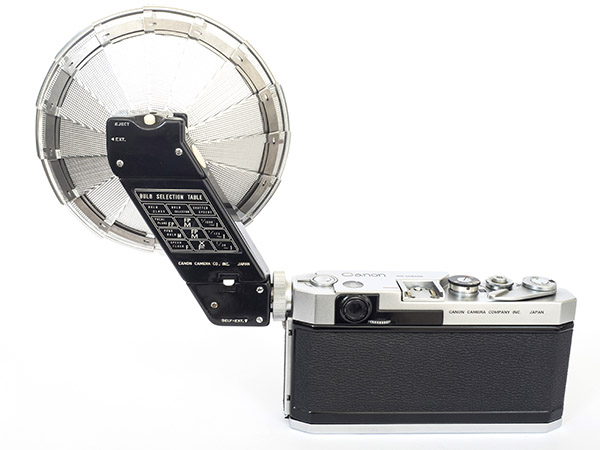
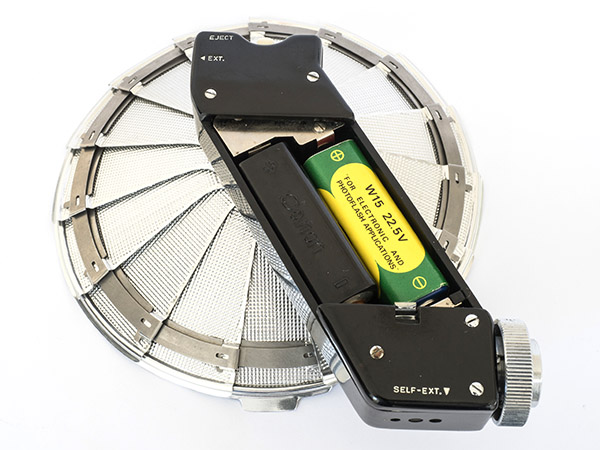
A user manual is available for download from Flynn Marr.
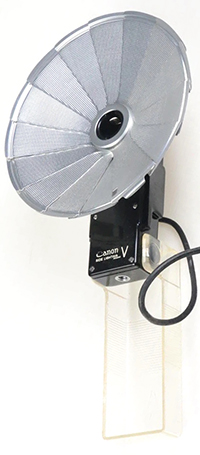
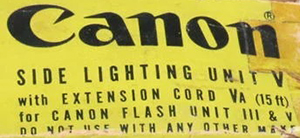
There was a new accessory Canon Side-lighting Unit V. As with the model III, the instructions warn to only use the designated sidelight, i.e. according to Canon, because of circuit design, the sidelights should not be mixed and matched, or substituted by other flashguns. However, the box for the Side-lighting Unit V clearly states that it is suitable for both the model III and V flash units:
(Web images)
Flash Unit V-2
This unit only appears in later Canon 7 user manuals, although it can be used with any earlier Series V and VI camera. It has a vertical body instead of angled and its primary difference is that the head can be rotated to provide bounce flash. It no longer supports an accessory sidelight but still features a two pin extension lead socket. Mounted on Canon 7:
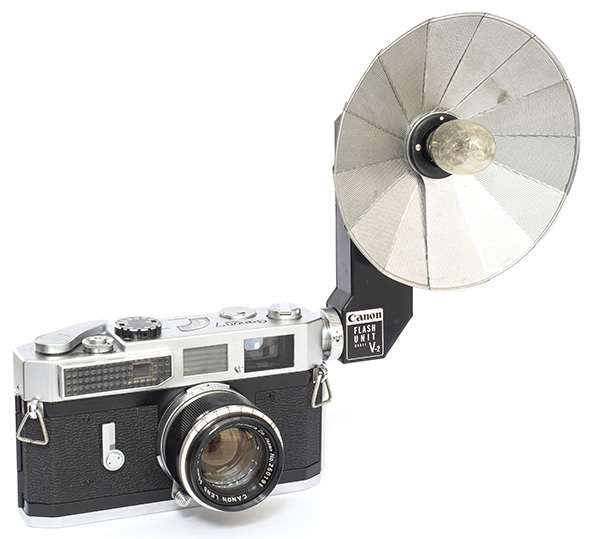
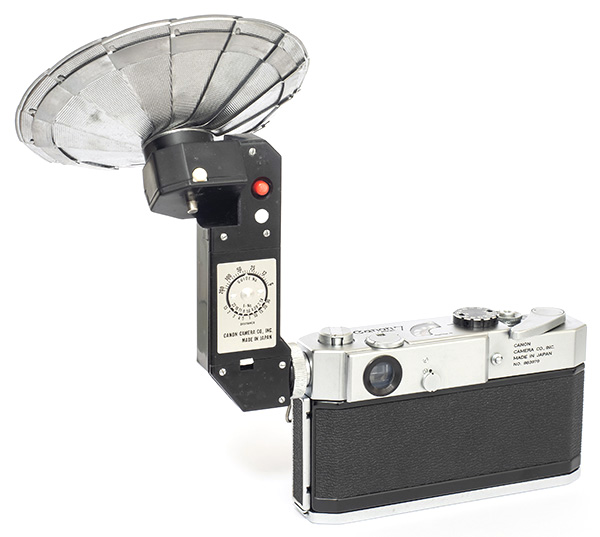
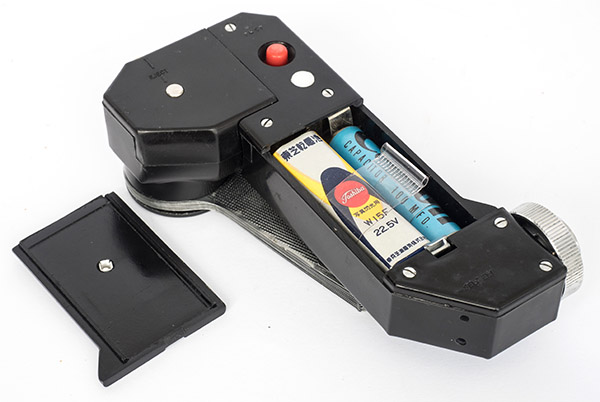
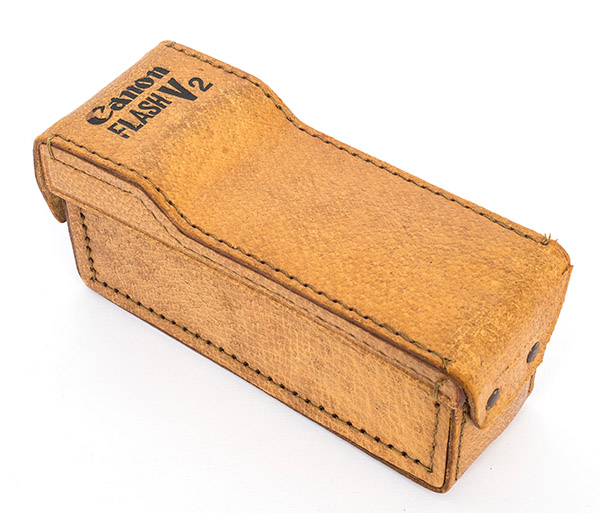
A user manual is available for download from Flynn Marr.
Canon Speedlights for Rail and Bayonet Mount Cameras
Canon initially called “their” early electronic strobe units “Speedlight”, the name “Speedlite” came later. “Speed Light” (two word form) was also a generic term Canon used in, e.g. the circa 1954 Flash Unit Y user manual above when connecting strobes to a camera with sync rail (a US Heiland Strobonar shoulder strap power pack model and an unknown brand pictured).
Canon introduced their own two models with shoulder strap power packs (as the most portable types were in the mid-50s, although under new owner Honeywell, Heiland released the first of the their power pack in handle type, the impressive Futuramic Strobonars in 1958). These were the “Canon Speedlight Unit” and the “Canon Speedlight Unit Model V”, which as far as I can tell were identical except for the flash heads which were designed to be mounted to the rails of Series IV cameras with X sync in the first instance and to the bayonet fitting of Series V cameras in the second instance. In time, this would include Series VI cameras and the Canon 7. The earliest that I have seen them mentioned is in the Canon VT de luxe user manual printed in March 1957. This is the Unit V photo in the manual in operating position:
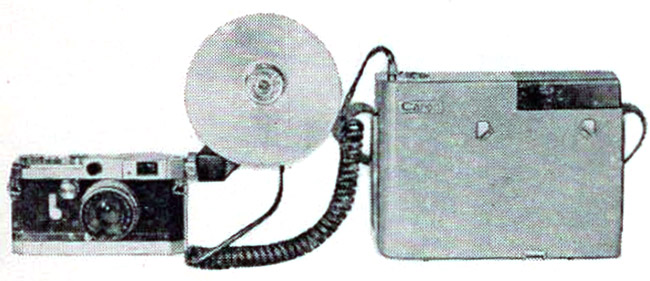
Operating instructions are available for download from Pacific Rim Camera.
Speedlight Unit, upper photo, with rail mount flash head and Speedlight Unit Model V, lower photo, with bayonet mount, both with their flash heads in their stowed postions utilising two upper hooks and a clip at the bottom of the power pack (note the two slots in the reflector rim for the the hooks):
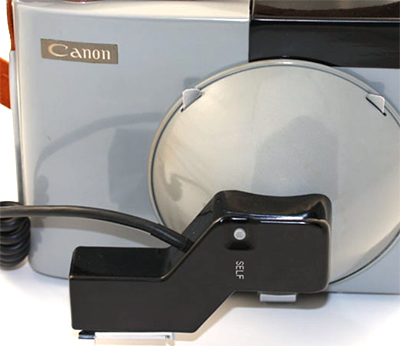
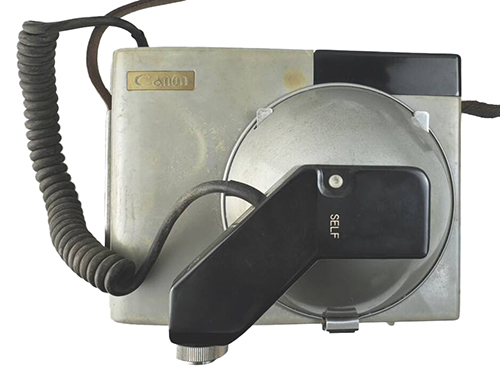 (Web images)
Power pack main switch on left, flash tube on right:
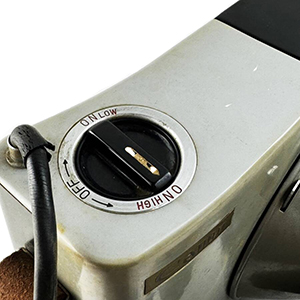
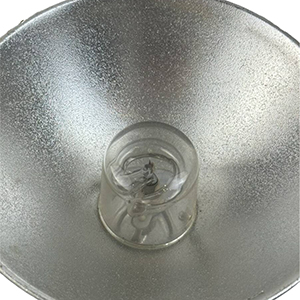
(Web images)
For Canon 7s
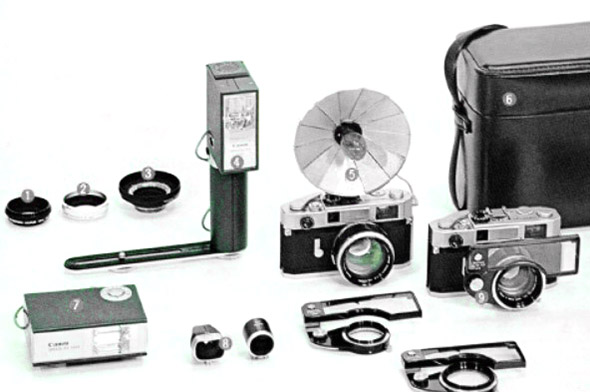
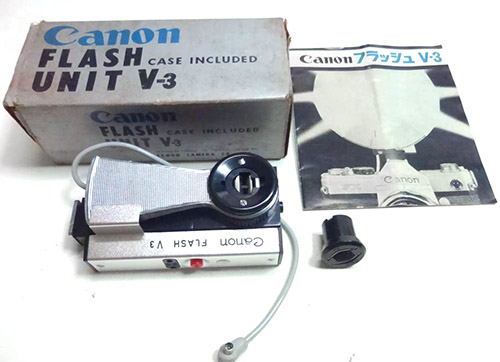
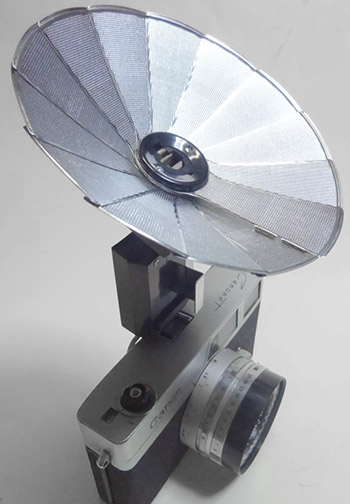
The Canon 7s (and the 7sZ) no longer featured the bayonet mount of the Series V, VI and Canon 7 cameras and therefore specialised flash units were not offered for it. The 7s user manual lists three suitable flash units; the Flash V-3 and Speedlite 100 and 200. These are displayed with other items on a Canon brochure page featuring the Canon 7s; left to right; Speedlite 100s, Speedlite 200 and Canon Flash Unit V-3:
Flash Unit V-3
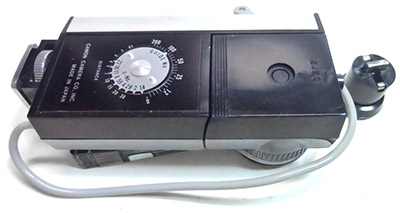
Speedlite 200
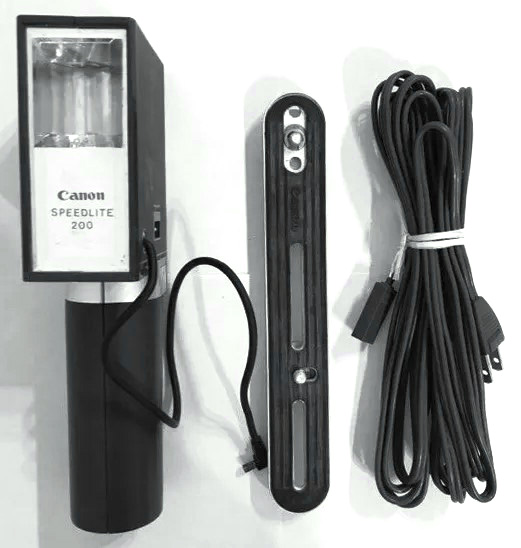 (Web image)