Canon Camera Models
Contents Page 3
(Scroll down or click on Links)
Hansa Canon & Canon Original
Canon S
Canon J
Canon NS
Canon JS
Canon J II
Canon S I
Canon S II
Canon II B
Canon 1950 (trial series Canon III & IV)
Canon III
Canon II-C
Canon IV
Canon III-A
Canon IV-F
Canon II-A
Canon IV-S
Canon II-D
Canon II-D1
Canon IV-Sb/IV-S2
Canon II-AF
Canon II-AX
Canon II-F
Canon II-S
Canon IV-Sb2
Canon II-S2
Canon II-D2
Canon II-F2
Canon VT
Canon L2
Canon L1
Canon VT de luxe
Canon VT de luxe Z (Peter Dechert name)
Canon L3
Canon VL
Canon VL-2
Canon VT de luxe M (internal Canon name)
Canon VI-T
Canon VI-L
Canon P (Populaire)
Canon 7
Canon 7s
Canon 7sZ (Peter Dechert name)
The Canon Pages
Page 1 Canon
Page 2 Kwanon Prototypes
Page 3 Canon Models
Page 4 Canon X-Ray Cameras
Page 5 Canon Lenses & Accessories
Page 6 Canon Flash Units
Page 7 Canonflex
My Canon Pages
The Models
The models are listed in chronological order of release. From an impact perspective, I'm more focused on when they went on sale, based on Canon Camera Museum's “advertised date”, than Peter Dechert's production dates but I have quoted both. Typically, camera makers build up some stock before release and sales continue after production ends until stock is exhausted. When several models were going to be released simultaneously, at least in the same month, it could have been a toss of a coin which would go down the production line first. Clearly though, in a number of cases, the dates are out of step with each other. Canon has made some obvious errors on its Camera Museum site so it's probably Peter Dechert who is more likely to be correct.
Also, Peter Dechert's researched serial numbers are far more meaningful than my relatively small pool of found numbers (circa 1,290 across all models in 2026). However, the found numbers do indicate the spread of the more easily found examples and in several instances, I have found serial numbers slightly outside of his range. I have also included a table of lenses likely supplied as original options with each model and serial numbers found. I have tried to exclude any obvious later swaps and other outliers but this is not definitive nor necessarily accurate. Serial numbers are indicative only and many lenses will lie outside my small sample size range. When numbers fall outside the range, compare to the the previous camera model for lower numbers or the next model for higher numbers. Obviously, body and lens serial numbers do not apply to the Kwanon.
Where I have quoted production numbers, these are Peter Dechert's, unless stated otherwise.
Hansa Canon & Canon Original
Production (Peter Dechert) |
Marketed (Canon) |
Slow
Dial |
Main Dial |
Sync |
S/Timer |
1935/10-1940/06 |
1936/02 |
None |
Z, 20-500 |
No |
No |
Note, both Kannonji Makoto and Hayato Ueyama believe that production finished in 1938
Nippon Kogaku Mount Numbers |
||
Source |
From |
To |
| Peter Dechert | 55 |
5200 |
| Found | 6x |
515x |
Base Plate (BP) Numbers |
||
Source |
From |
To |
| Peter Dechert | 1119 |
1334 |
| Peter Dechert | 2022 |
2997 |
| Peter Dechert | 3019 |
3223 |
| Found | 116x |
123x |
| Found | 202x |
279x |
| Found | 316x |
|
(Note, the Hansa Canon/Canon Original does not have a serial number as we know it. However, the focusing mounts were numbered by Nippon Kogaku and there is a Seiki Kogaku stamped number on the inside of the base plate. Both are explained below).
| Lens Mount: Bayonet in J mount focusing unit | |||
| Normal 50mm Lens (Peter Dechert): Nikkor f/3.5 | |||
| Found with Lens: | |||
| Lens | Description | Serial Numbers |
|
|---|---|---|---|
From |
To |
||
| Nikkor f/3.5 | Collapsible. Black face | n/a |
5050x |
| Nikkor f/3.5 | Collapsible. White face | 50117x |
|
| Nikkor f/3.5 | Collapsible | 50142x |
50176x |
| Nikkor f/4.5 | Collapsible. White face | 502x |
5086x |
(Note, there are no serial numbers on early black face and very earliest white face lenses.)
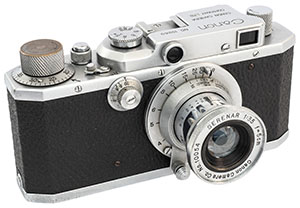
The first production model was the “Canon” camera, or as Seiki Kogaku referred to it, “Canon Standard Model”, the majority but not all, also featuring the word “Hansa” engraved above the Canon name, hence the name “Hansa Canon” being used. Collectors, being collectors, call the plain Canon “Canon Original”. See The Canon Story for a detailed explanation but basically, “Hansa” is a trademarked brand name belonging to camera distributer Omiya Photo Supply Co., Ltd. “Hansa Canon” on left and late (new accessory shoe) “Canon Original” on right, otherwise identical except for any other early/late variations:
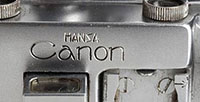
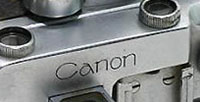 (Detail from larger web images)
There is no doubt that the Hansa Canon was a direct development of the Kwanon designs and design elements obviously carried over to the production camera. Over time, some of these were modified, sometimes to simplify production, other times as improvements. These design cues are obvious but it is not necessarily the same thing as “using up parts intended for Kwanon production” claimed by some. There is still no evidence that any of the Kwanon designs, apart from the Kwanon X, were built as working prototypes, let alone parts being produced for their production.
Serial Numbering - Lens Mounts & Base Plates
In addition to Peter Dechert, for this camera, I'm also relying on Kannonji Makoto's articles in the May and June 1982 editions of Camera Collectors' News and author Hayato Ueyama. Dechert tells us that the numbers stamped on the inside of base plates are design types; 1xxx being with central tripod mount, 2xxx being with end mount and 3xxx having additional strengthening (the positions of the three internal tripod mount screws are noticeably different) and that the only way to put the cameras in production order is via the lens mount number. On the other hand, both Makoto and Ueyama claim that the base plate numbers are also Seiki Kogaku's serial numbers although they freely admit that some were fitted out of order when they didn't fit the current cameras and that there had also been subsequent swapping of base plates. Makoto is far more scathing of Nippon Kogaku's inability to supply mounts in the correct numerical order. Interestingly, I have ordered my database according to mount number but if i was to reorder it via base plate number, there would only be a couple of relatively minor changes and it is almost impossible to say which would be more correct. However, I do note that with the Canon S model, the mount numbers are wildly at odds with the top plate serial numbers, something also commented on by Dechert.
Notably, there is a late Original in my database with a base plate which I am fairly certain has not been stamped with a number. It is the correct type with the notch in the side. Perhaps it is a replacement spare part?
“Hansa Canon” & “Canon Original” Production
Makoto notes that a friend, who was familiar with the Roppongi facility, claimed that three “Canon” named prototypes had been built and that one had been shown to potential distributor, Omiya Photo Supply, an event repeated by Hayato Ueyama. He says that the “Hansa Canon” was first mentioned “in the new products column of the October 1935 issue of Asahi Camera magazine” (confirmed by Martin Bacardi, see below). However, there is some doubt about whether it went on sale in 1935, or early 1936. Makoto is quiet on this, Dechert says production began in October 1935 but very few were available. To this, Canon has responded with “... introduced to market in February 1936 (although some have said that the actual date was October 1935)”. Martin Bacardi, a Canon Historical Society member, who claims to have all the Omiya Photo Supply and Seiki Kogaku ads from the 1930s and early 1940s (and has posted key examples, including the first one), says that the first ad appeared in the December 1935 edition of Asahi Camera magazine, and that one and all the Hansa Canon ads placed during 1936 were produced by Omiya Photo Supply. He also believes Canon's claim that sales commenced in February 1936.
According to Japanese website nikonfan.cocolog-nifty.com, the article below about the release of the Hansa Canon appeared in the 1 February 1936 issue of Nihon Shashin Kogyo Tsushin. My translate app doesn't make much sense of it apart from the broadest detail and that the Hansa Canon is a new camera that is being sold by Omiya Photo Supply. Whilst in theory, it could fit a timeline anywhere from October 1935 to February 1936 for a release, it sounds more like an introduction, or announcement than a review, the sort of thing that a competent distributor like Omiya, might arrange for a release:
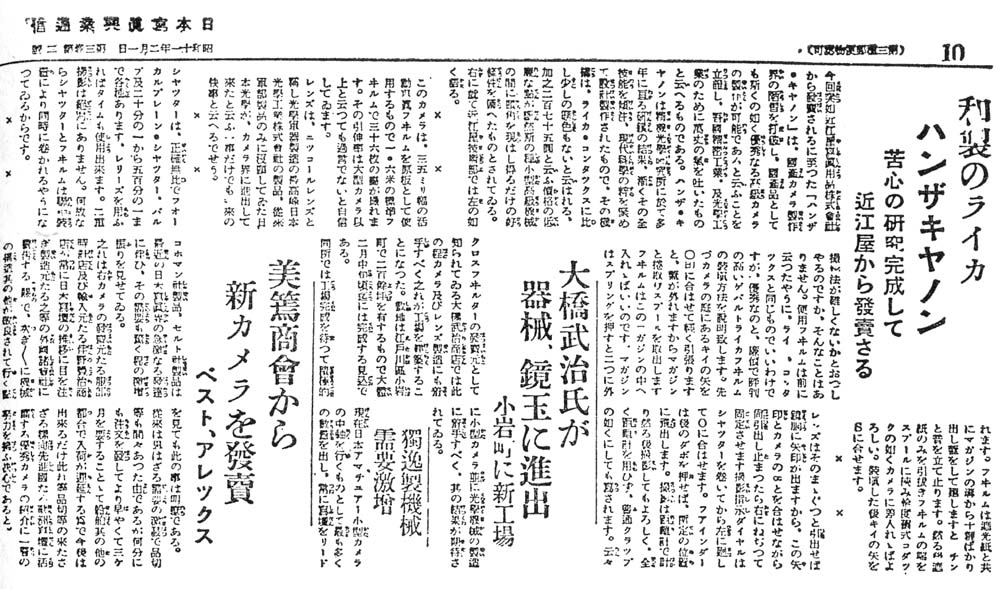
(Click on article for larger version)
In any case, the production rate at the Roppongi workshop during the first half of 1936 was quite low, according to Makoto, limited to about 10 cameras per month on average with frequent disruptions and according to Hayato Ueyama, initially only 1 to 2 units per month due to slow lens supply from Nippon Kogaku and problems with outsourced work.
There are four Canon Originals in my database from the end of production and one middle to late in production but they may have been made in small numbers throughout. Both Dechert and Makoto suggest 3 or 4 times as many Hansa engraved examples and Ueyama thinks that it is about 6 times. When I include two early ones in my database, it is just less than 6 times, but of course one, or two, cameras either way will affect that. Makoto provides details of an early Original example with mount number 113 and base plate 1175 (also identified by Ueyama). He says that such direct sales examples may have been to VIPs and army officers but apparently were frowned upon by Omiya Photo Supply.
Another early Original has recently surfaced in Australia. It has mount number 119, base plate number unknown. Both cameras have early numbers and would be expected to share features of the early Hansa examples around them, but that is not the case. Whereas early Hansas feature recessed top plates for the pop-up viewfinder, shutter collars with tapered base and plain shutter release levers without pointer, or any marking, both early Originals have typically later features, i.e. flat top plate, shutter collar with full height ribbing and release lever with pointer and “A-R” marking on the top plate. However, both still have early base plates with centre tripod socket which lasted about as long as the recessed top plates. In other words, these two cameras are a similar mix of very early and later parts. Perhaps they were both a result of rework and maybe that has something to do with why they were selected for direct sales?
Following the formation of the Seiki Kogaku company in August 1937, Makoto claims that the “Hansa” name disappeared from advertising and later, also the camera's top plate, which fits with my database and is confirmed by Hayato Ueyama. This is not unexpected, it is most unusual for the camera distributor's brand name to be co-included on the camera, something that Omiya Photo Supply no doubt achieved from a position of power over Seiki Kogaku's nascent future, however, as Seiki Kogaku developed momentum and achieved success, that power balance would have shifted. Notably, the Nippon Kogaku name also disappeared from the lens mount in 1937.
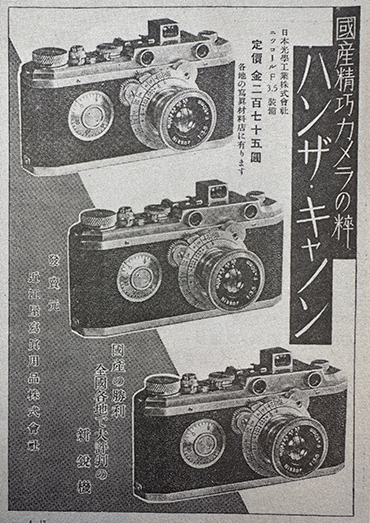
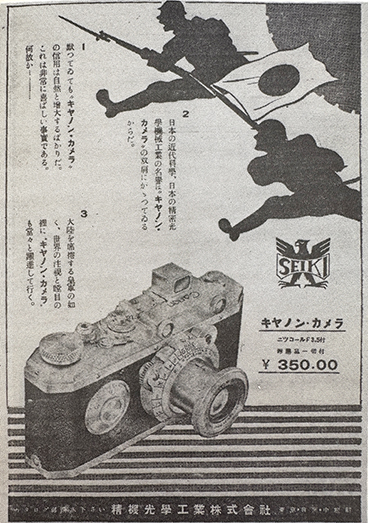
As evidence, Makoto presents the two ads below. Left is a 1936 Asahi Camera ad with “Hansa Canon” in big Japanese vertical characters in the big bar on the right side (according to Martin Bacardi, similar adds appeared in the July, August, October and November 1936 editions) and below right is a militaristic 1938 Asahi Camera ad with “Canon Camera” in smaller print under the Seiki vulture and just “Canon” on the camera top plate and the big text at the bottom translates to “Please contact Seiki Optical Industry Co., Ltd.”, no mention of Hansa:
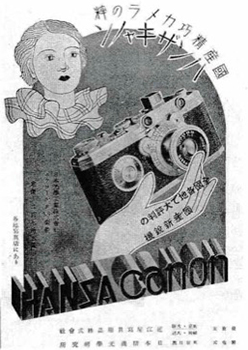
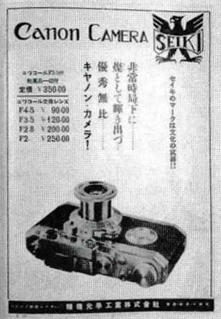
Hayato Ueyama's book similarly features a Hansa Canon ad from the June 1937 edition of Asahi Camera and a Canon Camera ad from the August 1938 edition, this time with the names in English:
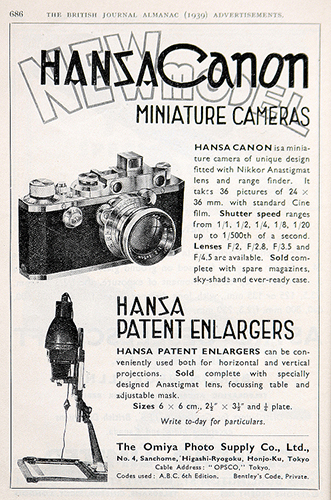
According to Peter Dechert, production of the Hansa Canon/Canon Original ended in June 1940. Kannonji Makoto, writing before Dechert, and Hayato Ueyama after him, both seem to think that it was when advertising seemed to end in late 1938, perhaps coinciding with the commencement of Canon S production in October 1938, although Canon didn't “market” the S until April 1939. Perhaps seeking interest from foreign importers, Omiya Photo Supply placed ads for a Hansa enlarger and the Hansa Canon in the British Journal Photographic Almanacs of 1938 and 1939 - that could indicate 1939 production, but probably, it does the opposite. Quite cheekily, the pictured 1939 camera is named “Hansa Canon New Model” at the top, i.e. Seiki Kogaku's “Canon Newest Model”, now known as the Canon S, and simply “Hansa Canon” in the description with slow speeds and all four lens options listed (f/2 to f/4.5) with no mention of the actual Hansa Canon without slow speeds. The camera in the earlier 1938 ad is the initial model and is marked “Hansa Canon” on the top plate, both ads somewhat contradicting Makoto's claims about “Hansa” disappearing from ads from 1937 on, but I think these two were a special case, all about raising overseas awareness of the Hansa brand and Omiya Photo Supply products, ergo, the Canon S being tagged with the Hansa name too. You would have to question whether theses ads had been cleared with Seiki Kogaku. Note, the slow speed shutter dial in the Canon S rendering is shown too far to the left and without its characteristic crank, this seems to be like the prototype S in both Hayato Ueyama's and Peter Dechert's books:
Dechert tells us that the “Original had been adopted as a Japanese army camera in April 1939, after the sales of the Canon S and J began”. At the end of very similar tables identifying variations, both Makoto and Ueyama (8 years later and more examples) list “Type 98 small camera (for Army use)” (Ueyama is unsure whether there were any differences to the Standard Model but believes only small numbers were procured by the military). Perhaps only this version continued on until 1940, although all three models are listed in the April 1939 Canon J ad further below. Ueyama does say that the Standard Model was a slow seller by this time and remained in stores for years after production finished - this could also be the source of confusion. I have to say that looking at my database mount numbers, there doesn't seem to be much of a possible cross over period with the S but it's certainly not conclusive given the vagaries of these numbers.
Lens Mount, Viewfinder & Rangefinder
As noted earlier, the Canon features lens, focusing mount and rangefinder system designed and made by Nippon Kogaku to circumvent Leica patents, the lens and mount heavily influenced by the Zeiss Contax I (Nippon Kogaku's name also appears in the first ad above). The main lens mount is 39mm diameter like the Leica but with a pitch of 24 TPI instead of 26 TPI and into this the focusing mount is screwed and secured by set screw. The removable lens barrel is inserted into the focusing mount using a bayonet fitting (see also Bayonet Mount). The viewfinder is a pop up type:
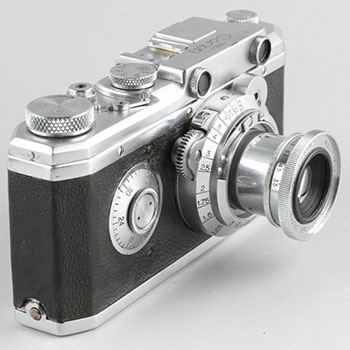
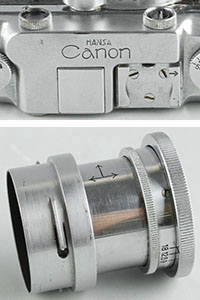
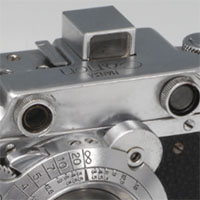
(Detail from larger web images)
Early lens mounts up to at least 717 were engraved “No. (x)xx Nippon Kogaku Tokyo”, later ones (from 853 in my database, Dechert says 800) are simply engraved with the number in the format “Nr. (x)xxx”, Nr. being the German abreviation.
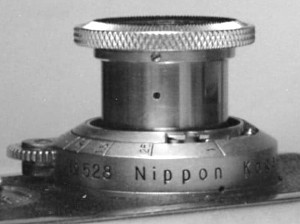
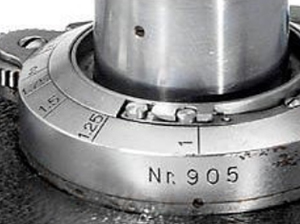
(Detail from larger web images)
The change seems to have occurred about the time that Seiki Kogaku formed into a company in 1937, but may be coincidental, according to Hayato Ueyama, a Nippon Kogaku employee claimed the change was due to the cost of engraving as it took a long time. Note, regarding claims that 712 was the last mount with Nippon Kogaku engraving and the only 7xx example known, 717 (BP 2452) is now the last one known. Both feature late black face lenses with serial numbers and “cm” markings (only two in my database).
A feature not mentioned by Dechert but covered in frustratingly little detail by Kannonji Makoto is magnification of viewfinder and rangefinder images. According to him, the first examples featured both magnified viewfinder and rangefinder images, camera with mount number 659, BP 2369, features a magnified rangefinder but life size viewfinder and by mount number 988, BP 2560, both finders are life size. Hayato Ueyama features virtually the same table with a couple of changes. Strangely, he lists mount 659 with different BP 2176 and both viewfinder and rangefinder being magnified. However, he has been able to bring forward the point of both finders becoming life size to mount 712, BP 2472.
Design
Two design features set this model apart from subsequent designs; the frame counter on the front, which is a carry over from the Kwanon winding knob design but resulted in a lower profile knob, and the one piece top plate design incorporating the rangefinder housing, which together gave it a more streamlined appearance.
The first Hansa Canons featured a recessed area on top of the viewfinder/rangefinder housing into which the pop-up viewfinder drops. It has been described as a carry over from the Kwanon prototypes. Design wise it certainly was but the visual evidence suggests that the Kwanon recess was much deeper to accommodate its fold-up viewfinder, probably as deep as the accessory shoe depression as it is in Peter Dechert's Kwanon C drawing and the auction Kwanon D replica. The second image demonstrates how vestigial the Hansa Canon version is (the button on the back allows the viewfinder to pop-up). In any case, the one-piece top plate pressing was all new, adding a platform under the shutter dial and removing the slight platform at the end of the top plate:
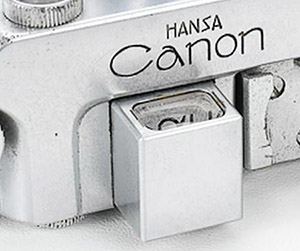
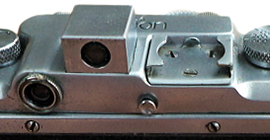
(Detail from larger web images)
The circular plug in the middle of the back is to assist with infinity focus adjustment when matching lens to body accomplished with adding or subtracting shims under the lens mount. It is found on all early bodies before the 1946 Canon S II (Leica also used this system until the early 1930s before they were able to adopt a standard back focus).
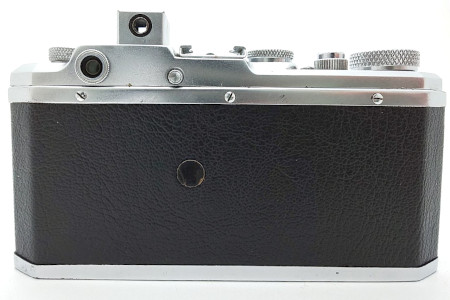 (Web image)
Most examples feature an accessory shoe with curved cutouts on the side rails but late examples, including the three Originals in my database, feature straight rails with pressure depressions inherited from the new Canon S:
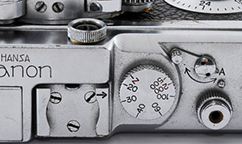
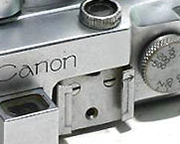 (Web images)
There were several iterations of the rewind release lever over time; the earliest was a basic lever to which a pointer was added to later (hard to see in the photos) and finally, “A-R” was engraved on the top plate:
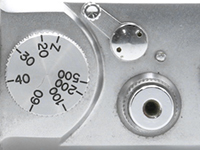
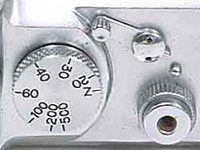
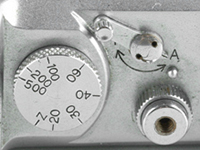
(Web images)
Note also that the earliest example on the left features a different shutter button collar; whereas later ones are simply ribbed for their full height, earlier ones featured a plain tapered base. As with the Kwanon designs, the shutter buttons feature a cable release thread which would disappear with the Canon S and not return until the 1956 Canon VT.
The shutter dial shared the Kwanon's Leica II speed progression markings: Z, 20, 30, 40, 60, 100, 200 and 500 (with “B” for “bulb” replacing the German “Z” for “zeit” starting with the 1946 S II and 20-1 used if fitted with slow speeds, it would remain the main dial progression until the Canon III).
Shutter Evolution
The bottom of the shutter crate started with a typical Leica II type flat spring and plain appearance but by maybe a third way through production, looked like a Leica III type, only missing the slow speeds retard rod flat spring (and the slow speeds mechanism inside). Kannonji Makoto explains that during production, Canon had already started development of a version with slow speeds, which would become the Canon S, and the necessary changes were slowly incorporated into the Hansa Canon. It probably made sense to have one shutter type which could be configured as required.
It probably also made it easier for slow speeds to be added later. In his book and monograph, “The Contax Connection”, Peter Dechert tells the story of Kōgaku Seiki-sha (Optics & Precision Co.), the future Nicca, which was an official Canon repair agency established in 1940 by eight former employees of Seiki Kogaku at the behest of Omiya Photo Supply. An ad in the June 1941 Asahi Camera magazine says that the company can install slow speed shutter dials in older Canons without them, presumably the Hansa Canon. Peter Dechert knew of one remaining example. This one, with mount number 853, came up for sale in 2023 and according to Hayato Ueyama, was once owned by the son of Seiki Kogaku founder, Saburo Uchida, so it could be either an in-house conversion, or one by Kogaku Seiki, however, another one in Ueyama's book, mount number 659, seems to have definitely been made inhouse:
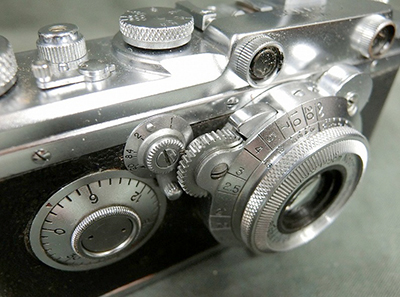 (Web image)
As expected, the shutter is fitted with a typical slow speeds flat spring (I've cranked up the levels to be able to see it). The top of the cylinderical pin in the disc which interacts with it is clearly visible (relevant to discussion below and Kwanon D Replica above):
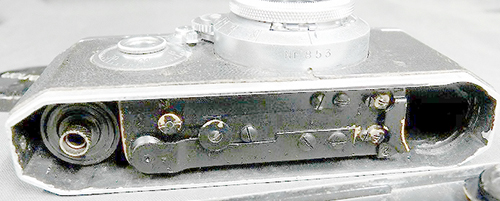 (Web image)
Peter Dechert suggests that the shutter below is the earliest type, which makes sense because it looks like the Leica II type and that was the starting point. In his book, he has photos of an example with mount number 127 and first type body shell (see further below). The flat spring has no cutouts, there is no disc and there are fewer screws. There are two examples in my database, the first with mount number 19x (BP 123x), this one is 20x (BP 202x):
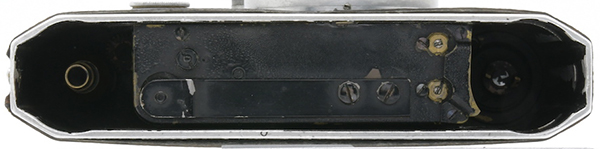
This is actually the earliest, by mount number, Hansa Canon in my database with the shutter crate visible, number 15x (BP 116x). The flat spring has its cutouts already and there is a blanked off hole in preparation for the disc spindle but the pair of screws on the top right in later cameras is still missing:
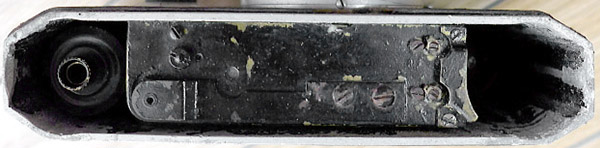
The last type without the disc, now featuring the pair of screws at the top right which on the Canon S will secure the slow speeds retard rod flat spring. This is mount number 43x (BP 238x), the last of this type in my database has mount number 62x (BP 240x):
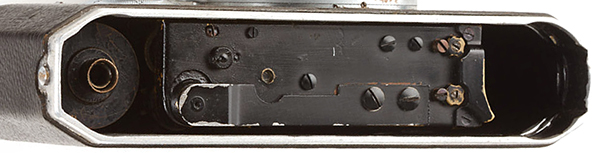
Finally, the transformation was complete. Dechert refers to the disk as a “flywheel”, however, on models with slow speeds, it has been identified as an “opening curtain cam”, a pin on the underside interacting with a hump on the slow speeds retard rod flat spring (see example with slow speeds above):
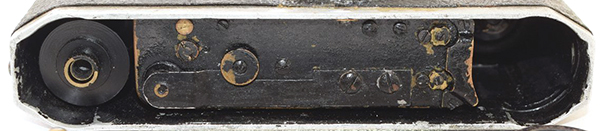
(Above are web images)
Body Shell Construction
Note, all the body shells above feature a “formed” construction, pressed from aluminium sheet metal and machined as required. This continued until die-casting was introduced post-War midway through Canon S II production. However, Peter Dechert notes on page 34 of his book, “a handful of Hansas (vide 127) was even made within body shells designed for the Kwanon” (“vide 127” referring to body shell with mount 127). On page 23, he clarifies this, in respect to 127, with “shell that seems to have been milled or die cast.” In addition to 127, I have seen partial images of the same type body shells with mount numbers 6x and 8x posted by someone on a forum, 8x shown below (either the first or second shutter type above):
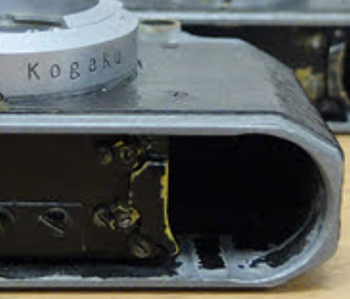 (Web image)
I have always been extremely dubious about the claims of milling, presumably from a solid billet, or die casting, an expensive process to set up and most suited to volume production. However, both Kannonji Makoto and Hayato Ueyama explain that these early bodies were sand cast and machined. Ueyama features such a body in his book, mount number 68 (shutter detail and wear is different to 6x mentioned above, i.e. different cameras). They note that sand casting is economical and well suited for prototypes and low volume production. Rather than being made for the Kwanon per se, Makoto also believes that all bodies were sand cast whilst limited production was based at the small workshop at Roppongi and only changed to the formed process with the move to the Meguro facility in June 1936 and the start of mass production. Dechert believes production started with mount 55 (Ueyama agrees), number 127 is 73 cameras on so at around 10 cameras production per month, that timeline is quite feasible. Makoto also claims that casting, pressing and plating were performed by subcontractors, Seiki Kogaku performing the machining, finishing and assembly.
Base Plates
The early base plates fitted to cameras up to mount 194, BP 1232, in my database feature a central tripod socket and blanked off indentation where the Kwanon's second magazine opening key would have been. In practice, this was a better design for use but perhaps more costly to make. Both Makoto and Ueyama believe the change was influenced by the development of the slow shutter, see above. Below are inside and outside views of first centre socket base plates and a later offset socket version, note standard 3/8” European thread of all examples (two cameras from near the end of production have Canon S style base plates, it is not known whether they are original or not). The key for most Hansa Canon examples (and following models to about 1946) base plate locks is designed so that it can only fold in one direction, but it seems that the very earliest examples of the centre tripod socket type featured the more common Leica style two way type - I've seen three (none in Peter Dechert's book), one of them is this base plate, number 1175 (camera mount number 113):
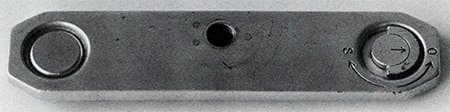
(Example from page 13, Camera Collectors' News, May 1982)
Later centre tripod socket:
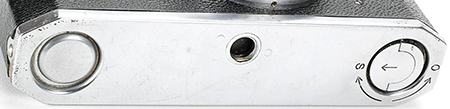
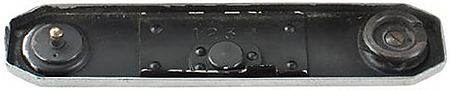
Offset tripod socket:
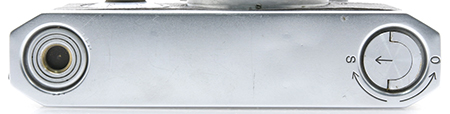
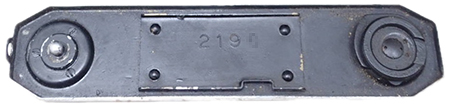 (Web images)
Note, the rectangular diversion in the side of the channel which is to clear the screw and tab for securing the shutter crate to the body - it's no longer there on the Canon S:
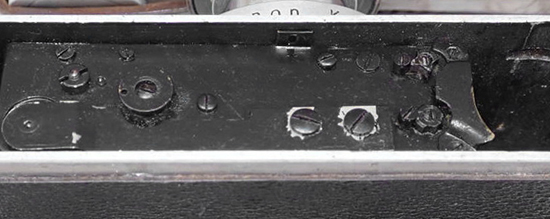 (Web image)
Nikkor Lenses
Approximately the first half of Hansa Canon cameras in my database feature a 50 mm Nikkor f/3.5 lens with “black face” with the aperture ring on the front:
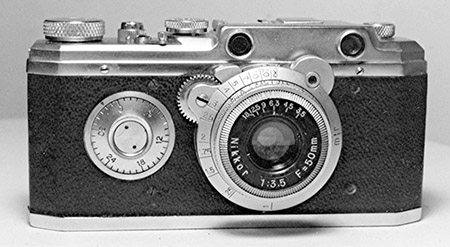 (Web image)
About the time that the Nippon Kogaku name disappeared from the mounts, these were replaced by a similar design 5 cm “white face” lens followed by the later Nikkor f/3.5 design on the right with outer aperture ring viewable from above (only fitted to some Hansa examples at the end of production):
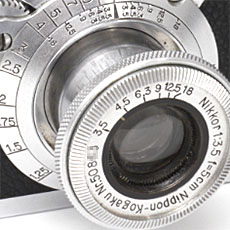
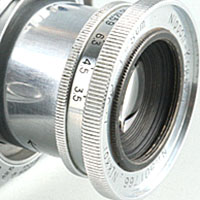 (Detail from larger web images)
Earlier lenses were nickel plated, later ones chrome (Peter Dechert says from serial number 50540 onward).
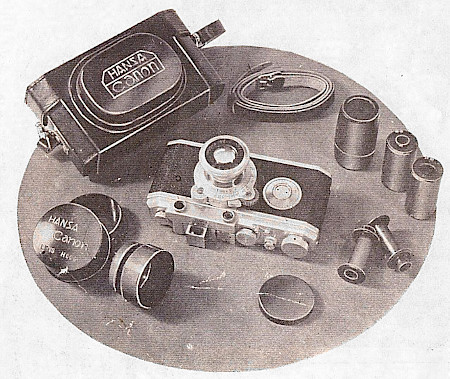
Hansa Canon Kit
The items in the period Hansa Canon brochure are separately priced but some, or all, would have been included in the box. The camera with lens was priced at ¥275 with the lens ¥100 if sold separately:
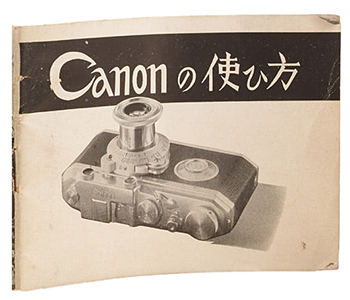
The “How to Use Canon” booklet found with several examples:
Pre-War Catalogues
Below is a 1936 Omiya Photo Supply catalogue (previously linked from the Japanese website https://w.atwiki.jp/saltysugar/pages/28.html, but the downloads from that site itself are no longer working). The covers and first 7 pages of content of the 78 page catalogue feature a very early version of the Hansa Canon with recessed viewfinder platform, first type shutter collar and rewind release lever and two way magazine/lock key:
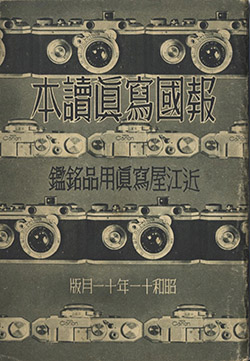
(Click on cover for PDF download)
Note, whilst the commonly used Google translate app insists that the edition date on the cover is “year 10, month 10”, i.e. October 1935 (10 Showa = 1935), Canon camera collector and Japanese speaker Todd Belcher, has confirmed that it is fact “year 11, month 11”, i.e. the November 1936 edition (Todd says the app is reading the “10” but not the character for “1” which together make 11). This is consistent with Hayato Ueyama's book (slightly ambiguous because of three different covers shown) and the download site for the year.
Another catalogue on the site published by what seems like a store called Saneido, with the main store in Kanda, Tokyo, lists the Hansa Canon for ¥275, Leica Standard (without rangefinder) for ¥420, Leica III for ¥580, Contax (Contax I) for ¥600 and Contax II for ¥970, all with their basic f/3.5 lenses. On face value, the Hansa Canon was more than price competitive, but a very big negative compared to the German system cameras was that were no other focal length lenses offered for its unique mount, and wouldn't be for over 10 years, and accessories would also remain limited over that time.
Canon S
Production (Peter Dechert) |
Marketed (Canon) |
Slow
Dial |
Main Dial
|
Sync |
S/Timer |
1938/10-1945 |
1939/04 |
1-8, 20 |
Z, 20-1, 30-500 |
No |
No |
Serial Numbers |
||
Source |
From |
To |
| Peter Dechert | 10520 |
12500 |
| Found | 1055x |
1218x |
| Lens Mount: Bayonet in J mount focusing unit | |||
| Normal 50mm Lens (Peter Dechert): Nikkor f/2, f/2.8 or f/3.5, Canon adds f/4.5 | |||
| Found with Lens: | |||
| Lens | Description | Serial Numbers |
|
|---|---|---|---|
From |
To |
||
| Nikkor f/2 | Rigid | 502x |
5043x |
| Regno-Nikkor f/2 | Rigid | 5044x |
|
| Regno-Nikkor f/2 | Rigid | 140015A |
|
| Nikkor f/2.8 | Collapsible. White face | 5030x |
5015x |
| Nikkor f/3.5 | Collapsible | 50130x |
50223x |
| Nikkor f/4.5 | Collapsible. White face | 5018x |
5022x |
As noted earlier, Seiki Kogaku originally called this camera “Canon Newest Model”. When the Hansa Canon ended production, the new camera took over the mantle of “Canon Standard Model”, which was abbreviated to “Canon S” after the War (see also Canon NS which is known as the “New Standard Model”).
The Canon S updated the Hansa Canon design in order to implement the slow speeds introduced by the Leica III. The move of the film counter to the top deck under the film wind knob was made to provide more room for the slow speed dial whilst reducing complexity and assembly time, but necessitated a redesign of the full width top deck. A simplified, more Leica-like design was adopted which further reduced the work required. Due to the proximity of the toothed focusing wheel, a low profile slow shutter dial was used with a crank to make operation easier. A “normal” slow shutter dial located further away from the mount had apparently been trialled at the prototype stage but introduced unnecessary complexities and cost.
Peter Dechert says that production commenced in October 1938 but according to Hayato Ueyama, in one part of his book he says it was announced in November 1938 with only a prototype available, in another, in October 1938, but he claims that the production version with the slow shutter dial crank wasn't ready until 1939 which aligns more closely with Canon's “marketed” date of April 1939.
New f/2 and f/2.8 Nikkor 5 cm lenses were offered in addition to the existing f/3.5. Found in smaller numbers, there was also an f/4.5, originally developed for the Canon J model. The f/2 Nikkor was a 6 element Zeiss Sonnar design. Very early examples feature a front set aperture with a smallest stop of f/22, note the 4 digit serial number:
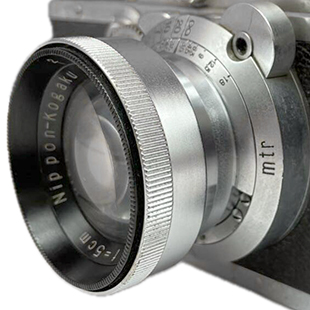
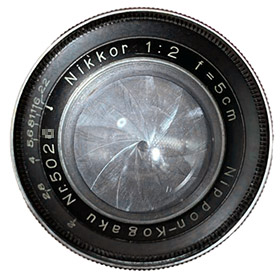 (Web images)
However, most feature an external aperture ring and minimum aperture of f/16. Additionally, there was also the uncommon f/2 Regno-Nikkor which has a minimum aperture of f/11 and was originally intended for use with X-Ray cameras, but due to War-time shortages, some were fitted to the Canon S bayonet mount barrels.
Surprisingly, Hayato Ueyama also claims that an f/1.5 lens was advertised. Earlier in his book, he matter of factly refers to the Nikkor f/1.5 several times in relation to X-ray camera development. I can find no other references anywhere to such a pre-War/War-time lens but I have wondered about the absence of a 5 cm f/1.5 Regno-Nikkor (for X-ray cameras) when f/1.5 seems to have been the preferred aperture size (at the start of the development of Japanese indirect X-ray photography, 20 f/1.5 Zeiss Sonnars were said to have been imported via submarine and there was Seiki Kogaku's own later f/1.5 R-Serenar). Of course, the lens may have just been an aspiration, Nippon Kogaku's role for the Japanese military machine was far more important than “wasting” resources on domestic camera lenses and maybe even X-ray camera lenses, other than its f/2 version. A mystery.
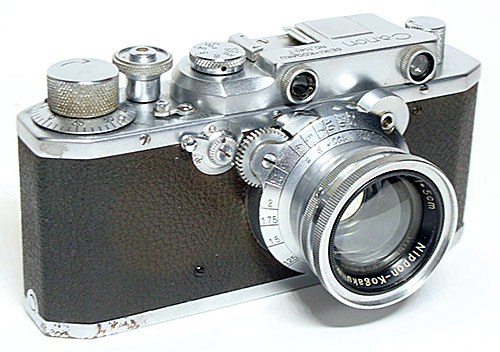
Canon S with later type standard Nikkor f/2 mounted (note, the tall mushroom shaped shutter guard is an accessory and features a new button with cable release thread - the same type is fitted to four Canon S examples and one JS in my database and also the Canon S II example on the Canon Camera Museum webpage):
 (Web image)
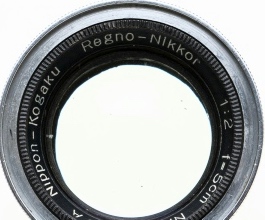
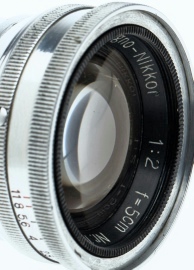
(Detail from larger web images)
Nikkor f/2.8:
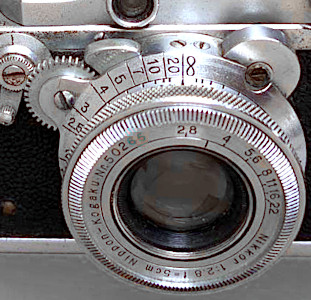 (Web image)
The base plate now looks more like later base plates but several things will change by the early 1950s. The lift-up “D” shaped locking key inherited from the Hansa Canon can still only lay flat in one direction and it wouldn't be until the Canon S II that the it could pivot down either way. It also features a European 3/8” tripod socket with the 1/4” socket first appearing on the Canon S II and becoming the most common type on II Bs. Also, the “S-O” dialogue will change to “Open-Close” with the Canon III:
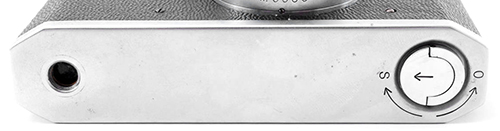 (Web image)
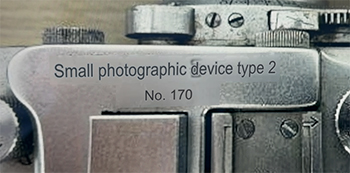
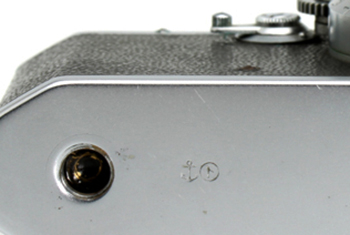
According to Peter Dechert, a very small batch of Canon S cameras was made with Imperial Japanese Navy markings in about 1942. They have their own serial numbers, those known to him were from 111 to 126, serial numbers that have surfaced more recently are 143, 167 and 170. Most/all were fitted with the Nikkor f/2 lens. Number 170 below, the mount number is 2540:
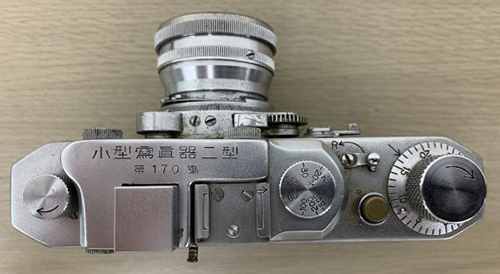 (Japanese auction photo)
Google app translated text, “Small Photographic Device Type 2 No 170”:
This is the base plate of another example, the anchor and other marking are also believed to be typical:
There is a belief that has been repeated in several places that these were made for use on Japanese submarines. As most were destroyed during the War, it is said that it would explain the small number of these cameras found. However, given the small number made, the War-time military environment and the circumstances of Japan's defeat, the fact that a number have surfaced (excuse the pun) suggests to me that there is nothing out of the ordinary about the ratio of found cameras to the total made. I suspect that they were more widely used for observation and intelligence purposes.
Canon J
Production (Peter Dechert) |
Marketed (Canon) |
Slow
Dial |
Main Dial
|
Sync |
S/Timer |
1939/01-1941+ |
1939/04 |
None |
Z, 20-500 |
No |
No |
Serial Numbers |
||
Source |
From |
To |
| Peter Dechert | 1700 |
2125 |
| Found | 1707 |
204x |
| Lens Mount: J | |||
| Normal 50mm Lens (Peter Dechert): Nikkor f/4.5, some late Js with f/3.5 | |||
| Found with Lens: | |||
| Lens | Description | Serial Numbers |
|
|---|---|---|---|
From |
To |
||
| Nikkor f/3.5 | Collapsible | 50185x |
50222x |
| Nikkor f/4.5 | Collapsible. White face | 501x |
50364 |
The pre-War introduced models following the Hansa Canon continued to be different from Leica because of patent concerns. However, in Leica Standard fashion, the 1939 budget model Canon J without slow speeds also omitted the rangefinder, thus eliminating the need for the expensive Nikon focusing mount to avoid infringing Leica patents for the lens connection to the rangefinder and instead used the 39 mm 24 TPI screw mount directly in Leica fashion, but of course not being Leica compatible. This was referred to as the “J mount” and also used immediately post-War. The pop-up viewfinder of the earlier models was replaced by a simpler built-in more Leica-like type but with the top cover featuring a squared-off end next to the rewind lever to allow for its larger diameter than the more typical S model type. The lens was typically a Nikkor f/4.5 but when Nippon Kogaku ceased production of this later in the War, a few late examples were fitted with the Nikkor f/3.5 in a J mount barrel. Early example with f/4.5 lens:
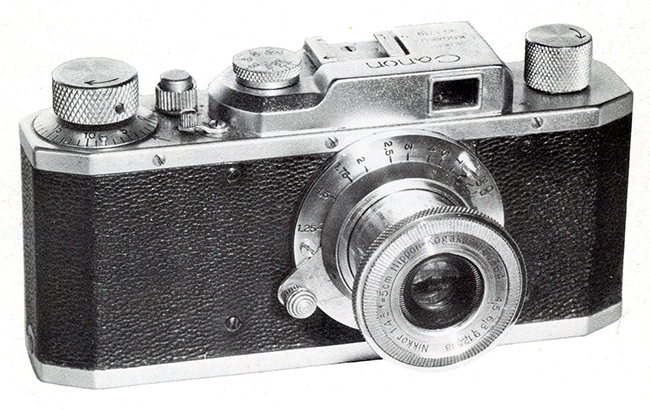
(Mikio Awano's 1719 from the cover of Camera Collectors' News, see below)
Seiki Kogaku initially called this the “Popular Model”. According to Peter Dechert, some early orders referred to it as the “Junior” Canon but after the War, the abbreviation “J” stuck.
Mikio Awano (introduced in Links to the Good Stuff) wrote an article in the December 1977 edition of Camera Collectors' News about the three J models (J, JS, and J II). Even though he thinks that a military order may have been involved, the J model was well promoted in the marketplace. He included two short introductory articles to the camera, the first which appeared in the March 1939 edition of Asahi Camera and the second in an April 1939 magazine, the name of which translates as Photo Hokoku, and also the large ad below from the April 1939 Asahi Camera Spring Special Edition. To make sense of it, I have added translations of the main elements:
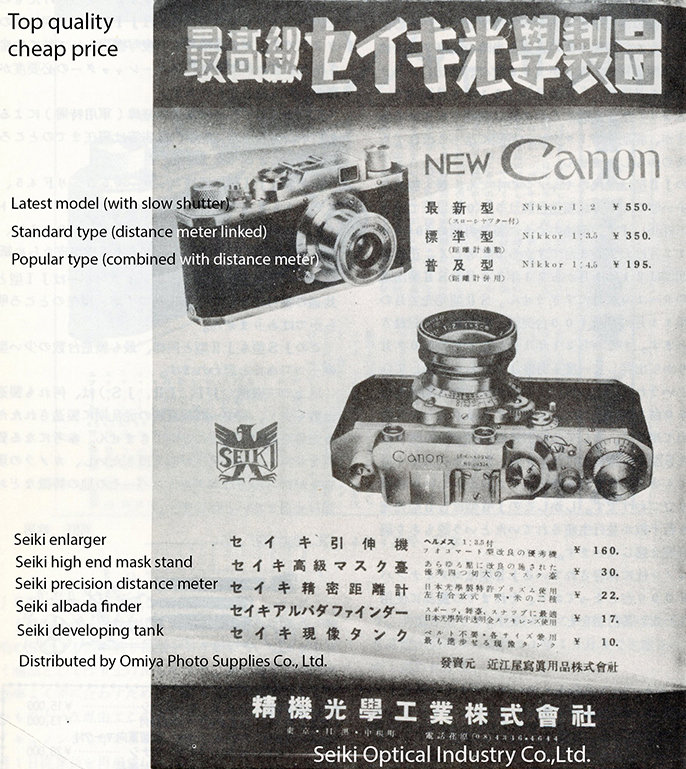
The price of the Canon J was almost half that of the Standard Model and one third of the Newest Model. Lower in the ad, Seiki Kogaku was willing to sell you an accessory (non-coupled) rangefinder for 22 yen. Note, the ad confusingly refers to “Popular type (combined with distance meter)” - was the accessory rangefinder included, was it just that the rangefinder was available, or is it the translation? With an f/4.5 lens, simply using the distance scale on the lens would be good enough for many use cases. Nevertheless, it was not a successful model with production probably of no more than a few hundred and after 1941, small numbers may have been made for military purposes only.
The example below has a fitting mounted that suggests that it may have been used as copy camera during the War.
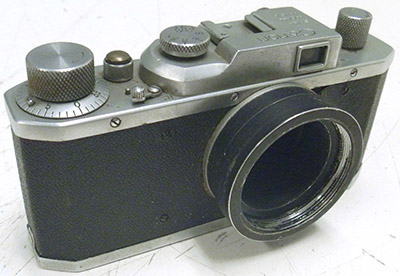
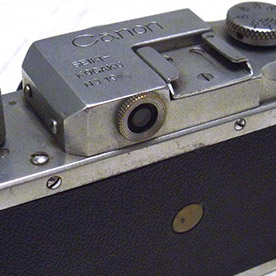
(Web images)
Canon NS
Production (Peter Dechert) |
Marketed (Canon) |
Slow
Dial |
Main Dial
|
Sync |
S/Timer |
1940/01-1942 |
1939/11 |
None |
Z, 20-500 |
No |
No |
Serial Numbers |
||
Source |
From |
To |
| Peter Dechert | 10800 |
11900 |
| Found | 1079x |
1156x |
| Lens Mount: Bayonet in J mount focusing unit | |||
| Normal 50mm Lens (Peter Dechert): Nikkor f/3.5 or f/4.5 | |||
| Found with Lens: | |||
| Lens | Description | Serial Numbers |
|
|---|---|---|---|
From |
To |
||
| Nikkor f/3.5 | Collapsible | 50138x |
50157x |
| Nikkor f/4.5 | Collapsible. White face | 503x |
|
| Nikkor f/4.5 | Collapsible. White face | 5025x |
5050x |
The Canon NS is a Canon S without the slow speed mechanism, or dial, and was to be a replacement for the Hansa Canon. According to Canon, it was introduced when the tax rate was significantly increased to support military expansion as war clouds were gathering, but wasn't a commercial success. According to Peter Dechert, advertisements described it as “Canon new standard model without slow speeds” and that “NS”, abbreviating “New Standard”, is a “recent suggestion”. He thinks that approximately 100 were made, as does Canon claim. According to Dechert, most were supplied with the f/4.5 lens, Canon says “Nikkor 50mm f/3.5 and others” and my database is 50% f/4.5 and 50% f/3.5. This one is the f/3.5:
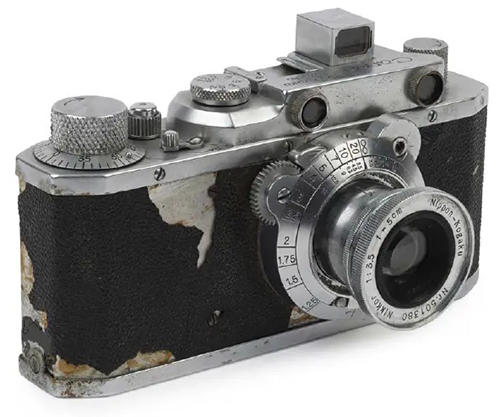 (Michaels' auction photo)
And this one is the f/4.5:
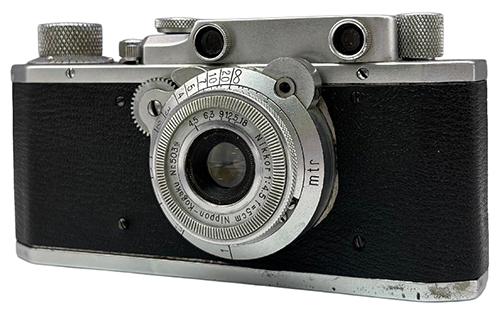 (Web image)
Canon JS
Production (Peter Dechert) |
Marketed (Canon) |
Slow
Dial |
Main Dial
|
Sync |
S/Timer |
circa 1941 |
1939? |
1-8, 20 |
Z, 20-1, 30-500 |
No |
No |
Serial Numbers |
||
Source |
From |
To |
| Peter Dechert | 1900 |
2130 |
| Found | 196x |
210x |
| Lens Mount: J | |||
| Normal 50mm Lens (Peter Dechert): Nikkor f/4.5 | |||
| Found with Lens: | |||
| Lens | Description | Serial Numbers |
|
|---|---|---|---|
From |
To |
||
| R-Serenar f/1.5 | Rigid | 303x |
|
| Nikkor f/4.5 | Collapsible. White face | 5044 |
50118 |
The Canon JS is a Canon J with added slow speed mechanism and dial. According to the Canon Camera Museum, it was intended for close-ups, photomicrography, astrophotography and other special applications which required slow shutter speeds and didn't benefit from the rangefinder of the S model. Canon claims that it was released pre-War, Peter Dechert says that it was never advertised and thinks that it was mainly War-time production for the Japanese Army as a possible copy camera. He believes that no more than 50 were made. Mikio Awano is of a similar opinion.
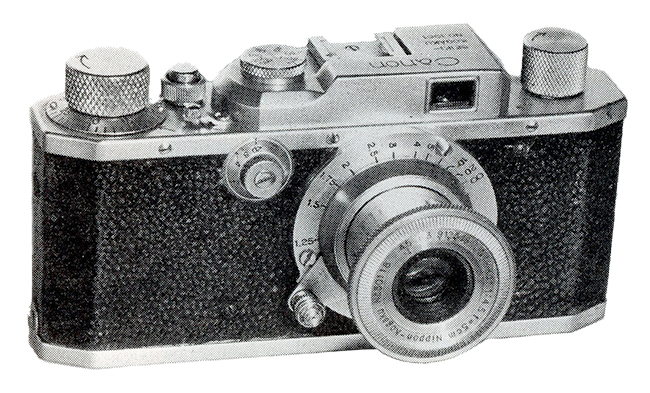
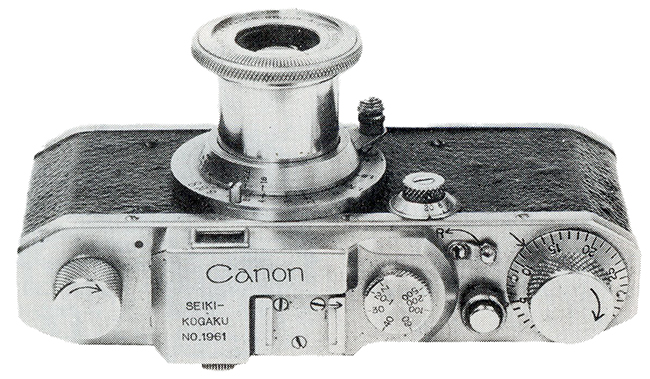
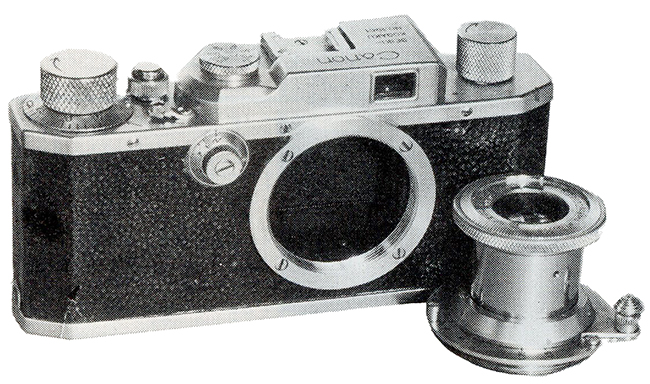
(Images are of Mikio Awano's No. 1961, from his December 1977 Camera Collectors' News article)
Peter Dechert also mentions JS examples found with the R-Serenar 5cm f/1.5 X-ray camera lens rehoused in J mount focusing barrels with diaphragms. Whilst most of these lenses were renamed “Serenar”, this unloved one retains its “R-Serenar” name:
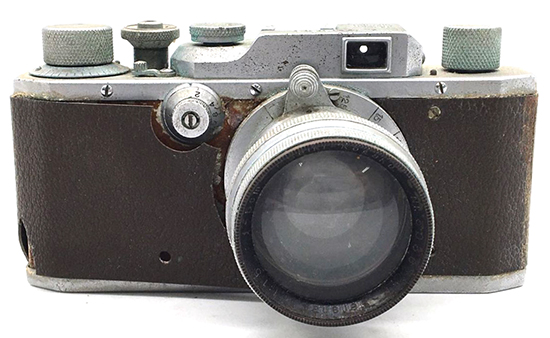
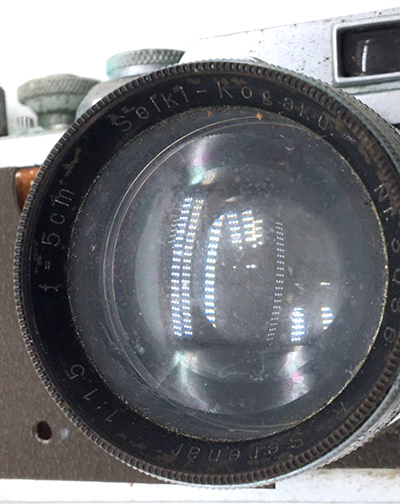
(Web images)
Hayato Ueyama was told that this version was intended for reconnaissance aircraft but has seen actual evidence of them being fitted out for oscilloscope photography. Either, or both, could be correct. See Serenar Lenses.
Canon J II
Production (Peter Dechert) |
Marketed (Canon) |
Slow
Dial |
Main Dial
|
Sync |
S/Timer |
1945/12-1946/11 |
1946/01 |
None |
Z, 20-500 |
No |
No |
Serial Numbers |
||
Source |
From |
To |
| Peter Dechert | 8000 |
8700 |
| Found | 803x |
856x |
| Lens Mount: J (early) & modified J (late) | |||
| Normal 50mm Lens (Peter Dechert): Nikkor f/3.5, a few with Serenar f/3.5 | |||
| Found with Lens: | |||
| Lens | Description | Serial Numbers |
|
|---|---|---|---|
From |
To |
||
| Nikkor f/3.5 | Collapsible | 50199x |
50223x |
| Nikkor f/3.5 | Collapsible | 5707x |
7041x |
| Nikkor f/3.5 | Collapsible | 46020x |
46021x |
| Serenar f/3.5 | Collapsible. Seiki Kogaku | 801x |
811x |
In order to get production going again, the post-War Canon J II featured the Canon J specs using mainly Canon S parts. This initially used up War-time parts stocks and were easiest and quickest to assemble into saleable cameras. The slow speed mechanism and dial were omitted and a plate with three screws was mounted over the hole for the dial. The viewfinder/rangefinder housing used the model S blank with the end wrapping around the smaller diameter S rewind knob.
The supplied lens was typically the Nikkor 5 cm f/3.5 (the f/4.5 had been discontinued earlier in the War) but according to Peter Kitchingman, it seems that some early Serenar f/3.5 lenses may have been made for the J mount from as early as December 1945. These were already range finder coupled, apparently in preparation for their implementation on future bodies.
In his December 1977 Camera Collectors' News article, Mikio Awano quotes from two articles which state that Seiki Kogaku reorganised its workforce on 1 October 1945 and restarted production with a total of 156 employees with sales restarting in December. In the beginning, production was very slow with only three J II cameras completed by the end of 1945. Production continued until November 1946. According to Peter Dechert, Canon records indicate 506 were made but other lists suggest only 164 completed.
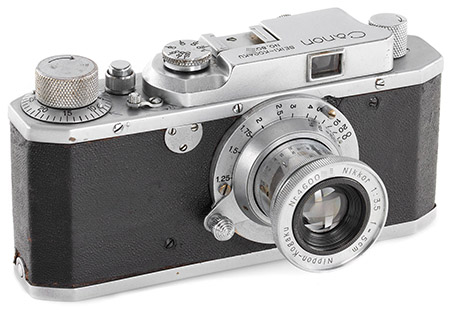 (Web image)
Because of the pop-up viewfinder, the Canon S had the maker name and serial number next to the model name. The Canon J on the other hand featured the shortened squared-off viewfinder/rangefinder housing without pop-up viewfinder and therefore the maker name and serial number moved to under the model name. With the model S housing, the J II reverted to the side-by-side layout up to somewhere between serial numbers 8078 and 8158 (see above photo) after which the details moved to below the name:
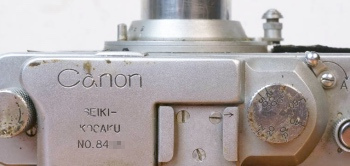 (Web image)
Canon S I
Production (Peter Dechert) |
Marketed (Canon) |
Slow
Dial |
Main Dial
|
Sync |
S/Timer |
1945/12-1946/11 |
1946/01 |
1-8, 20 |
Z, 20-1, 30-500 |
No |
No |
Serial Numbers |
||
Source |
From |
To |
| Peter Dechert | 12386 |
14160 |
| Found | 12412 |
14133 |
(Note: Camera serial number 12386 is the first S I produced but it is an arbitrary start point, as explained below, there could be lower numbered S I examples and higher numbered S examples)
| Lens Mount: Bayonet in J mount focusing unit | |||
| Normal 50mm Lens (Peter Dechert): Nikkor f/3.5 | |||
| Found with Lens: | |||
| Lens | Description | Serial Numbers |
|
|---|---|---|---|
From |
To |
||
| Regno-Nikkor f/2 | Rigid | 141130 |
141159A |
| Nikkor f/2.8 | Collapsible. White face | 50210 |
|
| Nikkor f/3.5 | Collapsible | 502187 |
502258 |
| Nikkor f/3.5 | Collapsible | 570530 |
|
The Canon S I is the Canon S produced after the War at the same time as the Canon J II. However, unlike the J II, at first glance, it may appear to be physically identical to late War-time production and much the same as when released. According to both Canon and Hayato Ueyama, there was little, if any, of it made post-War, the S I was simply assembled from leftover pre-War and War-time parts and Ueyama notes that because parts were pre-numbered, it is difficult to identify where a model precisely belongs. According to Peter Dechert, Canon's records indicate that camera 12386 was the first S made after the War, but given that cameras weren't assembled in strict numerical order in the best of times, there is nothing to say whether subsequent serial numbers belonged to earlier, or later made examples and conversely, whether some lower serial numbers weren't assembled after 12386.
Generally, examples of the S I model weren't the best quality, e.g. some of the parts had previously been rejected, then because leather was difficult to come by, many, but not all bodies, featured a paper based covering instead and the chrome plating didn't meet the standards achieved pre-War. Some parts from the coming S II, like the new plain accessory shoe and base plate with new two way key have been found on at least one late example, 14133, featured on the Canon Historical Society Facebook page by collector Martin Bacardi (also has the paper based covering). Whilst it has been suggested that the best way to identify an S I is by comparing it to a known earlier made S, some of the quality issues probably beset late War-time production as well.
Peter Dechert says that “S I” was Seiki Kogaku's name for the model but these days, the Canon Camera Museum is a little more ambivalent, referring to it as simply “S”, followed by 1946, on the model chart whilst clicking on it brings up the detailed description with the “S I” model name. According to Canon's records, 97 made. Ueyama notes that any Nikkor f/2 lens fitted to these cameras was likely to be the Regno variety.
Canon S II
Production (Peter Dechert) |
Marketed (Canon) |
Slow
Dial |
Main Dial
|
Sync |
S/Timer |
1946/10-1949/06 |
1946/10 |
1-8, 20 |
B, 20-1, 30-500 |
No |
No |
(Main shutter dial is marked B, 20-1, 30, 40, 60, 100, 200 and 500)
Serial Numbers |
||
Source |
From |
To |
| Peter Dechert | 15000 |
23375 |
| Found | 1504x |
2362x |
| Lens Mount: Semi-universal (some J & experimental mounts) | |||
| Normal 50mm Lens: (Peter Dechert): Serenar f/2, f/3.5 or Nikkor f/3.5 |
|||
| Found with Lens: | |||
| Lens | Description | Serial Numbers |
|
|---|---|---|---|
From |
To |
||
| f/2 Serenar | Collapsible. Seiki Kogaku | 20003 |
2010x |
| f/2 Serenar | Collapsible. Canon Camera Co. | 2023x |
2156x |
| f/3.5 Serenar | Collapsible. Seiki Kogaku | 812x |
921x |
| f/3.5 Serenar | Collapsible. Canon Camera Co. | 961x |
1343x |
| f/3.5 Serenar | Collapsible. Canon Camera Co. | 8325x |
8347x |
| f/3.5 Nikkor | Collapsible | 57079x |
57101x |
| f/3.5 Nikkor | Collapsible | 610x |
|
| f/3.5 Nikkor | Collapsible | 6107x |
6108x |
| f/3.5 Nikkor | Collapsible | 70540x |
|
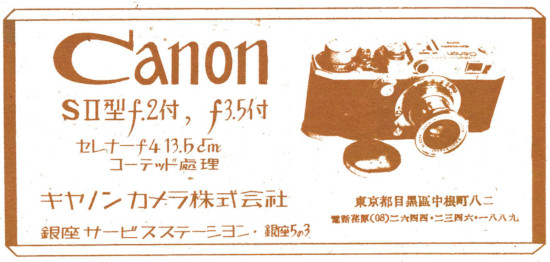
The first post-War designed model was the Canon S II released in October 1946. Ad from Camera times of 20 December 1947, by then the first accessory lens, the 135 mm f/4, had also been released and the maker name had changed to Canon Camera Co., Ltd.:
According to Hayato Ueyama, the prototype was completed in November 1945. Hidehiko Taguchi, who had recently transferred from Nippon Kogaku and had lead the design, described it as “the post-war model J with a rangefinder and slow shutter”. The S II featured Seiki Kogaku's first major innovation - the rangefinder and viewfinder were combined and there was a single viewfinder window. It was also the first Seiki Kogaku designed and manufactured rangefinder. However, with a short 38.5 mm rangefinder base length and 0.6x magnification giving an EBL of 23.1 mm, it was less than ideal from an accuracy viewpoint.
There was a small number of early Canon S II examples with the J lens mount but most featured the new “semi-universal” thread which is somewhere between the J mount's 24 and Leica's 26 TPI and would accept both J mount and most Leica lenses as well (see Semi-universal Mount).
This example is probably from 1948, almost exactly halfway through the production run and from after the two major updates experienced by this model, the maker name change and body construction:
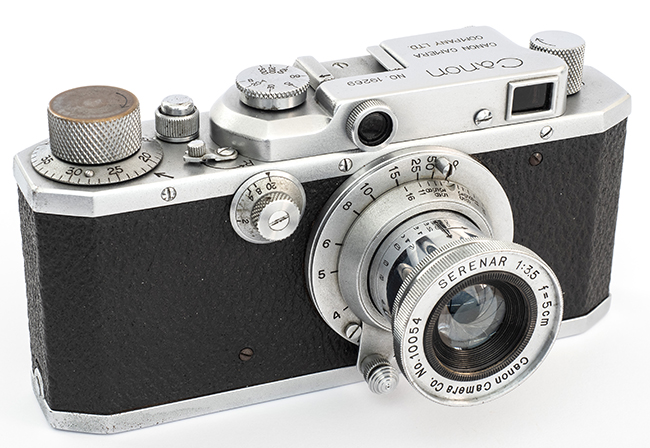
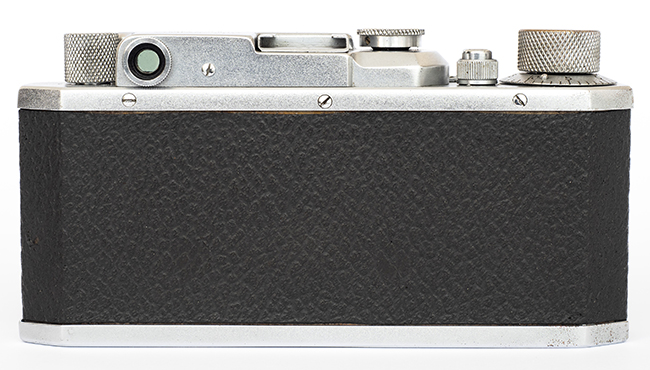
This was the first Canon model without the focus adjustment plug in the camera's back, although some early ones still have a hole in the pressure plate, probably remaining parts from earlier models:
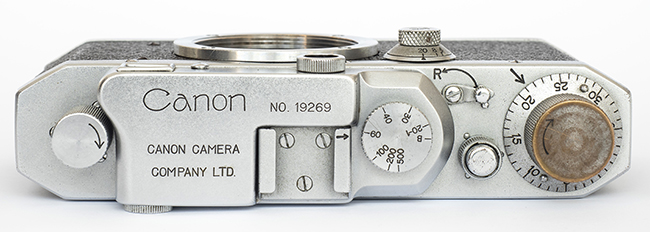
The top view is a typical Leica III layout. The accessory shoe side rails have lost the pressure depressions first introduced by the model S and as mentioned, this example already features the later maker name:
From now on, the base plate features a locking key that can fold flat in either direction, last seen on very early Hansa Canon examples and also some J II examples (perhaps borrowing from early S II production). As far as I am aware, until now, the tripod sockets had been the European standard 3/8”, as this one, but 1/4” started to appear with later production.:
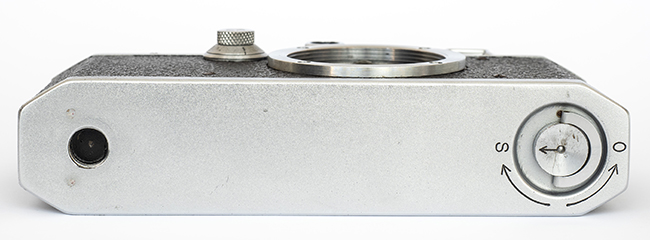
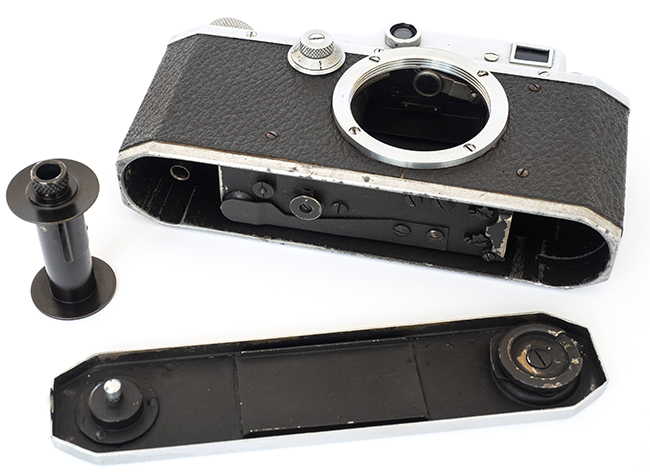
The other major change during production was the introduction of a stronger and more accurate die-cast body shell. Just slightly later, the four blind rivets securing the channel section inside the bottom plate (see further below) were replaced by non-mechanical attachment means (perhaps brazed?):
Maker Name Change
The company name officially changed on 15 September 1947. Generally speaking, until somewhere between serial numbers 1685x and 1693x according to my database, the maker name marked on the camera was “Seiki-Kogaku Tokyo” after which it became “Canon Camera Company Ltd.” However, there are also 4 earlier examples in my database with the Canon maker name mixed in between Seiki Kogaku named cameras, with serial numbers 1561x to 1595x, followed by another 14 cameras still with the Seiki Kogaku name. Hayato Ueyama explains that this happened because the company outsourced engraving to a number of subcontractors and some were quick and some were slow to return the top covers:
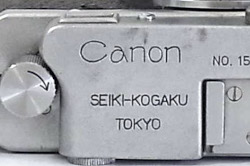
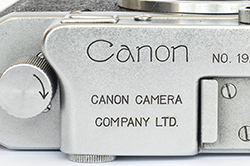
(Left detail from larger web image)
Body Shell
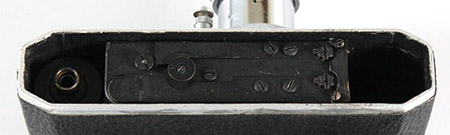
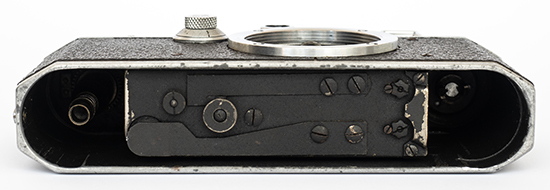
Between camera 1746x and 1784x, Canon changed construction of the body shells from forming to shape to the more accurate and stronger die-casting. Formed body on top with even thin thickness all around, note also the base plate channel section secured by four blind rivets, die-cast below with cylindrical internal ends, angular on the outside:
(Web image)
MIOJ and <CPO> Mark
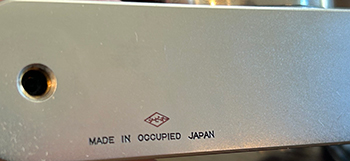
In my database, there is the occasional base plate marked “Made in Occupied Japan” (MIOJ) beginning with serial number 1624x and becoming increasingly common until by 2021x, all have the marking:
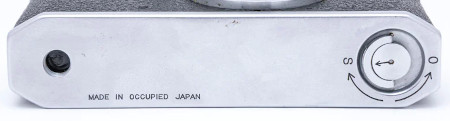
(Web image)
A few late 1948 cameras also feature the <CPO> mark before changing to the <シーピーオー> version in early 1949 (see B II example).
Lenses
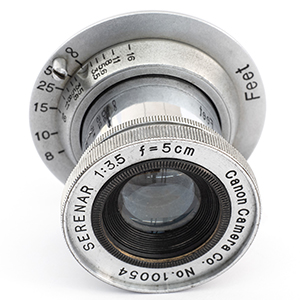
As in the ad further above, the usually supplied lenses were the new Seiki Kogaku Serenars (rebranded from Seiki Kogaku to Canon in October 1947), the f/3.5 (based on then current Nikkor Tessar design) and slightly later released f/2 5 cm (a Gauss based design quite different to the Nikkor Sonnar type), but early on, there were still some Nikkor f/3.5 lenses too. Canon branded f/3.5 Serenar on left, f/2 on right:
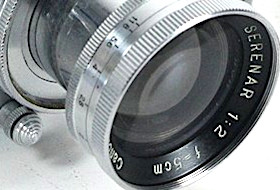
(Web image on right)
Canon S II with coated Nikkor f/3.5 5 cm lens from the October 1946 batch:
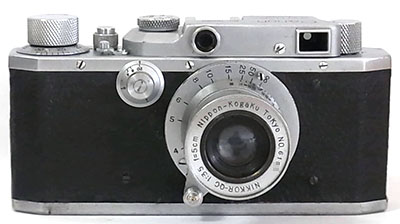 (Web image)
Shutter Dial Markings
Before the S II, the main shutter dial had featured the German “Z” marking for bulb, now changing to “B”. Most S II examples are marked “B” but the four earliest examples in my database, the last being 1527x, plus a couple of random later ones, are still marked “Z”. Also, late camera, 2207x, and the last four S II examples in my database, 23335x, 2343x, 2360x and 2362x have the “20-1” marked on the main dial, the “20” on the slow speed dial and the “0” on the frame counter picked out in red, like the following II B. “Z” version found on some early examples, typical all black “B” version found on most S II examples in middle, red infill on main dial example on right:
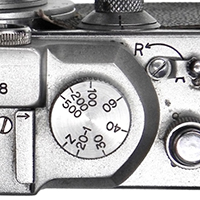
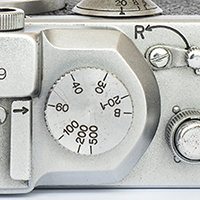
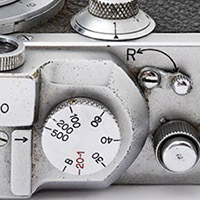
(Left and right detail from larger web images)
Canon II B
Production (Peter Dechert) |
Marketed (Canon) |
Slow
Dial |
Main Dial |
Sync |
S/Timer |
1949/01-1952/07 |
1949/04 |
1-8, 20 |
B, 20-1, 30-500 |
No |
No |
Serial Numbers |
||
Source |
From |
To |
| Peter Dechert | 21050 |
42400 |
| Found | 25002 |
4184x |
(Note: Dechert's 21050 is a prototype, he doesn't mention the first production cameras but the range is likely to start with 25000)
| Lens Mount: Semi-universal (maybe some late Universal ones) | |||
| Normal 50mm Lens (Peter Dechert): Serenar f/1.9 or f/3.5 |
|||
| Found with Lens: | |||
| Lens | Description | Serial Numbers |
|
|---|---|---|---|
From |
To |
||
| f/1.9 Serenar | Collapsible. Canon Camera Co. | 2094x |
3937x |
| f/3.5 Serenar | Collapsible. Canon Camera Co. | 1187x |
1505x |
The real innovation and major success came with the next model, the 1949 Canon II B (initially called the S IIb), which cleverly used a rotating prism to add three level magnification to the viewfinder of the S II. 1950 II B 33603 with early features:

The most commonly supplied lens was the new f/1.9 5 cm, basically a recomputed version of the f/2 released for the Canon S II, although the Serenar f/3.5 remained as a budget alternative. The f/1.9 lens ushered in the change to millimetre markings but the first f/3.5 lenses fitted to early S II examples used up the last of the centimetre marked stock.
Strap lugs were also added for the first time:


A new four screw accessory shoe with springs replaced earlier models' plain 3 screw type and the “20-1” marking on the main shutter dial, the “20” on the slow speed dial and the “0” on the frame counter were given a red infill instead of the uniform black numerals (hard to see on some examples, particularly earliest):

The 1.5x magnification provides the most accurate focusing and the approximate view of a 135 mm lens, the 1x magnification provides the approximate view of a 100 mm lens and the F position equates to 0.67x magnification and provides the view of a 50 mm normal lens:

In 1950, somewhere between serial numbers 35000 and 37000 in my database (Peter Dechert narrows it down to around 36000), Canon introduced a process to darken the natural alloy around the bottom lip of the body shell. After years of use, the difference is subtle in some photos, one of the reasons that I am not prepared to narrow the range. Natural 1950 body 33603 on bottom, darkened 1952 body 41005 on top:

Earlier Canon II B base plate, serial number 26256, with both MIOJ marking and red katakana version of the CPO mark, <シーピーオー>:
 (Image courtesy of Mohsen Saade)
The last Canon in my database with the CPO mark is II B 2936x. From between serial numbers 3894x and 3933x onward, base plates were no longer marked MIOJ (introduced with the Canon S II). Most Canon II B examples feature the 1/4” tripod socket rather than the earlier 3/8”:
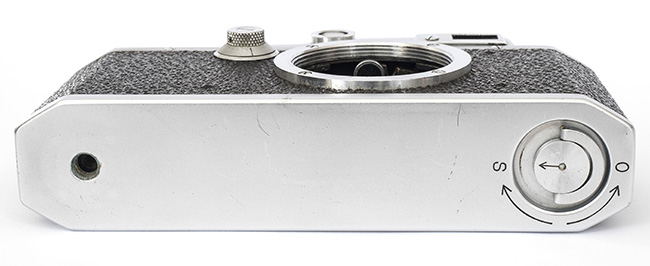
A minor change during production was that the screw in the rear of the viewfinder/rangefinder housing lined up with the screw below it in the top plate in cameras before 3966x, as in the camera above, and in front below, and lined up with the centre of the accessory shoe in later cameras after 3972x, as in the late camera below. The change was introduced by the new Canon III and IV and reflected the fact that even though there were still stocks of some older parts for the II B to use up, other parts were shared amongst models and hence updated:

The earliest found standard Canon II B is Peter Kitchingman's 25015, however, there is also Canon's early testbed, serial number 25002, used for developing rail mount synchro flash which debuted on the Canon IV-1950 trial series. The rail looks like the final item, the sync mechanism under the cover plate is familiar but different in detail to the Canon IV-1950 and later iterations. It also features unique strap lugs. In addition to its normal markings it is marked “Exp Model” on top between the “Canon” name and “Canon Camera”, presumably meaning “Experimental Model”. On the back edge of the top plate is marked “設.試.C.8”. The owner, Herbert Schlicker, translates the kanji text as “design and test”, Google translate suggests both “establishment trial” and “setup and tested”, another translator goes with “facilities.trial”. In any case, the characters are identical to those on a Serenar 50mm f/1.4 prototype lens made before being released as an f/1.5 lens and sold at Leitz Auction no. 46 (see Serenar Lenses). The Leitz Auction text translation is “Test Sample”. More on this camera, including a comparison of the sync mechanism with later models, can be found on the Facebook page of the Canon Historical Society.
Canon 1950 (trial series Canon III & IV)
Production (Peter Dechert) |
Marketed (Canon) |
Slow
Dial |
Main Dial
|
Sync* |
S/Timer |
1950/07-1950/10 |
T, 1-8, 25 |
B, 25-1, 40-1000 |
M/FP |
No |
(*Sync: Slow speed sync at 1/8 and below is for M class and other peak type bulbs as well as FP, high speed sync is for FP bulbs at 1/25 and above)
Serial Numbers |
||
Source |
From |
To |
| Peter Dechert | 50000 |
50199 |
| Found | 5005x |
5017x |
| Lens Mount: Semi-universal | |||
| Normal 50mm Lens (Peter Dechert): Serenar f/1.9 |
|||
| Found with Lens: | |||
| Lens | Description | Serial Numbers |
|
|---|---|---|---|
From |
To |
||
| f/1.9 Serenar | Collapsible | 2592x |
3873x |
The “Canon 1950”, 1950 being the year of its appearance, is the name given to the trial series of the Canon IV, which was later discovered to also include Canon III cameras. They shared all the important new features including a new shutter with 1/1000 top speed, a cross over speed of 1/25 instead of the old 1/20 and a “T” for Time setting for the first time. The shutter included a flash synchronisation mechanism for flashbulbs on the IV version, a first for Canon, and a side mounting rail with direct “hot shoe” type connection. There was also a new rewind release mechanism mounted on a raised platform.
Although Canon documents suggest the facility commenced with Canon III serial numbers, the take-up shaft on the bottom of the shutter crate was notched to allow use of the newly developed Canon Rapid Winder baseplate patterned on the Leitz Leicavit.
Like the Canon 7sZ, the Canon 1950 name is another Peter Dechert invention. In his book, he was aware that it was a trial series for the forthcoming Canon IV with flash sync. He thought that most of the 50 or so examples produced were shipped to new US importer, C. R. Skinner Manufacturing Co., for sale. He also believed that Canon confusingly called the camera Canon II C before reusing the name for a later unsynced model. The II C camera and new Flash Unit X are pictured in a C. R. Skinner ad in the February 1951 edition of US magazine, Photography.
However, in a 2006 article for Shutterbug, he updated his understanding as a result of what he had learnt since 1984. Production had been higher than 50 and probably closer to the 200 suggested by the serial numbers. Around 50 had been sent to C. R. Skinner for sale but some had been kept by Canon, presumably for further testing and marketing purposes (also used for some of the photos in the subsequent user manuals) and some had been issued to experienced photographers for evaluation. Also, some of the cameras were unsynced but had most of the new features and therefore appeared to be trial versions of the Canon III (their serial numbers appear to be at the end of the 200 number range). In this context, he considered the “Canon 1950” name a mistake and proposed three separate names “Canon IV-1950” (for testing and evaluation cameras), “Skinner Canon IV-1950” and “Canon III-1950”.
Also, rather than Canon naming the cameras Canon II C, he now believed that in the absence of any guidance from Canon, Skinner had given its allocation that name as the camera followed the II B.
There were some minor, mainly cosmetic variations in this period but by and large, the cameras are hard to tell apart from the following Canon III and IV except for their serial numbers and maker names. According to Peter Dechert, the 1950 models still feature “Canon Camera Company, Ltd.” on the viewfinder/rangefinder housing, except for the last few, whilst the Canon III and IV examples reflect the early 1951 change to “Canon Camera Co., Inc.” One of the “last few” Canon III-1950 examples (note the serial number 5019x) with the updated maker name:
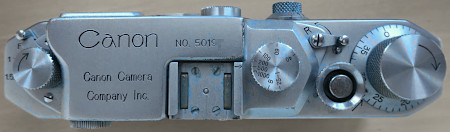 (Detail from larger web image)
The Skinner Canon IV-1950 models featured a base plate marked: “MADE IN OCCUPIED JAPAN/SERVICED AND GUARANTEED IN SAN FRANCISCO CALIFORNIA”.
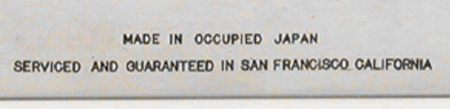 (Detail from Peter Dechert's 2006 Shutterbug article)
Canon III
Production (Peter Dechert) |
Marketed (Canon) |
Slow
Dial |
Main Dial
|
Sync |
S/Timer |
1951/02-1952/12 |
1951/02 |
T, 1-8, 25 |
B, 25-1, 40-1000 |
No |
No |
Serial Numbers |
||
Source |
From |
To |
| Peter Dechert | 50200 |
81850 |
| Found | 5060x |
8102x |
| Lens Mount: Semi-universal (maybe some late Universal ones) | |||
| Normal 50mm Lens (Peter Dechert): Serenar f/1.9 or f/3.5 |
|||
| Found with Lens: | |||
| Lens | Description | Serial Numbers |
|
|---|---|---|---|
From |
To |
||
| f/1.9 Serenar | Collapsible | 3706x |
4894x |
The Canon III was an improved II B, the main change being the new shutter with 1/1000 speed, 1/25 cross over and T setting on the slow dial with the marked speeds now:
Front Dial: T, 1, 2, 4, 8 and 25
Main Dial: B, 25-1, 40, 60, 100, 200, 500 and 1000
It also added the ability to use the new Rapid Winder baseplate with a notch added to the take up spindle to connect to the lug on the Rapid Winder (later model with finer leatherette pattern pictured):
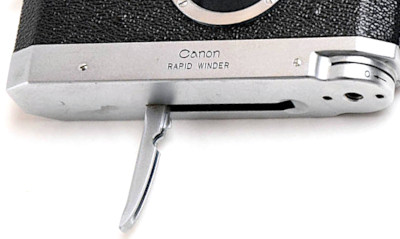 (Detail from larger web image)
A revised body shell for all new models featured a groove near the bottom of the shell from under the lens mount to where the flash sync connector would be installed on sync'd models. This was to enable the wiring to be installed under the leatherette. On non-sync'd models, like the Canon III, the groove and hole for the flash sync fitting was filled with a white grout (badly corroded Canon II D pictured):
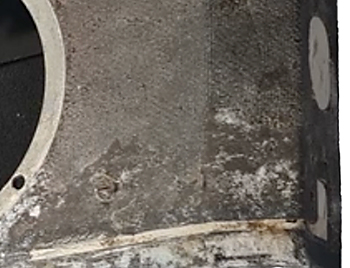 (Web image)
The new shutter was given a bottom cover plate for the first time allowing a warning label about the length of the the film leader to be included. As well as tidying things up, its main purpose was to protect the sync components of sync'd models. The body shell lip was also given a black finish instead of the dark grey of the II B:
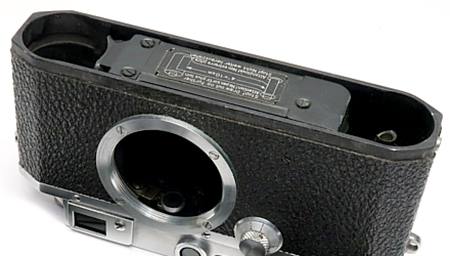 (Web image)
It also introduced the revised maker name, the earlier “Canon Camera Ltd.” becoming “Canon Camera Company Inc.” The well received Canon film take-up spool with spring loaded pop-up grip arrived shortly after release and was later copied by Leica (see IV Sb model). Early Canon III, note also the new raised platform under the rewind release lever and new mushroom shaped shutter collar. Whilst it can be unscrewed as before, it doesn't need to be for Canon Self-timers up to III, or other self-timers and cable releases using a Leica style connector, or “Leica nipple”:
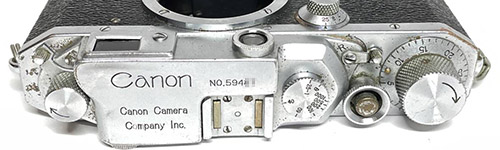 (Detail from larger web image)
Late Canon III, note “Japan” and red dot film plane mark added under the maker name (they didn't arrive at the same time). For a period of maybe 12 months or less, a few cameras were also marked “Made in Japan” on the base plate. This one still has two of the three features that separate the III from the later III-A; the old style knurling on the film wind and rewind knobs and no film reminder, but it does have the new type magnification lever of the III-A. Peter Dechert calls these transition cameras “hybrids”. With these, the mix of parts can involve any of the three variables, deciding which model it is depends on majority rule:
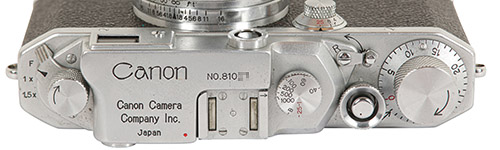 (Detail from larger web image)
With the Canon III, the base plate lock/magazine key dialogue changed from the previous “S-O” to “Open-Close”. This example also features “Made in Japan” whilst the late camera itself has the new “Japan” marking on the top plate (but not red dot film plane mark yet) even though it is not one of the hybrids:
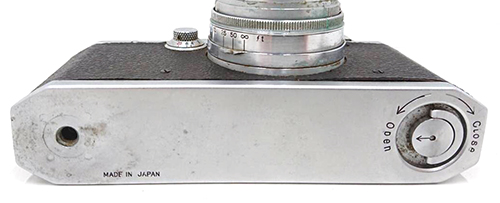
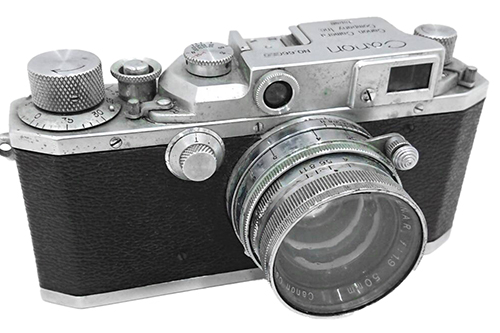 (Web images)
Canon II-C
Production (Peter Dechert) |
Marketed (Canon) |
Slow
Dial |
Main Dial
|
Sync |
S/Timer |
1951/03-1951/08 |
1950/07 |
T, 1-8, 25 |
B, 25-1, 40-500 |
No |
No |
Serial Numbers |
||
Source |
From |
To |
| Peter Dechert | 50200 |
57850 |
| Found | 5029x |
5550x |
| Lens Mount: Semi-universal | |||
| Normal 50mm Lens (Peter Dechert): Serenar f/1.9 or f/3.5 |
|||
| Found with Lens: | |||
| Lens | Description | Serial Numbers |
|
|---|---|---|---|
From |
To |
||
| f/1.9 Serenar | Collapsible | 3969x |
3984x |
The Canon II-C was the economy version of the Canon III, only differing from it by having a shutter top speed of 1/500. It makes sense that according to Peter Dechert, production started in March 1951, one month after the III. However, the Canon Camera Museum tells a different story. It claims that the II-C was “marketed” in July 1950, some 8 months before the III, and that the improvements over the II B were incorporated into subsequent models:
“Based on the II B, this camera had a T time exposure setting (pressing the shutter button once started the exposure and pressing it again stopped it) and slow shutter speed dial with click stops to prevent inadvertent rotation. The two shutter speed dials were split at 1/25 sec. The shutter release guard was larger for easier shutter button depressing. (These features were retained in later models.)”
In fact, Canon claims that the Canon III is an “improved version of the Canon II-C” and that “the III had a shutter curtain which remained at a fixed position even after the film was advanced”. I'm dubious of the Canon story, the II-C and III share the same start to their serial number ranges, and hence probably similar release times, and the early release of the II-C also doesn't fit what we know about the Canon III and IV trial series, Peter Dechert's “Canon 1950”. However, there isn't enough evidence to confidently decide one way, or the other. More interestingly, Canon claims that the optical performance of the II-C's 50 mm f/1.9 Serenar was improved - whether that was introduced on the II-C or III is immaterial, it would have applied to all future production. This is what Canon has to say:
“Although the fast Serenar 50mm f/1.9 lens which came with the II B was well received, people noticed lackluster performance at the maximum aperture. This was caused by the coma characteristic of Gauss-type lenses. Hiroshi Ito, who just joined the company, worked to improve the lens. He succeeded with a correction method that reduced the coma. Canon continued to employ him for lens design.”
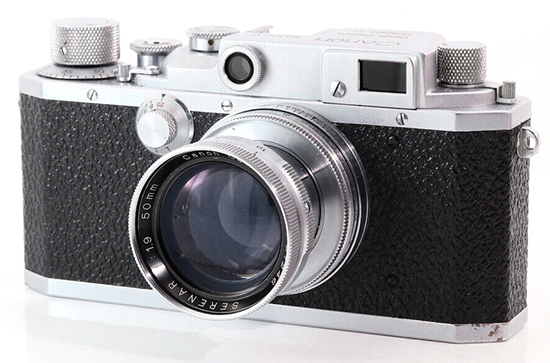
With the II B continuing in production, the similar specs meant that there was little appetite to pay a premium for the improved model with new shutter and production only lasted 5 months with 800 made. The II-C improvements over the II B are the 1/25 cross over speed, the raised platform for the release lever and the mushroom shaped shutter button surround (it's similar to the later II-D but that has the die-cast shutter crate and the giveaway revised knurling on the knobs and one piece magnification lever):
 (Web image)
Peter Dechert tells us that many II-Cs featured 3/8" tripod sockets with expectation of European sales. I have found some, but probably more 1/4” types. It may have been the 3/8” socket's last appearance.
Canon IV
Production (Peter Dechert) |
Marketed (Canon) |
Slow
Dial |
Main Dial
|
Sync* |
S/Timer |
1951/04-1952/04 |
1951/04 |
T, 1-8, 25 |
B, 25-1, 40-1000 |
M/FP |
No |
(*Sync: Slow speed sync at 1/8 and below is for M class and other peak type bulbs as well as FP, high speed sync is for FP bulbs at 1/25 and above)
Serial Numbers |
||
Source |
From |
To |
| Peter Dechert | 51270 |
67825 |
| Found | 5124x |
6112x |
| Lens Mount: Semi-universal (maybe some late Universal ones) | |||
| Normal 50mm Lens (Peter Dechert): Serenar f/1.9 |
|||
| Found with Lens: | |||
| Lens | Description | Serial Numbers |
|
|---|---|---|---|
From |
To |
||
| f/1.9 Serenar | Collapsible | 3475x |
4697x |
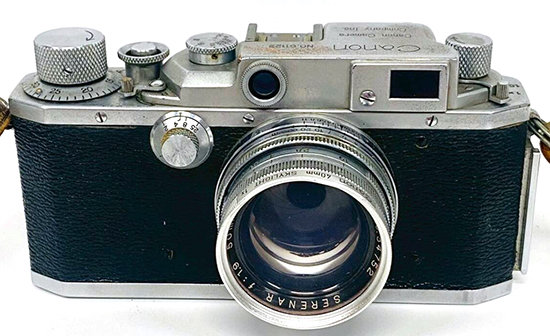
The Canon IV was the flash sync version of the Canon III, the pair being issued as a limited trial series in 1950 before its formal release in 1951. Whilst it already looks similar to later flash sync'd models, it still has the first type magnifier lever and no film type reminder:
 (Web image)
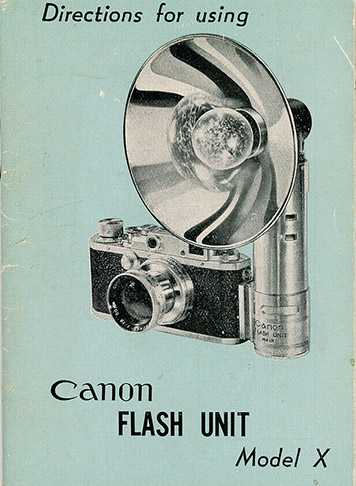
The flash sync mechanism was for flashbulbs only and operated via a contact in the side rail used for mounting the flashgun. Its companion flash unit was the Flash Unit X, the centrepiece of a comprehensive flash system. Canon IV and flash unit on cover of instruction manual:
 (Web image)
Note: In early 1953, US sales agent, Balfour, Guthrie & Co., Ltd., announced a free conversion of Canon IV cameras to IV-S2, i.e. adding zero second advance for electronic flash. A few months later, there was a second announcement that the temporary arrangement had been replaced by “a new official Canon Service Agency”, Professional Camera Repair Service. Undoubtedly, some Canon IV, IV-F and IV-S cameras have been converted. Presumably, these will now have slow speed shutter dial with “X” position.
Canon III-A
Production (Peter Dechert) |
Marketed (Canon) |
Slow
Dial |
Main Dial
|
Sync |
S/Timer |
1951/12-1953/09 |
1951/04 |
T, 1-8, 25 |
B, 25-1, 40-1000 |
No |
No |
Serial Numbers |
||
Source |
From |
To |
| Peter Dechert | 61150 |
105800 |
| Found | 6372x |
8973x |
| Lens Mount: Universal | |||
| Normal 50mm Lens (Peter Dechert): Serenar f/1.8 or f/3.5 |
|||
| Found with Lens: | |||
| Lens | Description | Serial Numbers |
|
|---|---|---|---|
From |
To |
||
| f/1.8 Serenar | Rigid | 6223x |
7965x |
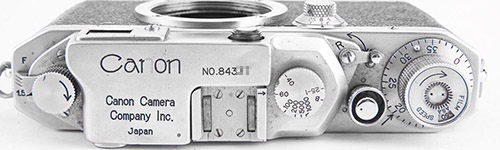
At first appearance, the Canon III-A is largely a cosmetic update of the Canon III with new knurling on the film wind and rewind knobs, film speed reminder in the top of the film winding knob and new single piece magnification lever:
 (Detail from larger web image)
Other changes that occurred during its life include the addition early on of “Japan” to the viewfinder/rangefinder cover (already there on late Canon III examples), the addition of a red dot to the right of “Japan” to indicate the film plane, a new high speed shutter dial with clearer numbers and significantly, a new die-cast shutter crate. Previously fabricated from a number of different parts, the die-cast version made assembly easier whilst improving rigidity and uniformity of production.
There is a significant discrepancy between Peter Dechert's claimed production dates and Canon's marketing, or release, dates, Peter Dechert claiming production started in December 1951, same as for the IV F, and Canon saying that the marketing date was April 1951, some 6 months before the production date but also 9 months before the IV F was released. Without access to Canon's records, there is no way to confirm one way or the other, however, whilst Peter Dechert says that the III-A and IV-F jointly introduced the universal lens mount, it may be that it came to the III-A once the IV-F was launched. That is the safe view I am taking but it may not be correct. In fact, although many examples have had their lenses removed, all found ones with lenses in my database came with the new Serenar f/1.8 which adds support to Peter Dechert's chronology as does the fact that the III-A and IV-F share the English language user manual (see below).
A small number of Canon III-A cameras have base plates marked “U.S. Army. Signal Corps”.
Canon IV-F
Production (Peter Dechert) |
Marketed (Canon) |
Slow
Dial |
Main Dial
|
Sync* |
S/Timer |
1951/12-1952/08 |
1952/01 |
T, 1-8, 25 |
B, 25-1, 40-1000 |
M/FP |
No |
(*Sync: Slow speed sync at 1/8 and below is for M class and other peak type bulbs as well as FP, high speed sync is for FP bulbs at 1/25 and above)
Serial Numbers |
||
Source |
From |
To |
| Peter Dechert | 52610 |
69000 |
| Found | 6458x |
70149 |
| Lens Mount: Universal | |||
| Normal 50mm Lens (Peter Dechert): Serenar f/1.8 |
|||
| Found with Lens: | |||
| Lens | Description | Serial Numbers |
|
|---|---|---|---|
From |
To |
||
| f/1.8 Serenar | Rigid | 5158x |
6609x |
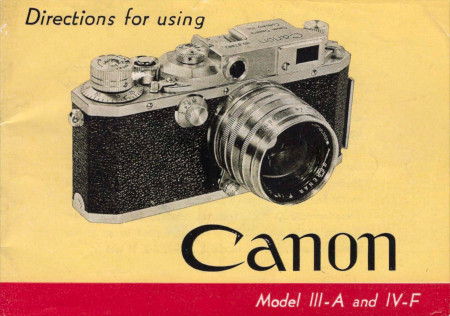
The Canon Camera Museum ignores the IV-F as a model and simply notes that the IV-F was renamed IV-S. Peter Dechert says that is also how Canon recorded production details. Below is the cover of the user manual for Canon III-A and IV-F models:
The Canon IV-F brought the same improvements to the IV model as the Canon III-A brought to the III model including new knurling on knobs, new magnification lever and film speed reminder:
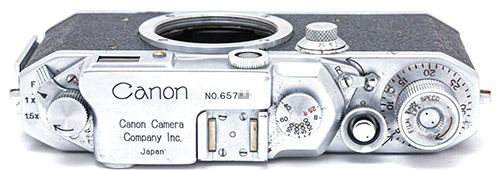
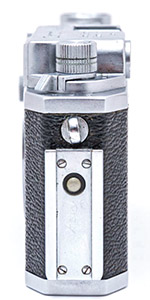
(Web images)
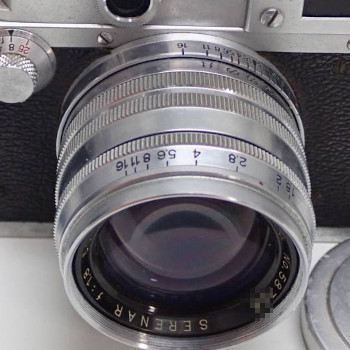
However, the biggest and most important news was that the Canon IV-F (perhaps shared with the III-A) was released with Canon's “universal” lens mount - Canon was finally fully Leica Thread Mount compatible. This came with a new matching lens, the highly regarded rigid f/1.8 50 mm Serenar:
 (Detail from larger web image)
All subsequent bodies (and later III-A examples at least, all according to Peter Dechert) featured the universal mount but given stocks of lenses in other aperture and focal length sizes, some may have not changed until renamed “Canon” or were discontinued first.
However, unlike with the Canon III-A, the introduction of the die-cast shutter crate resulted in a new model designation, Canon IV-S. The IV-F and IV-S are impossible to tell apart in most photos. Peter Dechert wrote that IV-F topped out at serial number 69000 but that the IV-S started at 64000, so quite a long transition period as old stock was used up. Knowledgeable collector Greg Harp has written to me to confirm that his camera, with serial number 70149, still definitely has the early shutter crate, i.e. it is an IV-F, so that extends the found IV-F range upward.
Note: Some US sold items may have been converted to include X synch, see Canon IV above.
Canon II-A
Production (Peter Dechert) |
Marketed (Canon) |
Slow
Dial |
Main Dial
|
Sync |
S/Timer |
1952/03-1952/09 |
1952/03 |
None |
B, 25-500 |
No |
No |
Serial Numbers |
||
Source |
From |
To |
| Peter Dechert | 64255 |
73500 |
| Found | 6731x |
7031x |
| Lens Mount: Universal | |||
| Normal 50mm Lens (Peter Dechert): Serenar f/3.5 |
|||
| Found with Lens: | |||
| Lens | Description | Serial Numbers |
|
|---|---|---|---|
From |
To |
||
| f/3.5 Serenar | Collapsible | 1507x |
|
According to Peter Dechert, produced a month earlier than the IV-S, the II-A is a III-A without slow speeds, the dial hole covered by a leatherette covered blank. Like the IV-F, it still features the earlier fabricated shutter crate. It was apparently ordered by distributor, Jardine Matheson Co., which only accepted partial delivery. Perhaps 99 made. Note the serial number of the 50mm f/3.5 Serenar lens found with the camera below (also listed in the table above) is of the correct Peter Kitchingman Type 6 version but is from about 4 months after the body was made, i.e. it may, or may not, be original:
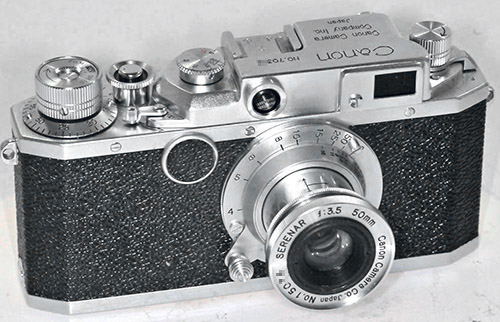 (Web image)
Canon IV-S
Production (Peter Dechert) |
Marketed (Canon) |
Slow
Dial |
Main Dial
|
Sync* |
S/Timer |
1952/04-1953/05 |
T, 1-8, 25 |
B, 25-1, 40-1000 |
M/FP |
No |
(*Sync: Slow speed sync at 1/8 and below is for M class and other peak type bulbs as well as FP, high speed sync is for FP bulbs at 1/25 and above)
Serial Numbers |
||
Source |
From |
To |
| Peter Dechert | 64000 |
85000 |
| Found | 6921x |
76801 |
| Lens Mount: Universal | |||
| Normal 50mm Lens (Peter Dechert): Serenar f/1.8 |
|||
| Found with Lens: | |||
| Lens | Description | Serial Numbers |
|
|---|---|---|---|
From |
To |
||
| f/1.8 Serenar | Rigid | 6438x |
6834x |
The only change from the Canon IV-F was the introduction of the die-cast shutter crate. Peter Dechert explains Canon's reason for the name change as being driven by the realisation that “4-F” meant “unfit for service” in US military parlance, a problem with Canon aggressively marketing to US military personnel. Cover of later Canon III-A and now IV-S user manual, note the typographical mistake, “VI-S”:
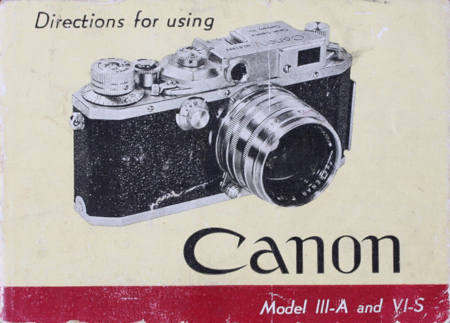
Note: Some US sold items may have been converted to include X synch, see Canon IV above.
Canon II-D
Production (Peter Dechert) |
Marketed (Canon) |
Slow
Dial |
Main Dial
|
Sync |
S/Timer |
1952/08-1955/02 |
1952/10 |
T, 1-8, 25 |
B, 25-1, 40-500 |
No |
No |
Serial Numbers |
||
Source |
From |
To |
| Peter Dechert | 64020 |
160150 |
| Found | 7624x |
15954x |
| Lens Mount: Universal | |||
| Normal 50mm Lens (Peter Dechert): Serenar/Canon f/1.8, f/2.8 or f/3.5 |
|||
| Found with Lens: | |||
| Lens | Description | Serial Numbers |
|
|---|---|---|---|
From |
To |
||
| f/1.8 Serenar | Rigid | 7323x |
|
| f/1.8 Canon | Chrome | 7780x |
13038x |
| f/3.5 Serenar | Collapsible | 1036x |
1233x |
| f/3.5 Canon | Collapsible | 2081x |
2357x |
Budget version of the unsynced Canon III-A with top shutter speed reduced from 1/1000 to 1/500 and no film reminder. Lens name changed from “Serenar” to “Canon” during production (with introduction of IV-Sb):
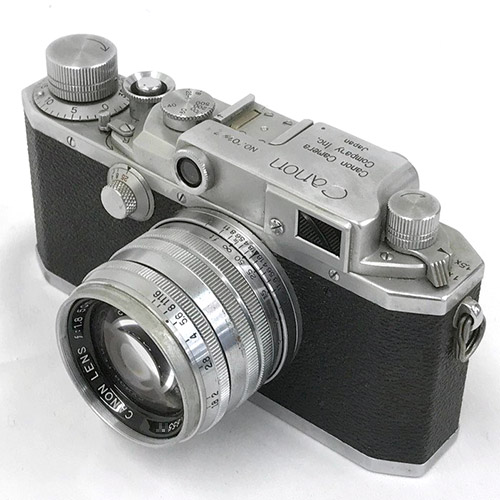 (Web image)
From between serial number 11399x and 11498x onward, the model name was marked on the film loading diagram on the bottom of the shutter crate (see Canon II-F).
The II-D didn't get its own user manual, it shares the IV-S2 manual (see IV-Sb below), but it barely rates a mention in that apart from a note that it doesn't have flash sync. See also the II-F model.
Canon II-D1
Production (Peter Dechert) |
Marketed (Canon) |
Slow
Dial |
Main Dial
|
Sync |
S/Timer |
1952/10-1954/06 |
1952/10 |
T, 1-8, 25 |
B, 25-1, 40-500 |
No |
No |
Serial Numbers |
||
Source |
From |
To |
| Peter Dechert | 72400 |
12500 |
| Found | 94021 |
9873x |
| Lens Mount: Universal | |||
| Normal 50mm Lens (Peter Dechert): Serenar/Canon f/1.8 or f/3.5 |
|||
| Found with Lens: | |||
| Lens | Description | Serial Numbers |
|
|---|---|---|---|
From |
To |
||
| f/1.8 Serenar | Rigid | 79533 |
|
| f/1.8 Canon | Chrome | 8230x |
8455x |
Simply a Canon II-D model with film reminder added to film winding knob. Only 2,400 produced compared to 21,725 II-Ds. Earlyish example (94021) with Serenar 50 mm f/1.8 lens (79533):
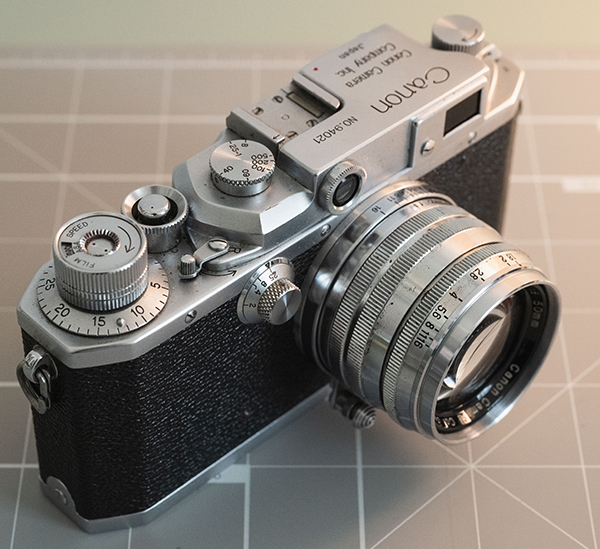
(Image courtesy of Mohsen Saade)
Canon IV-Sb/IV-S2
Production (Peter Dechert) |
Marketed (Canon) |
Slow
Dial |
Main Dial
|
Sync* |
S/Timer |
1952/12-1955/03 |
1952/12 |
T, 1-8, X, 25 |
B, 25-1, 40-1000 |
M/FP/X |
No |
(*Sync: Slow speed sync at 1/8 and below is for M class and other peak type bulbs as well as FP, high speed sync is for FP bulbs at 1/25 and above, X sync is approximately 1/25)
Serial Numbers |
||
Source |
From |
To |
| Peter Dechert | 65760 |
160000 |
| Found | 6757x |
16516x |
| Lens Mount: Universal | |||
| Normal 50mm Lens (Peter Dechert): Serenar/Canon f/1.5 or f/3.5 or Canon f/1.8 or f/2.8 |
|||
| Found with Lens: | |||
| Lens | Description | Serial Numbers |
|
|---|---|---|---|
From |
To |
||
| f/1.5 Canon | Chrome | 1428x |
1829x |
| f/1.8 Serenar | Rigid | 7086x |
7713x |
| f/1.8 Canon | Chrome | 8439x |
12589x |
| f/2.8 Canon | Zebra | 1019x |
|
| f/3.5 Canon | Collapsible | 2345x |
|
Canon IV-Sb was the official factory and domestic market name but for export markets, it was usually called IV-S2, e.g. all the English language manuals I have seen refer to the IV-S2. It is a Canon IV-S with two additions, a slow speed shutter dial lock and X sync for using electronic flash. X sync was engaged by setting the slow speed dial to the new “X” position with the sync speed being around 1/15 according to Peter Dechert, but 1/25 according to the notes to the tables in the Canon Flash Unit Y user manual printed in October 1955. Canon IV-Sb with f/1.8 50mm Canon lens, note the film take-up spool with spring loaded pop-up grip introduced shortly after release of the Canon III:
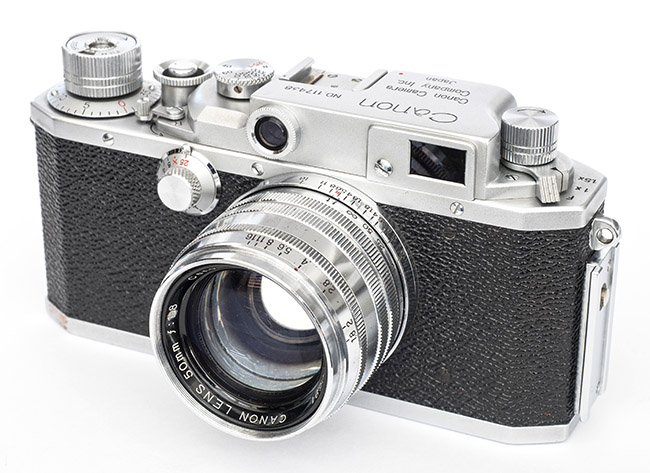
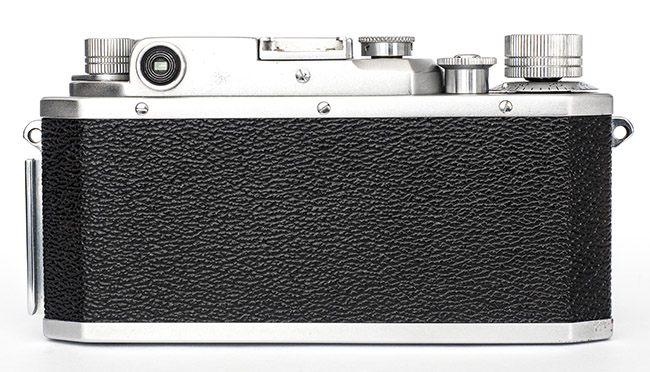
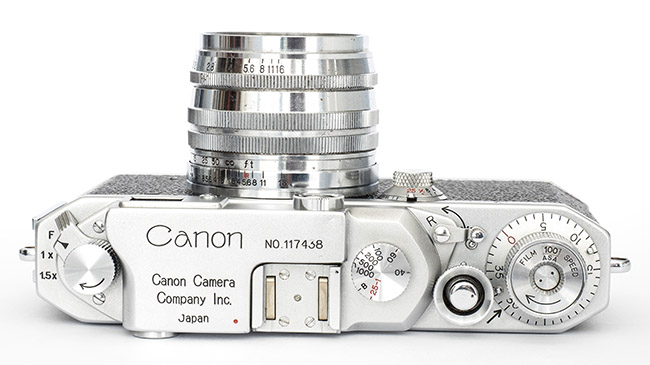
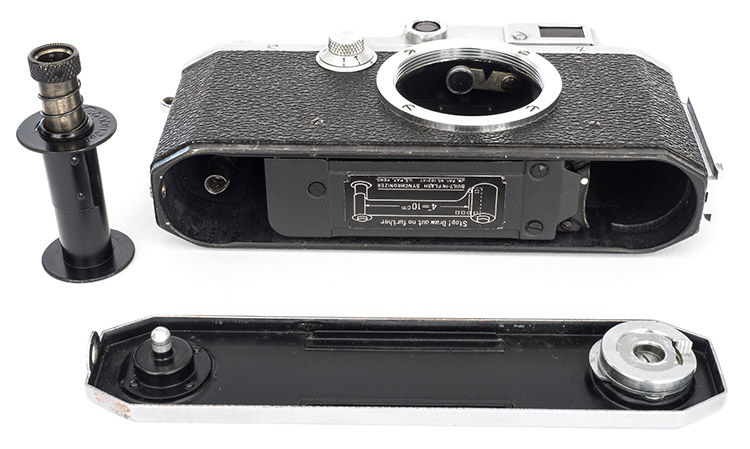
The IV-Sb was a very important model for Canon with 34,975 produced and the first model to make a real impact outside of Japan. Only the Canon P and 7 models sold more.
According to Peter Dechert, Canon announced that it was replacing the Serenar name with “Canon Lens” and lenses with that marking were delivered from the beginning. However, the seven earliest IV-Sb examples in my database with the f/1.8 lens still have lenses marked Serenar. Five of the lenses have serial numbers in the 7086x to 7713x range which seems to lead into the Canon range, the other two are slightly lower and could be later replacements. The newly arrived f/1.5 50 mm lens was initially available as a Serenar but soon changed to the Canon name. The alloy barrelled black and silver “zebra” patterned Canon f/2.8 50 mm lens arrived a little later and was destined to replace the f/3.5.
The top half of the Japanese ad below is for the new “IV-Sb”. The lens is named as the Serenar 50 mm f/1.8. The ad is titled “Two Announcements”, the other announcement being a flash unit update (see Flash Unit X). Canon's name and address is at the bottom (Shimomaruko, Ohta Ward, Tokyo):
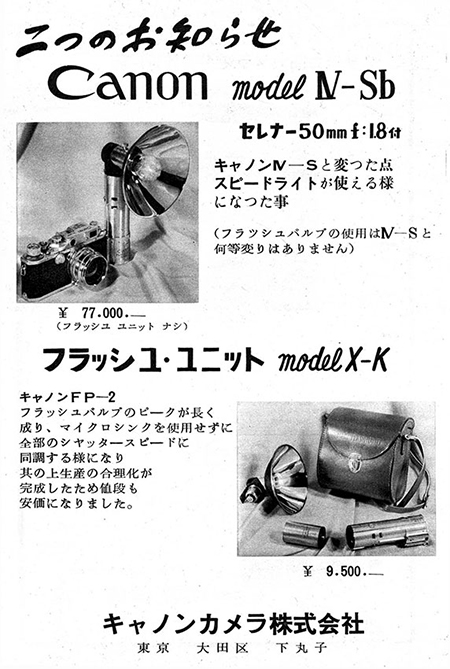
By the way, one Canon claim to fame doesn't quite stack up. On the Canon Camera Museum page for the Canon IV-Sb, “marketed Dec 1952”, Canon claims; “The world’s first camera of its kind to feature X-sync for Speedlites.” Technically, perhaps it was the first with an “X” marked on the shutter dial but on the relevant History Hall page it makes a broader claim with; “The IV-Sb was the world’s first 35mm rangefinder camera with electronic flash synchronisation.” That's simply not correct. The Nicca Type-III S with a likely September 1952 release had both FP and X sync sockets but the two years earlier 1950 Leica IIIf featured a flash delay setting dial (like Canon's “Micro Sync” on its flash units) with the ability to use electronic flash as well as most types of bulbs. For electronic flash, 1/30 sec with delay set to 2 on the earlier black dial model, 1/25 with delay set to 0, or 1/50 set to 20 on the 1952 red dial model. A more correct statement would be; “The world’s first camera of its kind to feature simplified X-sync switching for Speedlites.”
July 1953 English Language user manual for II-D and IV-S2:
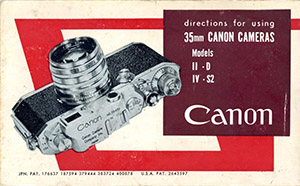 (Click on cover for PDF manual)
June 1954 Japanese user manual for IV-Sb and II-D (the Japanese manual has different content and additional information, e.g. sportsfinder and loading the Canon film magazine):
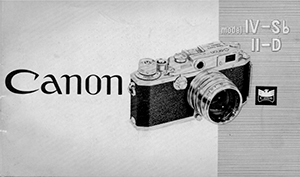 (Click on cover for Japanese PDF download page)
Cover of September 1954 manual for IV-S2 and II-S (not “2” version cameras). II-D and superseded III-A also mentioned regarding flash use. Downloadable from Pacific Rim Camera, Flynn Marr and Mike Butkus.
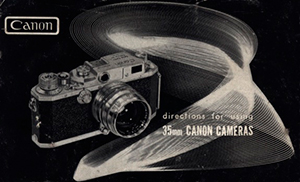
Canon II-AF
Production (Peter Dechert) |
Marketed (Canon) |
Slow
Dial |
Main Dial
|
Sync* |
S/Timer |
1953/06-1953/08 |
1953/06 |
None |
B, 25-500 |
FP |
No |
(*Sync: There is no slow speed sync for M class and other peak type bulbs, only high speed sync for FP bulbs at 1/25 and above)
Serial Numbers |
||
Source |
From |
To |
| Peter Dechert | 92165 |
95500 |
| Found | None |
|
| Lens Mount: Universal |
| Normal 50mm Lens (Peter Dechert): Canon f/3.5 (“presumed”), Canon claims it was the Canon f/1.8 |
Peter Dechert describes the Canon II-AF as a Canon II-A, the model without slow speeds, but with flash rail and flash sync for flash bulbs added. The only other material difference is that the II-A still featured the fabricated shutter crate whereas the II-AF was updated with the new die cast version. Or alternatively, you could describe the II-AF as a Canon II-F without slow speeds:
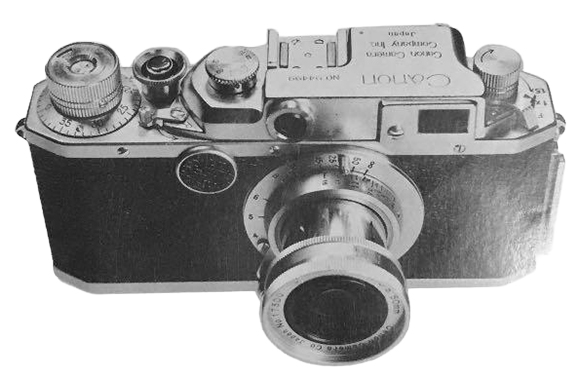
(From cover of March 1984 edition of Camera Collectors' News)
The Canon Camera Museum identifies both the AF and AX as “for export only” as there was no Japanese price. The reason for making these two variations, and in such small quantities is unknown, but it is surmised that it may have been another cancelled order, somewhat like the Jardine order for the Canon II-A.
Peter Dechert presumes that the normal lens was the Canon f/3.5. The Canon Camera Museum claims that the normal lens for both the AF and AX was the the Canon f/1.8 but the magazine photo above features the f/3.5 version. Peter Dechert also says “exactly 15” were produced.
Canon II-AX
Production (Peter Dechert) |
Marketed (Canon) |
Slow
Dial |
Main Dial
|
Sync* |
S/Timer |
Doesn't exist |
1953/06 |
None |
B, 25, X, 40-500 |
X |
No |
(*Sync: Canon claims that X sync is at approximately 1/40, shutter dial marking is guess)
Serial Numbers |
||
Source |
From |
To |
| Peter Dechert | n/a |
n/a |
| Found | None |
|
| Lens Mount: Universal |
| Normal 50mm Lens: Canon claims it was the Canon f/1.8 |
In his book, “Canon Rangefinder Cameras 1933-1968”, Peter Dechert refers to the Canon II-AX as “mythological”, he claims that it didn't exist. His reasoning, based on his assertion that Canon “did not manage X synchronisation on the fast shutter speed dial” for another two years, sounds plausible and he adds, “it is my understanding that Canon's own historians now agree with this conclusion.” However, notwithstanding his belief, almost 40 years after his book was published, the Canon Camera Museum still lists the model and has this to say about it:
“Often called the mysterious Canon, the II-AX was named “Flash-dedicated Camera” during its development. It was a II-A with 1/40 sec. X-sync and a side flash rail with built-in flash sync contacts. Shutter speeds slower than 1/8 sec. were not provided. The slow shutter speed dial hole was covered by a round patch like the II-A. Altogether only about 20 II-AX and II-AF cameras were made.”
History doesn't always follow a logical path and in any case, logic requires that you have access to all salient facts, rarely the case in the historical context. It may well be that an X synch at the then unusually high speed of 1/40 on the main dial was not especially difficult to implement, noting that it is the only Canon with X sync but without slow speeds and separate flashbulb sync. A somewhat similar example of this was the 1958 Nicca Type 33, a budget version of the popular 3-F models. Since 1952 (1955 for single socket models), Niccas featured X sync at the changeover speed (not marked with an “X”, first at 1/25 and then 1/30). The budget Type 33 saved money by dropping flashbulb sync but offered X sync at 1/60. The flagship Nicca III-L followed with flashbulb sync restored and X sync reduced back to the crossover speed. So it seems to me that a highish X sync speed on the main deal was probably not that difficult to implement, the tricky thing was to include it with flash bulb sync which had to function throughout most of the speed range. My mind remains open on this one.
Interestingly, in a reference to low volume rangefinder models on page 32 of his later book, “Canon Single Lens Reflex Cameras 1959-1991”, Peter Dechert refers to the Canon-AX as “putative”, somewhat more accommodating of its possibility without necessarily accepting it as fact.
If his claim is correct that precisely 15 Canon II-AF cameras were made and Canon is correct about the total for the two models being around 20, then around 5 Canon II-AX cameras may have been made.
Canon II-F
Production (Peter Dechert) |
Marketed (Canon) |
Slow
Dial |
Main Dial
|
Sync* |
S/Timer |
1953/07-1955/03 |
1953/06 |
T, 1-8, 25 |
B, 25-1, 40-500 |
FP |
No |
(*Sync: There is no slow speed sync for M class and other peak type bulbs, only high speed sync for FP bulbs at 1/25 and above)
Serial Numbers |
||
Source |
From |
To |
| Peter Dechert | 84380 |
166050 |
| Found | 9817x |
15920x |
| Lens Mount: Universal | |||
| Normal 50mm Lens (Peter Dechert): Canon f/1.8, f/2.8 or f/3.5 |
|||
| Found with Lens: | |||
| Lens | Description | Serial Numbers |
|
|---|---|---|---|
From |
To |
||
| f/1.8 Canon | Chrome | 8738x |
14296x |
The Canon II-F is another budget model but with 11,900 made, was well received even though it was largely anonymous - it didn't seem to appear in any Canon advertising or documentation, perhaps because the great majority were sold through US military exchange stores. It is missing the IV-Sb's 1/1000 top speed, slow speed shutter dial lock and X and slow speed sync sync whilst still offering sync for FP flash bulbs at 1/25 and above which would have fulfilled most amateur photographer's needs in the 1950s.
Whilst I am not aware of a user manual, or “Directions”, which specifically mentions the II-F, an earlier II-F has been found with a July 1953 Canon II-D/IV-S2 (IV-Sb) user manual and another such manual sold by itself had the yellow II-F slip below loosely inserted inside so presumably, this manual with the slip is what was supplied with the camera. A later II-F, originally bought in a PX store by a correspondent's father, was supplied with the different September 1954 printed manual for the IV-S2/S-II. Now well used, unfortunately this doesn't include any slip but it may have been there originally (see IV-Sb/IV-S2 above for more manual information). The found slip explains the relevant spec differences and flash limitations between the three models:
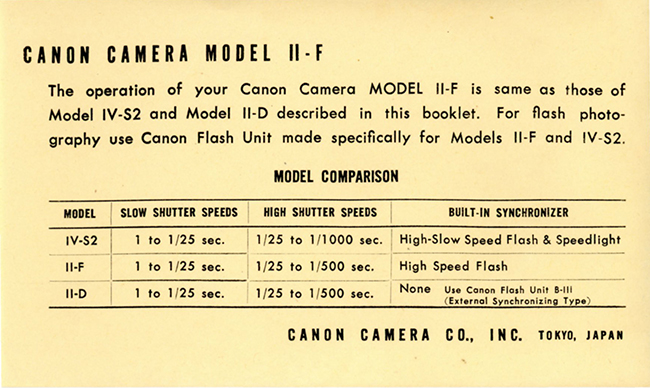
Although it doesn't have slow speed sync either, without the dial lock and X sync, it is more like an IV-S with 1/500 top speed in the same way as the II-S is an IV-Sb with 1/500 instead. Whilst there is no <EP> mark on the first 1953 cameras from 9817x to 10777x (the mark was only introduced in 1953), from that point on, most have the mark with only the odd exception. Nearly all the examples in my database found with lenses came with the f/1.8 50 mm Canon. Example below with the Canon lens but later camera with no <EP> mark:
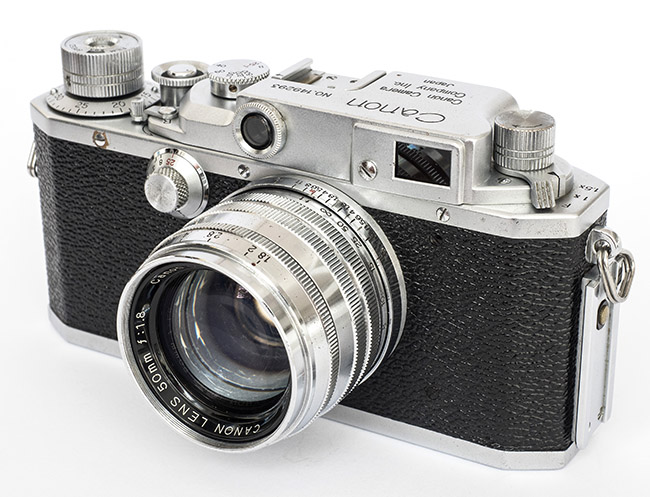
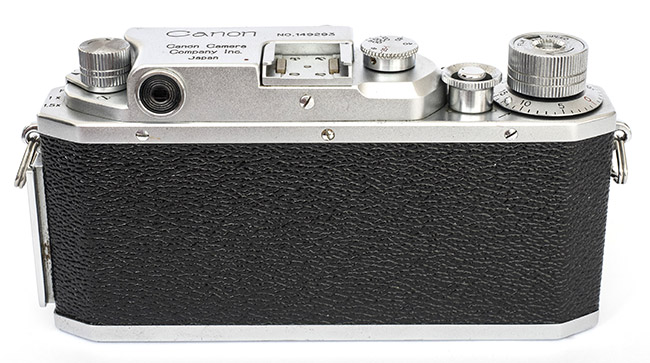
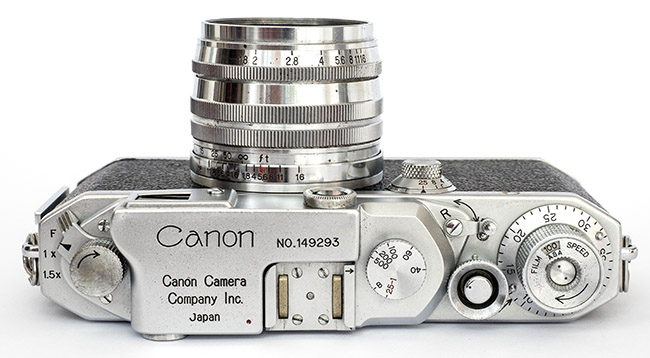
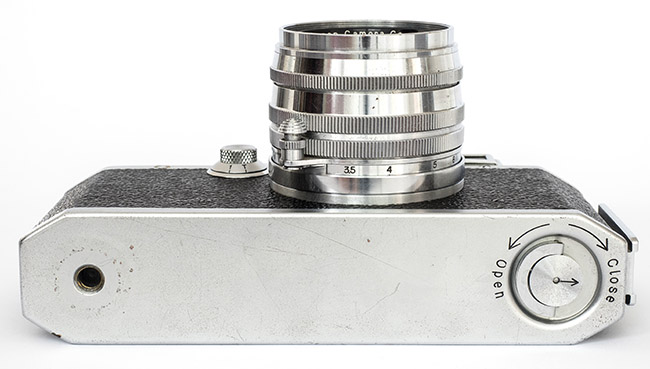
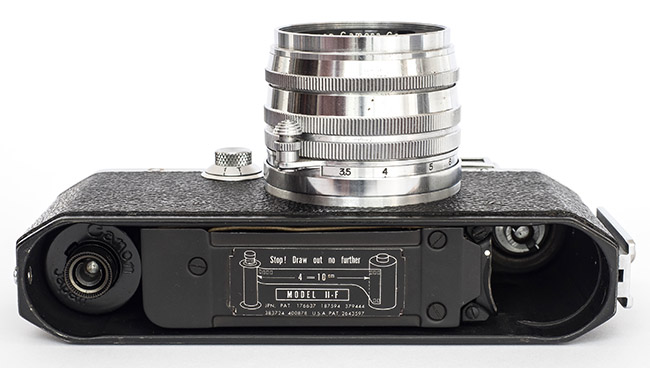
Up to serial number 12704x, there was no model name, but from 13991x onward, the model name was marked on the film loading diagram on the bottom of the shutter crate. Between those numbers is a cross over period where both types are found.
Canon II-S
Production (Peter Dechert) |
Marketed (Canon) |
Slow
Dial |
Main Dial
|
Sync* |
S/Timer |
1954/02-1955/03 |
1954/02 |
T, 1-8, X, 25 |
B, 25-1, 40-500 |
M/FP/X |
No |
(*Sync: Slow speed sync at 1/8 and below is for M class and other peak type bulbs as well as FP, high speed sync is for FP bulbs at 1/25 and above, X sync is approximately 1/25)
Serial Numbers |
||
Source |
From |
To |
| Peter Dechert | 108870 |
160150 |
| Found | 10826x |
12678x |
| Lens Mount: Universal | |||
| Normal 50mm Lens (Peter Dechert): Canon f/1.5, f/1.8, f/2.8 or f/3.5 |
|||
| Found with Lens: | |||
| Lens | Description | Serial Numbers |
|
|---|---|---|---|
From |
To |
||
| f/1.8 Canon | Chrome | 10020x |
11243x |
| f/3.5 Canon | Collapsible | 1933x |
|
Whilst the Canon II-F features sync for high speed flash bulbs only, the Canon II-S also includes X and low speed sync - it is basically a Canon IV-Sb without the highest shutter speed of 1/1000. Only 1,850 were made. Unless it is one of the later examples with the name inside, the only way to tell the II-F and II-S apart is the slow speed dial, the II-S has the IV-Sb dial lock and the “X” sync marking both missing on the II-F:
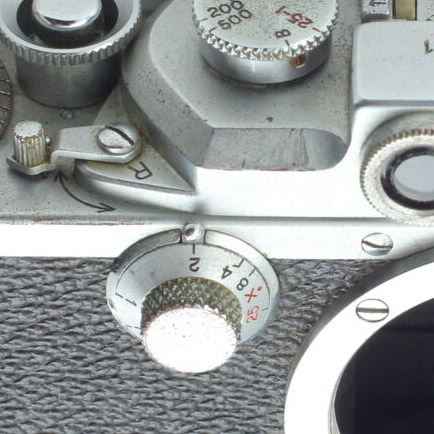 (Detail from larger web image)
From between serial number 10826x and 11327x onward, the model name was marked on the film loading diagram on the bottom of the shutter crate.
Released after the July 1953 IV-S2 user manual was printed, it is briefly mentioned in the September 1954 manual.
Canon IV-Sb2
Production (Peter Dechert) |
Marketed (Canon) |
Slow
Dial |
Main Dial
|
Sync* |
S/Timer |
1954/07-1956/07 |
1954/03 |
T, 1-15, X, 30 |
B, 30-1, X, 60-1000 |
M/FP/X |
No |
(*Sync: Slow speed sync at 1/15 and below is for M class and other peak type bulbs as well as FP, high speed sync is for FP bulbs at 1/30 and above, X sync is approximately 1/45 on main dial or approximately 1/30 on slow dial for older electronic flash units)
Serial Numbers |
||
Source |
From |
To |
| Peter Dechert | 122490 |
229000 |
| Found | 17123x |
22893x |
(See comments below regarding serial numbers from 122490 to 169999)
| Lens Mount: Universal | |||
| Normal 50mm Lens (Peter Dechert): Canon f/1.5, f/1.8 or f/2.8 |
|||
| Found with Lens: | |||
| Lens | Description | Serial Numbers |
|
|---|---|---|---|
From |
To |
||
| f/1.5 Canon | Chrome | 1877x |
2310x |
| f/1.8 Canon | Chrome | 10626x |
16668x |
| f/2.8 Canon | Zebra | 1552x |
|
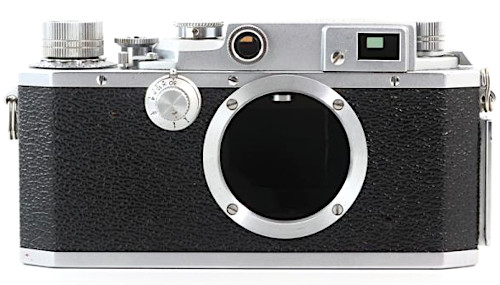 (Web image)
Whilst the IV-Sb2 is externally similar to the IV Sb there were a number of improvements, all but two visible in the photo below. The changeover speed from slow to high speeds has increased from 1/25 to 1/30 and for the first time, a Canon shutter uses a geometric speed sequence (speeds increase by a factor of 2). X sync has moved to the main dial with a speed of about 1/45 whilst the position on the slow dial remained to cater for older long delay strobes. The slow dial also adds a 1/15 speed for the first time. The revised shutter dial markings and new speed progression are now:
Front Dial: T, 1, 2, 4, 8, 15, X, 30
Main Dial: B, 30-1, X, 60, 125, 250, 500, 1000
The main shutter dial is now in two parts and the speed can be set cocked or uncocked and although the dial still spins, the two parts and set speed stay locked together. There is also the serrated wheel between the film wind knob and frame counter disc which can be set against the frame counter to indicate the number of exposures available on the roll (e.g. 24 or 36, in 1955 20 was suggested as an option). Not visible in the photo is the improved viewfinder eyepiece or the re-engineered shutter which enabled the updates noted above:
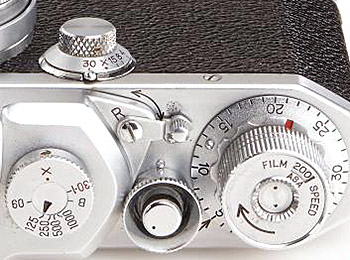 (Detail from larger web image)
A minor update on the “2” models is a new film leader instruction label on the bottom of the shutter crate. Whilst it looks more “modern”, it sacrifices the “Stop! Draw out no further” warning for more patent numbers:
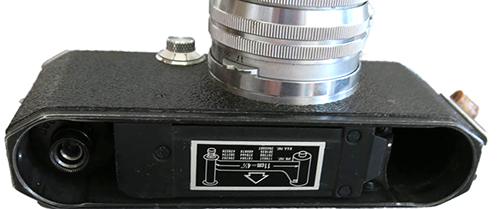
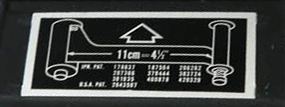 (Web images)
Peter Dechert says that production started with serial number 122490 in July 1954 but numbers under 170000 are quite low (I haven't found any) whereas the companion models, the II-S2, II-D2 and II-F2, didn't arrive until serial number 170000 starting in February 1955. Canon actually claims that the IV-Sb2 was “marketed” in March 1954 yet strangely, an October 1955 user manual for the Canon Flash Unit Y offers two sets of tables; one for IV-Sb, II-S and II-F cameras up to serial number 169999 with shutter cross over speed of 1/25, the other for the same models (see below) over 170000 with cross over speed of 1/30. That ignores any earlier IV-Sb2 production. It is an anomaly I have no answer for, a guess is that there may have been a trial series, a reason perhaps for the low numbers, its purpose misremembered in the passing of time.
The IV-Sb2 was an important model for Canon, setting the high bar for bottom loading LTM rangefinders. Peter Dechert called it “the finest bottom-loading 35 mm rangefinder camera anyone has ever built” but I'm certain that he wasn't including the bottom loading Leica M3 in that comparison. About 16,800 were made, less than half the IV-Sb number which continued concurrently for some time. The new shutter lived on in Canon's V series models.
Canon has now embraced the naming of the IV-Sb2 and its lesser siblings but the evidence is that back in the mid-1950s, Canon barely acknowledged any difference to the earlier IV-Sb, e.g. an April 1955 Canon camera brochure displays pictures of the IV-Sb2, II-S2 and II-D2 (not the II-F2 though) showing the updated features, casually includes the new shutter progression including 1/15 and 1/30 speeds but avoids any other discussion and uses the old names without the “2” suffix. Peter Dechert tells us that the confusion started with Canon simply referring to the new models as “improved” and that the Japanese character for that looked like a western “2” and then the 2 stuck. Sellers in Japan these days still refer to the IV-Sb2 as “IV-Sb (modified)”, or similar (as machine translated), and the same for its companion models.
The IV-Sb2 and the other two models are among the few Canon post-War cameras that I have not found downloadable user manuals for, however, these are the covers of 2 different versions. I presume the first, because of the similarity of the cover to the September 1954 version of the IV-Sb/IV-S2 manual, this is the February 1955 printing (there is also an August 1955 printing):
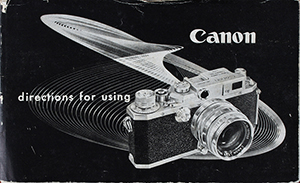
Presumably, the second version:
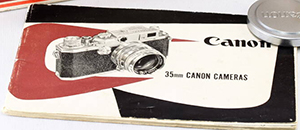
Note, the “Canon” name on both covers is in the form of the new corporate logo with backward sloping “o” which Canon claims was adopted in 1956. Not official yet? A mistake with its own history?
Canon II-S2
Production (Peter Dechert) |
Marketed (Canon) |
Slow
Dial |
Main Dial
|
Sync* |
S/Timer |
1955/02-1956/07 |
1955/04 |
T, 1-15, X, 30 |
B, 30-1, X, 60-500 |
M/FP/X |
No |
(*Sync: Slow speed sync at 1/15 and below is for M class and other peak type bulbs as well as FP, high speed sync is for FP bulbs at 1/30 and above, X sync is approximately 1/45 on main dial or approximately 1/30 on slow dial for older electronic flash units)
Serial Numbers |
||
Source |
From |
To |
| Peter Dechert | 170000 |
227000 |
| Found | 17171x |
227593 |
| Lens Mount: Universal | |||
| Normal 50mm Lens (Peter Dechert): Canon f/1.5, f/1.8 or f/2.8 |
|||
| Found with Lens: | |||
| Lens | Description | Serial Numbers |
|
|---|---|---|---|
From |
To |
||
| f/1.5 Canon | Chrome | 2089x |
2172x |
| f/1.8 Canon | Chrome | 13229x |
16731x |
| f/2.8 Canon | Zebra | 1467x |
|
The Canon II-S2 is the IV-Sb2 minus the 1/1000 shutter speed. It is still a very capable camera and proved quite popular with 16,575 made, a lot more than the II-S it replaced:
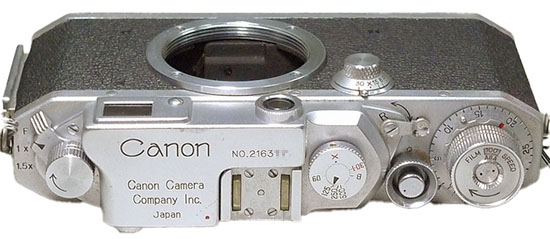 (Web image)
Canon II-D2
Production (Peter Dechert) |
Marketed (Canon) |
Slow
Dial |
Main Dial
|
Sync |
S/Timer |
1955/03-1956/07 |
1955/04 |
T, 1-15, 30 |
B, 30-1, 60-500 |
No |
No |
Serial Numbers |
||
Source |
From |
To |
| Peter Dechert | 170160 |
228200 |
| Found | 17851x |
22770x |
| Lens Mount: Universal | |||
| Normal 50mm Lens (Peter Dechert): Canon f/1.8 or f/2.8 |
|||
| Found with Lens: | |||
| Lens | Description | Serial Numbers |
|
|---|---|---|---|
From |
To |
||
| f/1.8 Canon | Chrome | 13727x |
16630x |
| f/2.8 Canon | Zebra | 1105x |
1590x |
The Canon II-D2 brings the same improvements to the II-D1 (the II-D version with film speed reminder) as the the IV-Sb2 brought to the IV-Sb plus it adds the slow dial lock missing from the original. Or, a simpler way to consider it is as a Canon II-S2 minus flash sync and side rail. It was also made in similar numbers to the II-S2:
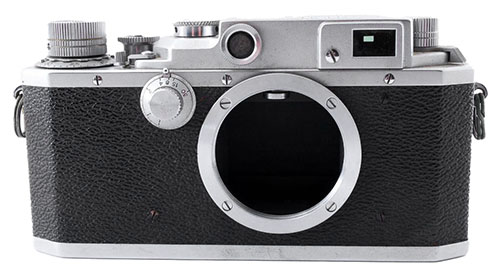 (Web image)
Canon II-F2
Production (Peter Dechert) |
Marketed (Canon) |
Slow
Dial |
Main Dial
|
Sync* |
S/Timer |
1955/06-1955/11 |
1955/04 |
T, 1-15, 30 |
B, 30-1, 60-500 |
FP |
No |
(*Sync: There is no slow speed sync for M class and other peak type bulbs, only high speed sync for FP bulbs at 1/30 and above)
Serial Numbers |
||
Source |
From |
To |
| Peter Dechert | 173200 |
217100 |
| Found | 18175x |
20035x |
| Lens Mount: Universal | |||
| Normal 50mm Lens (Peter Dechert): Canon f/1.8 or f/2.8 |
|||
| Found with Lens: | |||
| Lens | Description | Serial Numbers |
|
|---|---|---|---|
From |
To |
||
| f/1.5 Canon | Chrome | 2267x |
|
| f/1.8 Canon | Chrome | 12434x |
14868x |
The Canon II-F2 is identical to the II-S2 except that there is no slow speed sync or X sync, as indicated by the shutter dials without the “X” position marked. Production of 2,625 was much lower than the original II-F but it arrived late and was only made for 5 months. Canon II-D2/II F2-dials:
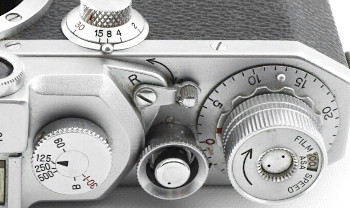 (Detail from larger web image)
Canon VT
Production (Peter Dechert) |
Marketed (Canon) |
Slow
Dial |
Main Dial
|
Sync* |
S/Timer |
1956/04-1957/02 |
1956/08 |
T, 1-15, 30 |
B, 30-1, X, 60-1000 |
M/FP/X |
Yes |
(*Sync: 2 position switch, FP/M is for FP bulbs from 1 to 1/1000 and M bulbs from 1 to 1/250, X/F is for electronic flash at approximately 1/50 and F bulbs from 1 to 1/30)
Serial Numbers |
||
Source |
From |
To |
| Peter Dechert | 500010 |
540000 |
| Found | 50011x |
51814x |
| Lens Mount: Universal | |||
| Normal 50mm Lens (Peter Dechert): Canon f/1.2, f/1.5, f/1.8 or f/2.8 |
|||
| Alternative 35 mm Lens (Peter Dechert): Canon f/1.8 or f/2.8 | |||
| Found with Lens: | |||
| Lens | Focal Length/ Description | Serial Numbers |
|
|---|---|---|---|
From |
To |
||
| f/1.8 Canon | 50mm Black | 20745x |
22129x |
Whilst there is an argument that the Canon IV-Sb2 was superior to the Leica IIIf, the Canon VT was Canon's first effort to try to narrow the gap to the Leica M3 by offering something different. It used the same IV-Sb2 shutter and much of the internals were the same but there were some major changes to how it operated. Instead of adopting lever film wind, Canon had in fact permanently mounted its trigger operated Rapid Winder on the bottom and made the courageous call that this was the future. Whilst no doubt in some circumstances for some people it offered advantages, in others such as portrait mode and using on tripods, or copy stands, it was an obstacle and for that reason, and also for winding on the first two frames when loading film, a vestigal film wind knob was also provided (note, the requirement to knob wind the first two frames and be gentle with the lever wind for the last three frames only appeared as red stamped additions on pages 11 and 20 of the later version user manual marked “VT”).
More usefully, it features a hinged opening back for film loading/unloading with fixed take-up spool.
Canon had taken note of the trend to using 35 mm focal length lenses as normal lenses and modified the viewfinder/rangefinder to give a 35 mm lens view at the widest setting with 0.4x magnification, a 50 mm lens view at the middle setting with 0.72x magnification and a setting with 1.4x magnification for accurate focus purposes only. The magnification lever was replaced by a thumbwheel on the back and a circular indicator window in the top plate with clockwise markings “50”, “35” and “RF”. In addition, Canon now offered camera sets with 35 mm normal lenses in addition to the usual 50 mm lenses.
Whilst the camera's viewfinder doesn't offer parallax correction, a very useful feature is built-in parallax correction for the matching Series V accessory viewfinders. A pin at the front of the accessory shoe raises or lowers the front of the viewfinder as the camera is focused.
The “X” position was removed from the slow speed shutter dial and a tab operated switch added under the high speed dial for selecting X or bulb sync, although it is not quite as simple as that, see above table and description under. The 1/250 maximum speed for M sync was perhaps overly ambitious, it dropped initially to 1/125 on the L1 and following Series V models, then back to 1/250 on Series VI cameras before dropping to 1/15 on the 7 models, the 7s user manual mentioning that up to 1/250 was possible “where only the central part of the picture is necessary.” The earlier flash rail was incompatible with the opening back and was replaced by a bayonet fitting at the end of the top plate. Inside this is a standard PC socket which allows connection of any flashgun with cable and PC plug, or cleverly, direct mounting of the new Canon Flash Unit Model V.
With the new 35 mm lens focusing capability also came a new f/1.8 35 mm lens. The earlier chromed brass f/1.8 50 mm lens was rehoused in a new lighter alloy barrel in mainly black to better match the style of the VT. At the same time, a new hero lens was launched, the f/1.2 50 mm.
Other new features included the first self-timer offered by Canon and a pop-up rewind knob released by the surrounding lever:
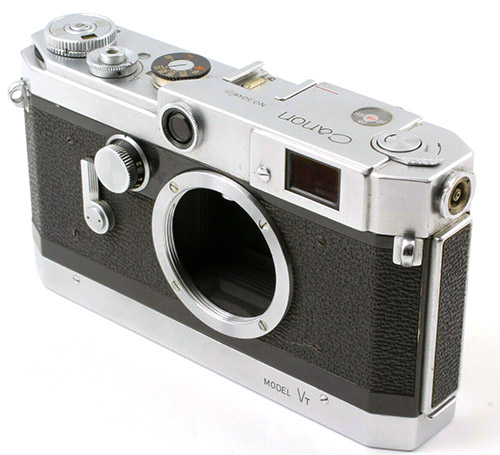
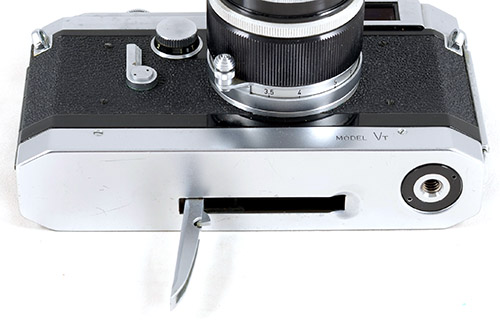
(Web images)
Note, the Canon VT has a tripod socket on the right side (when viewed from the front), i.e. the wrong side, to enable mounting of the accessory pistol grip. Consequently, there is no key to close and open the reloadable film magazine as found on the prior bottom loading models and in a different form, on the earlier accessory Rapid Winder. That means that Canon film magazines can't be used.
The Canon VT is easy to recognise, the name “MODEL VT” is engraved on the right side (looking at the camera) of the front of the base plate. This wasn't so before its actual release. Perhaps Canon hadn't even envisaged a future lever wind version, or maybe it just hadn't thought through its naming system. There are a lot more brochures and ads found for the “Canon V” camera than the “Canon VT” and there are instruction manuals for both names. Below are instruction and brochure covers. Top left is the original “Canon MODEL V” instructions, below left is a B & W reprint of the later “Canon MODEL VT” instructions (Peter Kitchingman posted his original on a forum, the colours are the same as the earlier version) and on the right is a “Canon VT” brochure (note range of standard lenses offered):
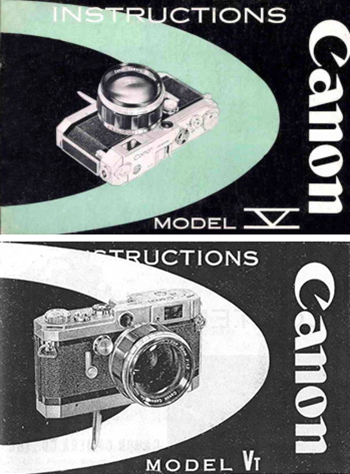
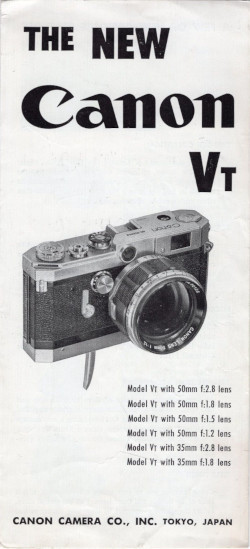
The camera that is mostly featured in the “V” documents has serial number 303002 whereas production cameras belong to the range beginning with 500010 so it is clearly a pre-production example. Where the relevant area is visible, most documents show it without a model name, including the first user manuals, but at least a couple of “V” brochures show the same camera with “MODEL” visible under the lens, presumably with modified artwork rather than camera but it is too far to the left in any case. Examples of both below, the serial number may be hard to see but it is 303002 in each case:
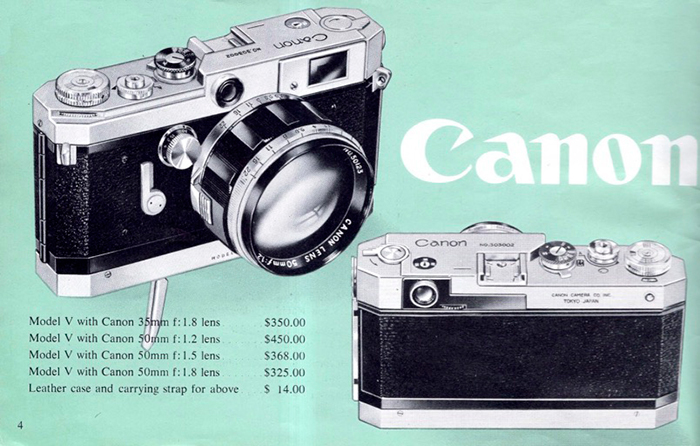
Canon L2
Production (Peter Dechert) |
Marketed (Canon) |
Slow
Dial |
Main Dial
|
Sync* |
S/Timer |
1956/11-1956/12 |
T, 1-15, 30 |
B, 30-1, 60-500 |
FP |
No |
|
1957/05-1957/12 |
1957/03 |
(*Sync: The L2 is synchronised for FP bulbs only from 1/60 to 1/500, i.e. there is no slow speed or M synch)
Serial Numbers |
||
Source |
From |
To |
| Peter Dechert | 505850 |
583000 |
| Found | 506096 |
58328x |
| Lens Mount: Universal | |||
| Normal 50mm Lens (Peter Dechert): Canon f/1.8 or f/2.8 |
|||
| Alternative 35 mm Lens (Peter Dechert): Canon f/1.8 or f/2.8 | |||
| Found with Lens: | |||
| Lens | Focal Length/ Description | Serial Numbers |
|
|---|---|---|---|
From |
To |
||
| f/1.8 Canon | 50mm Black | 20871x |
22428x |
| f/2.8 Canon | 50mm Zebra | 1945x |
2148x |
Peter Dechert tells us that 11 Canon L2 cameras were produced in November and December 1956 and the rest from May 1957 onward. That makes the first batch another trial series and means that the L2 didn't really come before the L1 based on his production dates but according to Canon's marketing, it did and I think that in this case, Canon is correct, see further below. Also, a Japanese user manual, dated February 1957, features camera number 506008, suggesting perhaps that volume production commenced with serial number 506001 and that Canon's March marketing date is realistic. Peter Dechert's earliest serial number, 505850, is no doubt the first of the 1956 batch of 11.
Compared to the VT, the L2 replaces the VT's trigger with lever wind but misses out on its 1/1000 top speed, self-timer, X sync and slow speed sync for both FP and peak bulbs. The sync switch is absent, the window left empty. The L2 brought back the key to open and close the film magazine but it seemed to necessitate a change from the Zeiss inspired magazine design of the bottom loaders to a more Leica-like design for V series magazines. The name is marked on the bottom of the base plate. Lens selection was limited to just the f/1.8 and f/2.8 50 mm lenses. Early camera 506096:
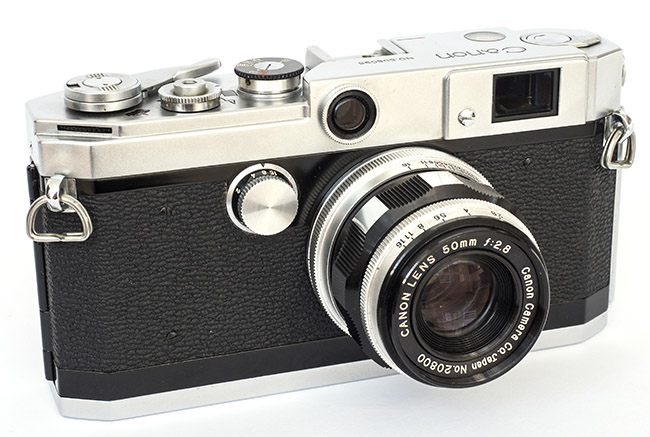
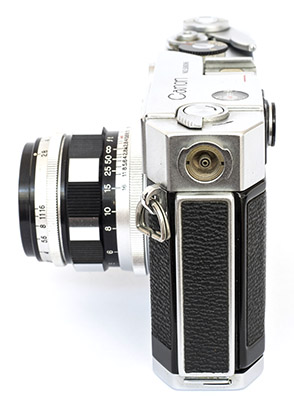
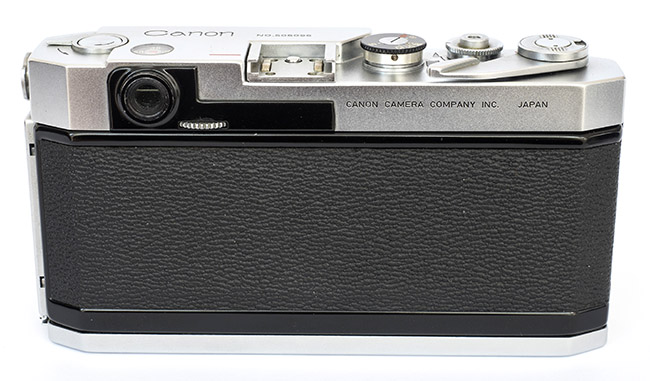
Note the parallax correcting pin in the front of the accessory shoe and also the style of the “Canon” which hadn't really changed on camera bodies from the Hansa Canon to Canon VT:
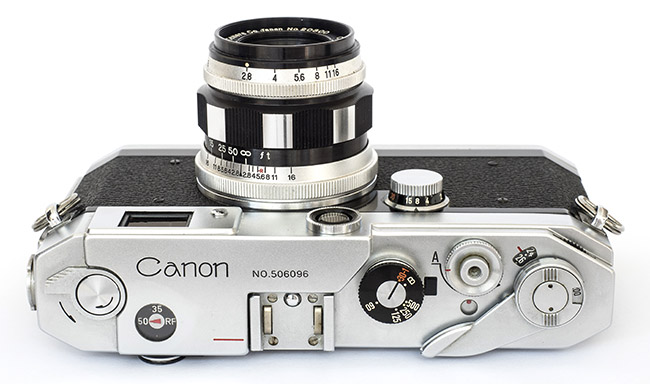
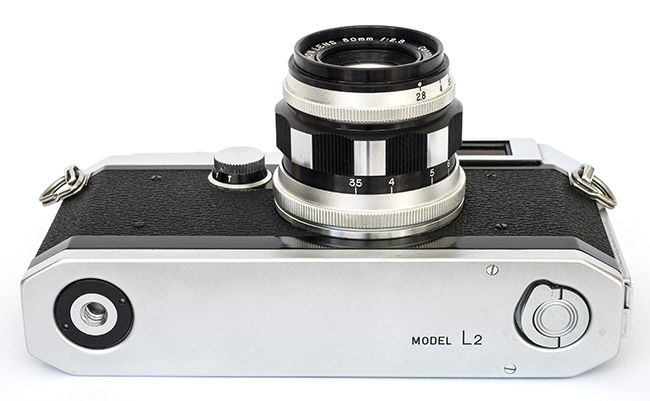
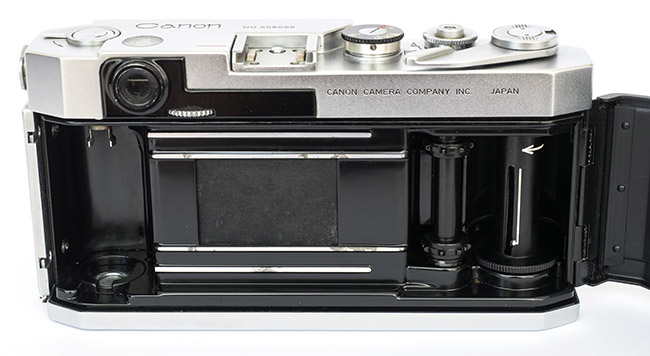
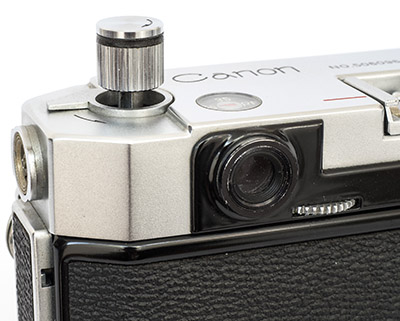
The style of the “Canon” name above changed between L2 serial number 523143 and 524163 to the new style below:
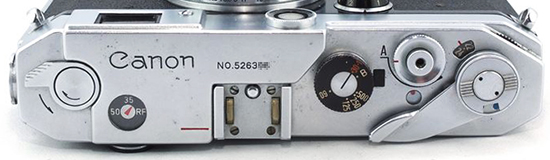 (Web image)
As the L2 was the only model to be released after the VT still with the old style name (approximately the first half of my L2 database), it follows that the L2 was released before the L1.
Correspondent Todd Belcher has sent me a photo of an L2, serial number 506940, with the base plate marked “L-2” instead of “L2”:
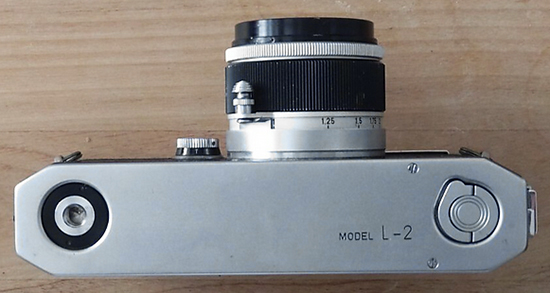
(Image courtesy of Todd Belcher)
It's a mystery, but both of us are of the opinion that it may have been the initial design and was possibly changed even before the camera went on sale. However, this style of name may well have been found on the the first batch of 11. Whilst the found camera is a relatively early one, it is not as early as the user manual camera, 506008, or my example above, 506096, both of which are marked “L2” already, which leads us to further speculate that perhaps there was a supply of base plates with the earlier engraving and Canon later decided to use them up. Another possibility that occurs to me is that they may have been used up as spare parts, but how often does a base plate need replacement?
Japanese L2 & L3 user manual dated October 1957, note, the featured L2 is still the same 506008 as in the February 1957 L2 manual:
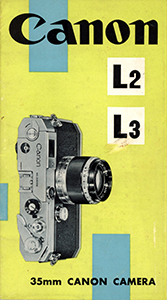 (Click on cover for PDF manual)
Canon L1
Production (Peter Dechert) |
Marketed (Canon) |
Slow
Dial |
Main Dial
|
Sync* |
S/Timer |
1957/02-1957/12 |
1957/05 |
T, 1-15, 30 |
B, 30-1, X, 60-1000 |
M/FP/X |
No |
(*Sync: 2 position switch, FP/M is for FP bulbs from 1 to 1/1000 and M bulbs from 1 to 1/125, X/F is for electronic flash at approximately 1/50 and F bulbs from 1 to 1/30)
Serial Numbers |
||
Source |
From |
To |
| Peter Dechert | 540000 |
566000 |
| Found | 54206x/div> |
56328x |
| Lens Mount: Universal | |||
| Normal 50mm Lens (Peter Dechert): Canon f/1.2, f/1.5, f/1.8 or f/2.8 |
|||
| Alternative 35 mm Lens (Peter Dechert): Canon f/1.8 or f/2.8 | |||
| Found with Lens: | |||
| Lens | Focal Length/ Description | Serial Numbers |
|
|---|---|---|---|
From |
To |
||
| f/1.2 Canon | 50mm Black | 4347x |
|
| f/1.8 Canon | 50mm Black | 21039x |
24160x |
The L1 is a cross between the VT and L2 but brings a new innovation as well. It is a VT with lever wind but misses out on the self-timer whilst adding the L2's magazine key. The top sync speed for M class bulbs is 1/125, half of the VT's 1/250, as it is for the other Series V models (see VT above). The innovation is a new rewind crank that folds neatly into its top plate recess:
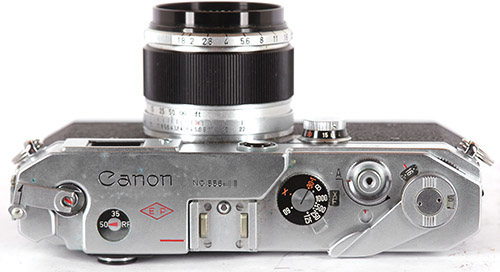 (Web image)
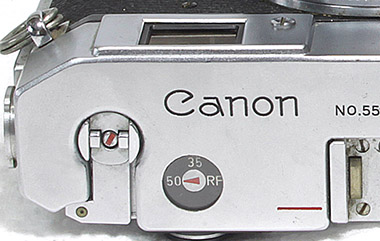
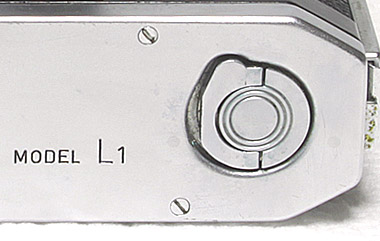
(Detail from larger web images)
According to Peter Dechert, the L1 and VT de luxe were the first Canon models available in a black painted finish.
The last camera in my database is an anomaly. It has serial number 581721 (not included in the range above) which is higher than Peter Dechert's range end, 566000, and my second highest found, 56328x. It has metal shutter curtains and the viewfinder system seems to have the cooler colour of the later VL which would make sense in terms of its serial number, however, it doesn't have a self-timer.
Canon VT de luxe
Production (Peter Dechert) |
Marketed (Canon) |
Slow
Dial |
Main Dial
|
Sync* |
S/Timer |
1957/02-1957/09 |
1957/05 |
T, 1-15, 30 |
B, 30-1, X, 60-1000 |
M/FP/X |
Yes |
(*Sync: 2 position switch, FP/M is for FP bulbs from 1 to 1/1000 and M bulbs from 1 to 1/125, X/F is for electronic flash at approximately 1/50 and F and M-2 bulbs from 1 to 1/30)
Serial Numbers |
||
Source |
From |
To |
| Peter Dechert | 540000 |
545500 |
| Found | 54074x |
54486x |
| Lens Mount: Universal | |||
| Normal 50mm Lens (Peter Dechert): Canon f/1.2, f/1.5, f/1.8 or f/2.8 |
|||
| Alternative 35 mm Lens (Peter Dechert): Canon f/1.8 or f/2.8 | |||
| Found with Lens: | |||
| Lens | Focal Length/ Description | Serial Numbers |
|
|---|---|---|---|
From |
To |
||
| f/2.8 Canon | 35mm Black | 3376x |
|
The only change from Canon VT to Canon VT de luxe is the substitution of the pop-up rewind knob with the new L1 rewind crank. There is still no magazine key. As with all three VT de luxe variations, the name “MODEL VT de luxe” is engraved on the right side (looking at the camera) of the front of the base plate.
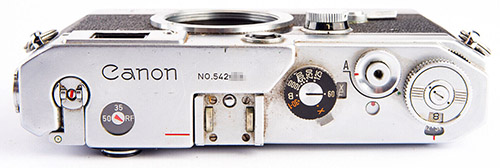
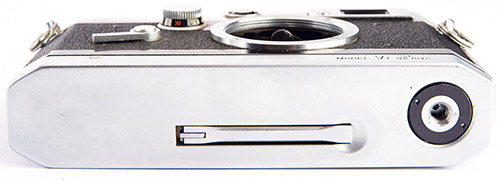
(Web images)
Peter Dechert says that the model name is generally picked out in red but so far, only the three earliest I have found, 540110, 540745 and 541267 are in red, from serial number 542454 the ones I have found are in black. Red and black examples below:
(Detail from larger web images)
Canon VT de luxe Z (Peter Dechert name)
Production (Peter Dechert) |
Marketed (Canon) |
Slow
Dial |
Main Dial
|
Sync* |
S/Timer |
1957/04-1958/06 |
T, 1-15, 30 |
B, 30-1, X, 60-1000 |
M/FP/X |
Yes |
(*Sync: 2 position switch, FP/M is for FP bulbs from 1 to 1/1000 and M bulbs from 1 to 1/125, X/F is for electronic flash at approximately 1/50 and F and M-2 bulbs from 1 to 1/30)
Serial Numbers |
||
Source |
From |
To |
| Peter Dechert | 540500 |
560000 |
| Found | 54812x |
55499x |
| Lens Mount: Universal | |||
| Normal 50mm Lens (Peter Dechert): Canon f/1.2, f/1.5, f/1.8 or f/2.8 |
|||
| Alternative 35 mm Lens (Peter Dechert): Canon f/1.8 or f/2.8 | |||
| Found with Lens: | |||
| Lens | Focal Length/ Description | Serial Numbers |
|
|---|---|---|---|
From |
To |
||
| f/1.2 Canon | 50mm Black | 2475x |
2537x |
| f/1.8 Canon | 50mm Black | 21857x |
22728x |
The Canon Camera Museum only acknowledges one version of the Canon VT de luxe but there were two updates. Whilst internal Canon production summaries differentiate between the first and this one, there was no separate name, the naming of this one “Canon VT de luxe Z” is another Peter Dechert initiative.
The update the VT de luxe Z brings is the new L1/L2 style magazine key now adapted to the trigger type base plate with combined key and tripod mount also used for the accessory pistol grip.
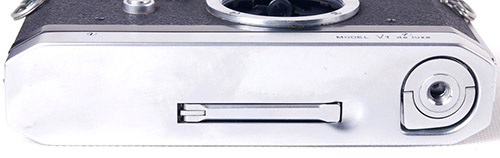 (Detail from larger web image)
Canon L3
Production (Peter Dechert) |
Marketed (Canon) |
Slow
Dial |
Main Dial
|
Sync |
S/Timer |
1957/10-1958/12 |
1957/11 |
T, 1-15, 30 |
B, 30-1, 60-500 |
No |
No |
Serial Numbers |
||
Source |
From |
To |
| Peter Dechert | 529000 |
592000 |
| Found | 52692x |
581829 |
| Lens Mount: Universal | |||
| Normal 50mm Lens (Peter Dechert): Canon f/1.8 or f/2.8 |
|||
| Alternative 35 mm Lens (Peter Dechert): Canon f/1.8 or f/2.8 | |||
| Found with Lens: | |||
| Lens | Focal Length/ Description | Serial Numbers |
|
|---|---|---|---|
From |
To |
||
| f/1.8 Canon | 50mm Black | 23782x |
24475x |
| f/2.8 Canon | 50mm Black | 2426x |
3051x |
The Canon L3 is a Canon L2 with the flash sync removed and the bayonet socket fitting blanked off:
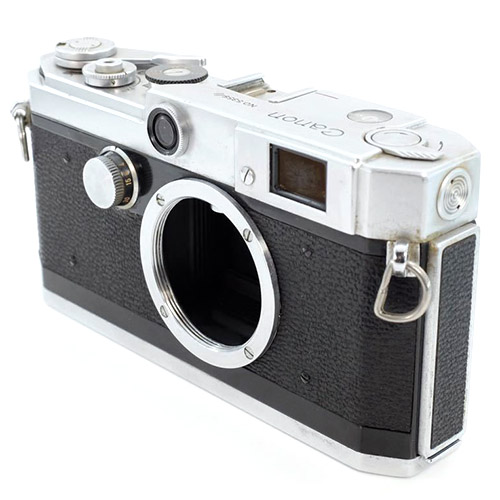 (Web image)
But sometimes it is a lot more than the L2. Below are photos of an L3 with flash socket, X sync and X sync/flashbulb switch. This is not an odd one, there are 10 examples with the expected 1/500 speed that I have either seen, or that have been confirmed by members of the Canon Historical Society Facebook group, and there are another 4 examples with a 1/1000 speed. One of the group members claims that he has recorded around 20 from observing eBay auctions:
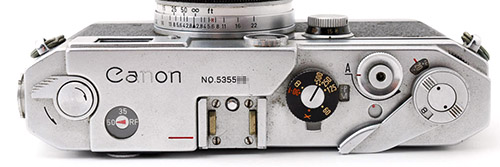
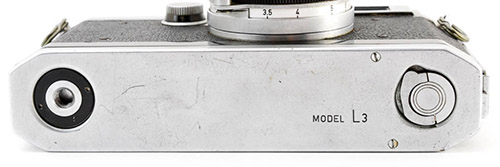
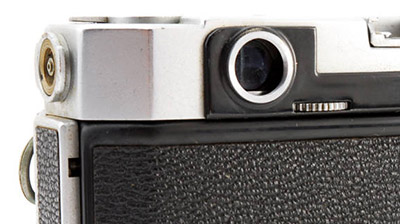 (Detail from larger web images)
Another L3 oddity is that unlike the L1 and L2, the L3 name does not appear on all base plates. In my database, the name is there on all examples from serial number 526928 up to 537348. It is not there from serial number 537971 to the end at 581829. All except the last two L3s with flash sync fit into the first half of serial numbers and all have the “L3” marked base plate as expected. Of the two examples with higher serial numbers, on one the base plate is not visible but the second also features the L3 name.
The examples with the 1/1000 top speed have the same specs as the L1 but remain differentiated by retaining the pop-up rewind knob instead of crank. The 1/500 shutter dial with X sync marked is likely to be a Canon VL2 part. Speaking of the VL cameras, I also have photos of a camera with L3 base plate, L3/L2/VL-2 top plate with knob rewind, L1/VL shutter dial with 1/1000 and X sync, L1/VL/VL-2 mode switch and sync socket, i.e. the same as the 4 previous 1/1000 examples so far, but it also adds the VL/VL-2 self-timer. Unfortunately, the serial number is hidden by the accessory finder.
Rather than thinking of these cameras as L3s with flash sync, it's probably better to think of them as part of a bigger L/VL group of cameras with a mix of features/parts, it's just that these ones have an L3 base plate, more in Odd Spec Canon L and VL Cameras.
For a niche model, the L3 sold in good numbers, some 12,975 even though it seems to have been a domestic Japanese market only model. Strangely, according to Peter Dechert, it entered production in October 1957, only two months before the L1 and L2 ended production in December 1957, being replaced by the VL and VL-2. Therefore, even though it was an L2 without flash sync, it was more a junior partner to the VL and the VL-2 than to the L1 and L2.
Japanese L2 & L3 user manual dated October 1957:
(Click on cover for PDF Manual)
Canon VL
Production (Peter Dechert) |
Marketed (Canon) |
Slow
Dial |
Main Dial
|
Sync* |
S/Timer |
1956/05 (22) |
T, 1-15, 30 |
B, 30-1, X 60-1000 |
M/FP/X |
Yes |
|
1957/12-1958/12 |
1958/03 |
(*Sync: 2 position switch, FP/M is for FP bulbs from 1 to 1/1000 and M bulbs from 1 to 1/125, X/F is for electronic flash at approximately 1/50 and F and M-2 bulbs from 1 to 1/30)
Serial Numbers |
||
Source |
From |
To |
| Peter Dechert | 555000 |
592000 |
| Found | 547640 |
56774x |
| Lens Mount: Universal | |||
| Normal 50mm Lens (Peter Dechert): Canon f/1.2, f/1.5, f/1.8 or f/2.8 |
|||
| Alternative 35 mm Lens (Peter Dechert): Canon f/1.8 or f/2.8 | |||
| Found with Lens: | |||
| Lens | Focal Length/ Description | Serial Numbers |
|
|---|---|---|---|
From |
To |
||
| f/1.2 Canon | 50mm Black | 2291x |
|
| f/1.8 Canon | 50mm Black | 22711x |
|
| f/2.8 Canon | 50mm Black | 2884x |
|
The Canon VL does not have a name marked on its body. The only obvious external difference between the Canon VL and L1 is the addition of the self-timer, however, the VL was an important Canon milestone introducing metal shutter curtains made of thin stainless steel for the first time. These operate the same way as cloth curtains and are interchangeable. Whilst subject to wrinkling, more often a euphemism for careless finger poking, they have proven entirely reliable whilst also eliminating the problem of pinholes burnt by the sun. One other improvement was to use silver coated finder optics, noticeable by the comparatively cooler cast to the view:
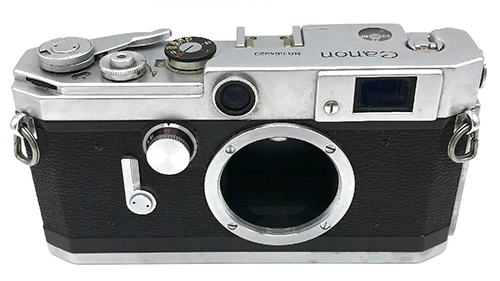
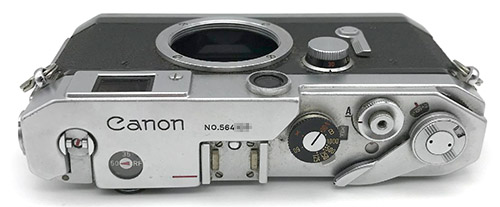
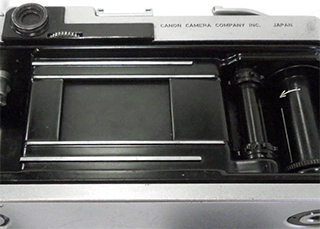 (Web images)
Peter Dechert tells us that an initial 22 VL examples were made in May 1956, some 18 months before release, presumably for long term testing. However, he adds that these may have had the “L1” marked baseplates, the name hadn't been finalised and they may or may not have had self-timers. To my mind, these could simply have been L1s fitted with metal curtains and Peter Dechert says as much. These are both V series cameras but Canon only used “V” in the name for models with self-timer, perhaps because “V” is commonly found on German cameras to indicate self-timer. I don't think the name had anything to do with the curtains. As such, I wouldn't include the 22 early examples in VL reckoning other than as part of the background to development of the metal curtains.
However, Peter Dechert's serial number range for the VL is from 555000 to 592000, not including the original 22 (serial numbers unknown) but I have found 4 cameras below that range, 547640, 553456, 554285 and 554610. Of these 553456 appears to have a cloth shutter but also an “L1” base plate. Whilst that might sound like some fiddling going on, 554610 has both metal curtains and an L1 base plate as does a slightly later camera from within Peter Dechert's VL serial numbers range, 564323. It seems that perhaps these are not full VLs per se, but like the flash synchronised L3s, may be part of the special production discussed in Odd Spec Canon L and VL Cameras.
Canon VL-2
Production (Peter Dechert) |
Marketed (Canon) |
Slow
Dial |
Main Dial
|
Sync* |
S/Timer |
1958/01-1958/12 |
1958/03 |
T, 1-15, 30 |
B, 30-1, X, 60-500 |
M/FP/X |
Yes |
(*Sync: 2 position switch, FP/M is for FP bulbs from 1 to 1/500 and M bulbs from 1 to 1/125, X/F is for electronic flash at approximately 1/50 and F and M-2 bulbs from 1 to 1/30)
Serial Numbers |
||
Source |
From |
To |
| Peter Dechert | 527000 |
585000 |
| Found | 53697x |
58350x |
| Lens Mount: Universal | |||
| Normal 50mm Lens (Peter Dechert): Canon f/1.8 or f/2.8 |
|||
| Alternative 35 mm Lens (Peter Dechert): Canon f/1.8 or f/2.8 | |||
| Found with Lens: | |||
| Lens | Focal Length/ Description | Serial Numbers |
|
|---|---|---|---|
From |
To |
||
| f/1.2 Canon | 50mm Black | 2047x |
|
| f/1.8 Canon | 50mm Black | 23017x |
24192x |
The only two differences between the Canon VL and VL-2 are that the VL-2 uses the pop-up rewind knob instead of crank and that it is missing the 1/1000 top speed. Unlike the earlier L2 version of the L1, it retains the full VL flash synchronisation:
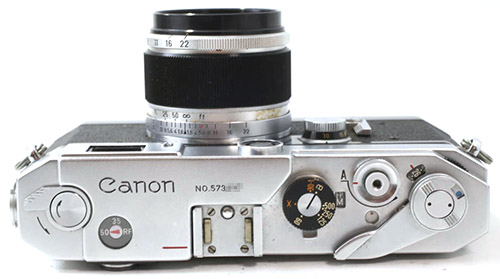 (Web image)
Canon VT de luxe M (internal Canon name)
Production (Peter Dechert) |
Marketed (Canon) |
Slow
Dial |
Main Dial
|
Sync* |
S/Timer |
1958/01-1958/12 |
T, 1-15, 30 |
B, 30-1, X, 60-1000 |
M/FP/X |
Yes |
(*Sync: 2 position switch, FP/M is for FP bulbs from 1 to 1/1000 and M bulbs from 1 to 1/125, X/F is for electronic flash at approximately 1/50 and F and M-2 bulbs from 1 to 1/30)
Serial Numbers |
||
Source |
From |
To |
| Peter Dechert | 540100 |
585000 |
| Found | 54624x |
58370x |
| Lens Mount: Universal | |||
| Normal 50mm Lens (Peter Dechert): Canon f/1.2, f/1.5, f/1.8 or f/2.8 |
|||
| Alternative 35 mm Lens (Peter Dechert): Canon f/1.5, f/1.8 or f/2.8 | |||
| Found with Lens: | |||
| Lens | Focal Length/ Description | Serial Numbers |
|
|---|---|---|---|
From |
To |
||
| f/1.2 Canon | 50mm Black | 2301x |
|
| f/1.8 Canon | 50mm Black | 26750x |
|
| f/2.8 Canon | 50mm Black | 2858x |
|
The name marked on the front is “MODEL VT de luxe”, the same as the previous two versions identified by Peter Dechert. Whilst he notes that Canon used “M” internally to distinguish this version, Canon's marketing only ever treated the three variations as one model, as reflected on the Canon Camera Museum website.
The VT de luxe M updates the previous version by adding metal curtains and silver coated optics, as on the VL update to the L1. Well used example but with the cooler optics and stainless shutter curtains (wrinkled) clearly on display:
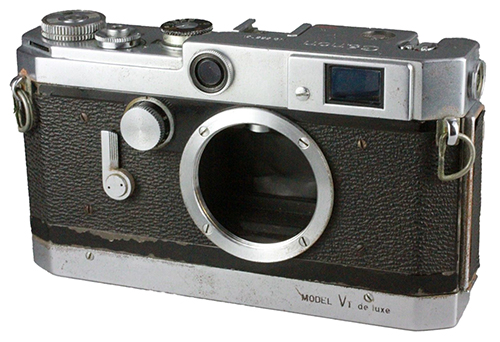 (Web image)
Canon VI-T
Production (Peter Dechert) |
Marketed (Canon) |
Shutter Dial
|
Sync* |
S/Timer |
1958/06-1960/07 |
1958/09 |
X, B, 1-1000 |
M/FP/X |
Yes |
(*Sync: FP sync from 1 to 1/1000, except 1/30. M sync from 1 to 1/250, except 1/30. F bulbs 1 to 1/30. X sync at 1/55)
Serial Numbers |
||
Source |
From |
To |
| Peter Dechert | 600000 |
620000 |
| Found | 60163x |
61795x |
| Lens Mount: Universal | |||
| Normal 50mm Lens (Peter Dechert): Canon f/1.2, f/1.4, f/1.5, f/1.8 or f/2.8 |
|||
| Alternative 35 mm Lens (Peter Dechert): Canon f/1.5, f/1.8 or f/2.8 | |||
| Found with Lens: | |||
| Lens | Focal Length/ Description | Serial Numbers |
|
|---|---|---|---|
From |
To |
||
| f/1.2 Canon | 50mm Black | 2247x |
3387x |
| f/1.8 Canon | 50mm Black | 24259x |
|
The Canon VI-T, with “Model VI-T” engraved in the usual place for trigger models on the the front of the base plate, was released at the same time as its lever wind companion, the VI-L. They are the first two of the Series VI cameras which were attempting to play catch up with Leica and Nikon and the VI-T is Canon's last attempt to convince the market about trigger operated film wind.
Canon had finally caught up with the competition with a single non-spinning shutter dial which also enabled the use of a shutter coupled exposure meter like the Leica M3 and Leica Meter and the 1957 Nikon SP with its meter, however, the “T” position did not carry across from the previous shutter. Also, the viewfinder/rangefinder was improved to provide a 0.65x magnification for the 35 mm view, 1x magnification for the 50 mm view and 1.55x magnification for the accurate focusing position. The indicator window in the top plate was re-ordered to now read clockwise “Mg”, “50” and “35”. The 50 mm lens view was a little wider and now incorporated parallax corrected 50 mm and 100 mm bright line frames.
Canon also implemented an auto reset film counter for the first time. Flash sync speed increased to around 1/60 and no longer required switching between flashbulbs and X sync.
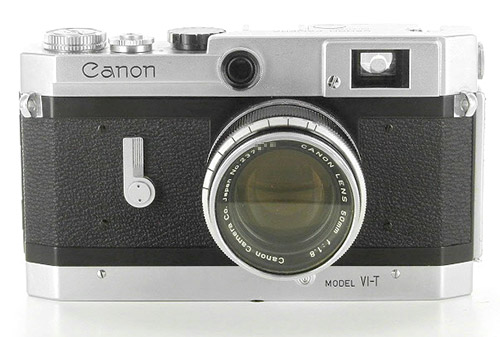 (Web image)
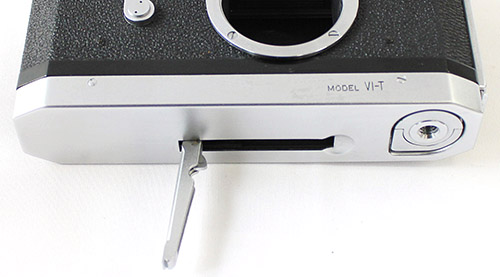 (Detail from larger web image)
The Series VI cameras also feature a new film type/speed reminder on the camera back instead of on the rewind knob. Earlier black on silver version on top which featured on nearly all examples, later colour coded type on bottom, camera serial number unknown, but on the sibling lever wind VI-L, the change occurred between camera 61580x and 62020x, so right towards the end of VI-T production which finished earlier:
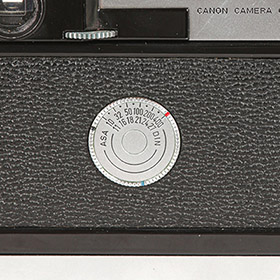
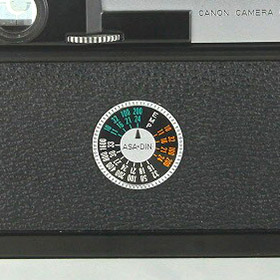
(Web images)
Accessory shutter coupled Canon Meter mounted via the accessory shoe:
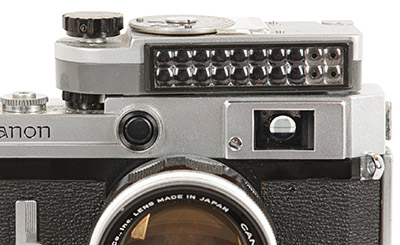 (Detail from larger web image)
See Canon Meters for more information.
Canon VI-L
Production (Peter Dechert) |
Marketed (Canon) |
Shutter Dial
|
Sync* |
S/Timer |
1958/06-1961/03 |
1958/09 |
X, B, 1-1000 |
M/FP/X |
Yes |
(*Sync: FP sync from 1 to 1/1000, except 1/30. M sync from 1 to 1/250, except 1/30. F bulbs 1 to 1/30. X sync at 1/55)
Serial Numbers |
||
Source |
From |
To |
| Peter Dechert | 600000 |
621000 |
| Found | 60061x |
62020x |
| Lens Mount: Universal | |||
| Normal 50mm Lens (Peter Dechert): Canon f/1.2, f/1.4, f/1.5, f/1.8 or f/2.8 |
|||
| Alternative 35 mm Lens (Peter Dechert): Canon f/1.5, f/1.8 or f/2.8 | |||
| Found with Lens: | |||
| Lens | Focal Length/ Description | Serial Numbers |
|
|---|---|---|---|
From |
To |
||
| f/1.2 Canon | 50mm Black | 2652x |
4893x |
| f/1.8 Canon | 50mm Black | 20516x |
23783x |
| f/2.2 Canon | 50mm Black | 1026x |
|
The Canon VI-L is the lever wind companion model to the VI-T released at the same time but like the late L3, VL and VL-2 lever wind models and unlike its trigger operated sibling, its name is not marked on the body. All the same improvements apply including the non-spinning single shutter dial, increased magnification viewfinder, raised X sync speed, auto frame counter reset etc.:
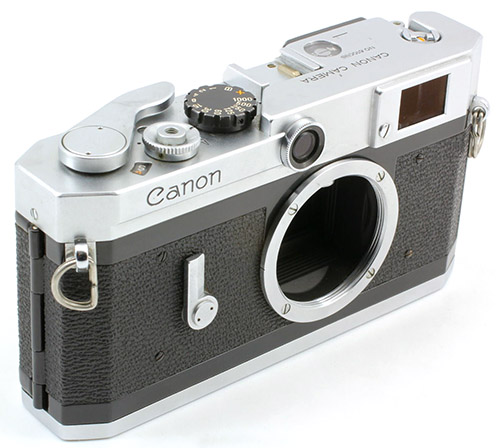 (Web image)
I have found only one f/2.2 lens (released in January 1961) with a VI-L (a late example). Whilst according to Peter Kitchingman, the lens was made for the Canon P, the VI-L was still in production and I have only found one with the Canon P as well. Whether any were sold with the VI-L is unknown. Peter's reasoning for singling out the Canon P is that the two colour distance scale of the lens matches the colours of the later type Canon P film reminder dial on the back, this also featured on the very late VI-L (and also right at the end of the VI-T, see above) - it's there on the last two VI-L cameras in my database, 62011x and 62020x but not the previous one, 61580x (the only large gap in my VI-L database), or the late example found with the f2.2 lens. Peter Dechert didn't identify this lens, it is believed to have been sold only in the Japanese domestic market and is quite hard to find.
 (Web image)
Example with meter mounted and the earlier and much more common black on silver film reminder dial:
 (Web images)
The VI pair were not a success for Canon, the VI-T was a hard sell in any case but the reality was that they were only a little less expensive than Leica M3 and Nikon SP but the VI pair had been late to market and didn't offer enough to get attention. Nevertheless, the VI-L is an excellent camera and has more to offer than the very popular Canon P offspring.
See Canon Meters for more information regarding the accessory coupled exposure meter.
Canon P (Populaire)
Production (Peter Dechert) |
Marketed (Canon) |
Shutter Dial
|
Sync* |
S/Timer |
1958/12-1961/05 |
1959/03 |
X, B, 1-1000 |
M/FP/X |
Yes |
(*Sync: FP sync from 1 to 1/1000, except 1/30. M sync from 1 to 1/250, except 1/30. F bulbs 1 to 1/30. X sync at 1/55)
Serial Numbers |
||
Source |
From |
To |
| Peter Dechert | 700000 |
798000 |
| Found | 70007x |
79x999 |
| Lens Mount: Universal | |||
| Normal 50mm Lens (Peter Dechert): Canon f/1.2, f/1.4, f/1.8 or f/2.8 |
|||
| Alternative 35 mm Lens (Peter Dechert): Canon f/1.5, f/2 or f/2.8 | |||
| Found with Lens: | |||
| Lens | Focal Length/ Description | Serial Numbers |
|
|---|---|---|---|
From |
To |
||
| f/1.2 Canon | 50mm Black | 3610x |
4246x |
| f/1.4 Canon | 50mm Black | 1902x |
2857x |
| f/1.8 Canon | 50mm Black | 24238x |
30186x |
| f/2.2 Canon | 50mm Black | 1001x |
|
| f/2.8 Canon | 50mm Black | 3754x |
|
(The 50 mm f/2.2 was made from January to June 1961, believed to have been for the Japanese domestic market only. It is a hard to find lens these days and not identified in Peter Dechert's book.)
The Canon P, in some markets known as the “Canon Populaire” certainly lived up to its name with 87,875 produced, second only to the Canon 7. This was at a time when other Japanese rangefinder makers were either abandoning the market or going bankrupt. The Canon P is the third Series VI model and is the VI-L with simplified viewfinder and the accessory shoe parallax correcting pin removed, changes which enabled a price that seemed to totally change the value for money perception.
The viewfinder/rangefinder was modified by removing the variable magnification facility and making it 1x with a 35 mm bright line frame added to the 50 mm and 100 mm parallax corrected frames:
Whilst the magnification was competitive, it was applied to an exisiting rangefinder design with a relatively short base length of either 43 mm (Canon) or 41 mm (other sources) resulting in an Effective Base Length of either 43 mm or 41 mm, about 2/3 of the Leica M3 and Nikon EBLs and the shortest of any Canon since the 1946 S II. First image shows shutter coupled Canon Meter 2 mounted (see Canon Meters for more information):
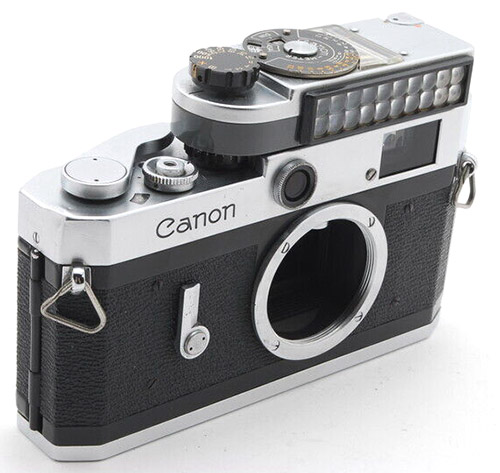
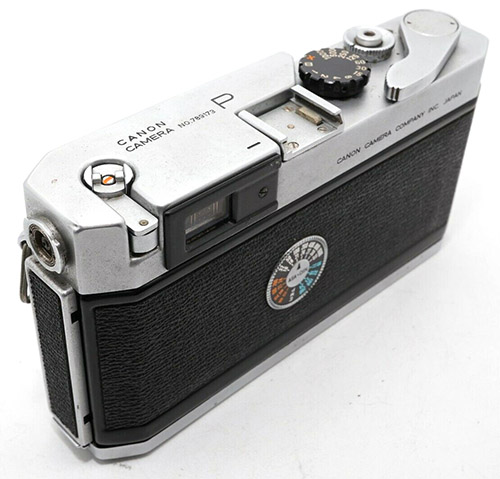
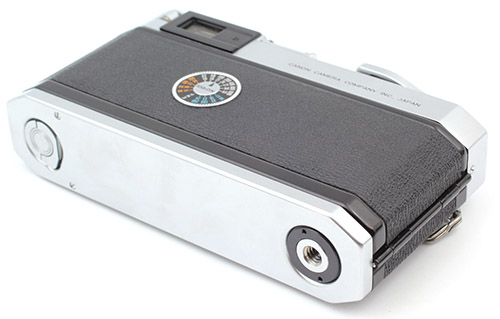 (Web images)
Like the Canon VI-T and VI-L, the Canon P started with a black on silver film reminder dial on the camera back and changed to the colour coded type above. Being introduced some 6 months later, the Canon P change occurred very early on between serial numbers 70711x and 70994. First black on silver type:
 (Web image)
Black bodied example with matching black 50 mm f/1.8 lens:
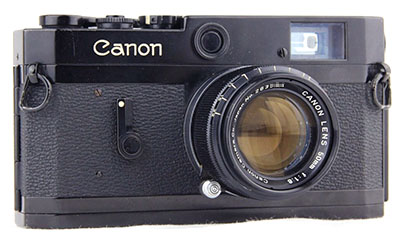 (Web image)
Canon 7
Production (Peter Dechert) |
Marketed (Canon) |
Shutter Dial
|
Sync* |
S/Timer |
1961/06-1964/11 |
1961/09 |
X, T, B, 1-1000 |
M/FP/X |
Yes |
(*Sync: FP sync from 1 to 1/1000, except 1/30. M sync from 1 to 1/15. F bulbs 1 to 1/30. Electronic flash at X, B and 1 to 1/30 positions)
Serial Numbers |
||
Source |
From |
To |
| Peter Dechert | 800000 |
999000 |
| Found | 80135x |
94155x |
| Lens Mount: Universal | |||
| Normal 50mm Lens (Peter Dechert): Canon f/0.95, f/1.2, f/1.4 or f/1.8 |
|||
| Found with Lens: | |||
| Lens | Focal Length/ Description | Serial Numbers |
|
|---|---|---|---|
From |
To |
||
| f/0.95 Canon | Black | 1133x |
1498x |
| f/1.2 Canon | Black | 5053x |
5154x |
| f/1.4 Canon | Black | 5215x |
11577x |
| f/1.8 Canon | Black | 29695x |
33749x |
| f/2.2 Canon | Black | 1282x |
1385x |
(The 50 mm f/2.2 was made from January to June 1961, an economy option believed to have been for the Canon P, and possibly the Canon VI L, for the Japanese domestic market only. It is a hard to find lens these days and not identified in Peter Dechert's book. However, I have only found one lens with a Canon P, one with a VI-L but three with Canon 7 bodies. Lenses get swapped around but all three have higher serial numbers than those on the other two cameras. It is possible, but by no means necessarily likely, that excess stock may have been sold with some Canon 7 bodies.)
In September 1961, Canon launched the Canon 7, its by far most successful model of all with 137,250 made. It featured a built-in shutter coupled exposure meter, projected frame lines rather than the earlier reflected type and an external bayonet lens mount for the optional f/0.95 50mm lens (also used with the Mirror Box II reflex housing). It was also the last model available in black.
The superstructure was new, incorporating the new viewfinder, its illumination window and the selenium cell exposure meter, essentially the Canon-Meter 2 built in. The “T” setting made a return to the shutter dial and the film rewind crank changed from the unique Canon recessed design to the more common crank on a disc type. The camera's footprint remained the same but its height increased to be basically the same as the trigger operated models. However, the superstructure is thicker than earlier models with the selenium cell adding a some millimetres at the front and the rangefinder/viewfinder housing bulging out at the rear.
The rangefinder base length was increased to 59 mm to improve focusing accuracy, particularly with the new f/0.95 lens. Peter Dechert notes that the base length is longer than any previous Canon model but with magnification of 0.8x, the effective base length (EBL) is only 47.2 mm which is significantly less than the Leica and Nikon competition and less than Canon models offering 1.5x magnification (variable magnification models) and only longer than the 1946 Canon S II and Canon P. However, the viewfinder is a far more useable and pleasant experience than Canon's earlier ones. The five projected frame lines are parallax corrected and selectable with a four position dial switch on the top plate; 35 mm, 50 mm, 85 mm and 100 mm together and 135 mm.
The large meter readout in the middle of the top plate caused a problem for placement of the accessory shoe so it was simply omitted, probably the main negative that can be said about the camera. To be fair, the Canon flash system didn't require an accessory shoe and most focal length lenses didn't require a matching accessory viewfinder and in any case, Canon did offer two accessory shoe types. Both mounted via the sync socket bayonet, the smaller neater one placing the shoe over the rewind knob and only really being suitable for non-Canon flashguns, the larger one placing the accessory shoe in the middle of the top plate over the meter readout and this also makes it suitable for mounting viewfinders for wider and longer lenses, an essential feature of most rangefinder cameras. However, the removable shoes are ungainly extras and not entirely satisfactory solutions, both have to be removed to rewind film and whilst the larger one has a cut-out for the meter readout, the meter is difficult to read with anything mounted in the shoe. Canon was happy to sell you one of these shoes back in the 1960s but finding them these days is not easy.
The Canon 7 was undoubtedly the finest LTM rangefinder made till then, only surpassed by the updated Canon 7s. It is not perfect but features wise it was also competitive with the perhaps slightly more professional Nikon models (by then, they had ceased series production) and the rangefinder benchmark, the Leica M3.
Canon 7 with f/1.18 50mm lens which was now the budget option. The serial number is a bit early for this model and the lens probably originally belonged to a Canon VI-T, VI-L or P:
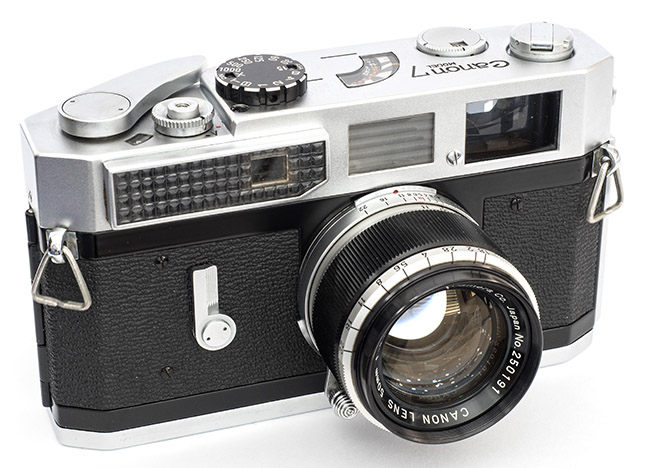
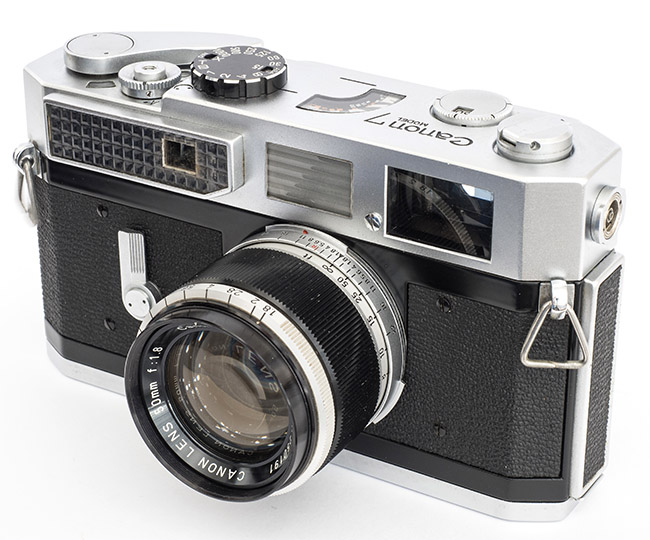
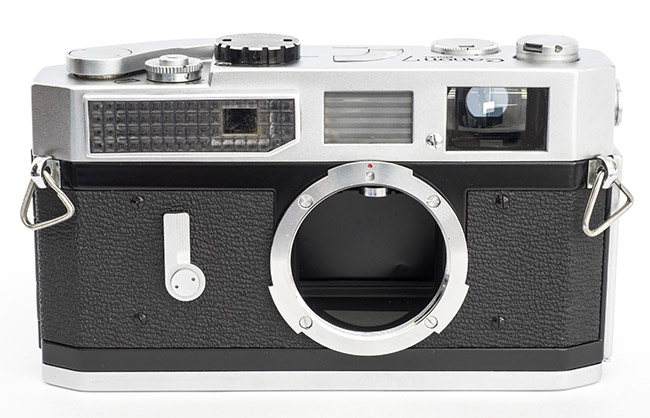
The knob on the back is for setting the light meter sensitivity:
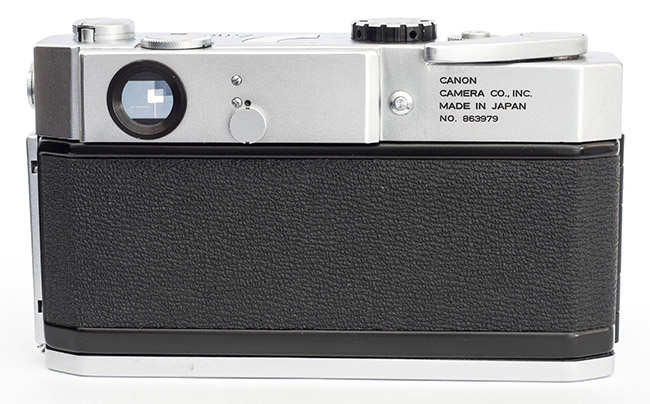
The dial near the rewind crank is for selecting the viewfinder frame lines:
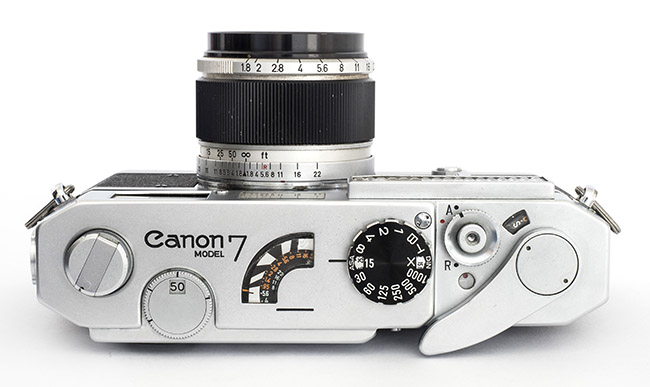
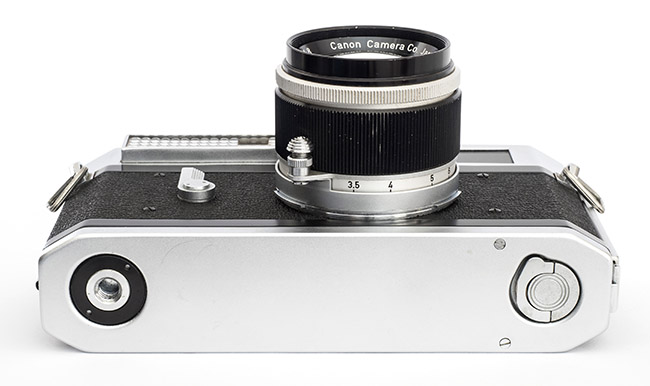
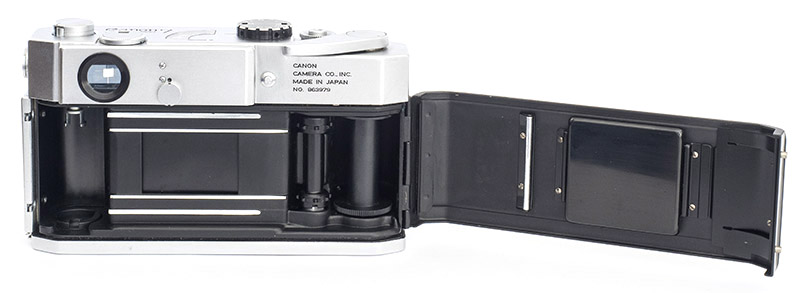
An example with the f/0.95 50 mm lens mounted:
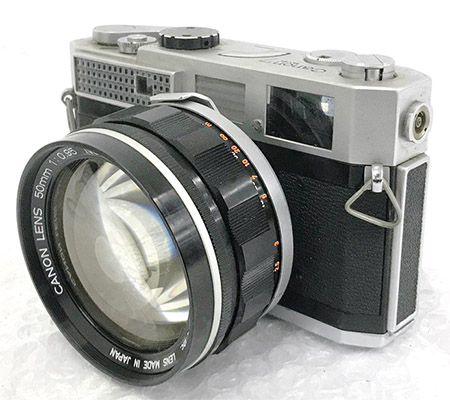 (Web image)
A black body (with correct paint over brass strap lugs, white dot on self-timer and chrome film rewind crank) and an example with Bell & Howell co-branding resulting from Bell & Howell taking over USA distributorship in 1962 (features the rare Canon 50 mm f/2.2 lens but this is almost certainly not original to the camera, production ended mid-1961 at the time of the Canon 7 release, well before the Bell & Howell distributorship, and in any case, it was likely a domestic Japanese market only product):
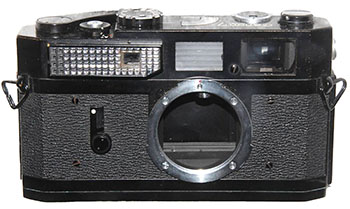
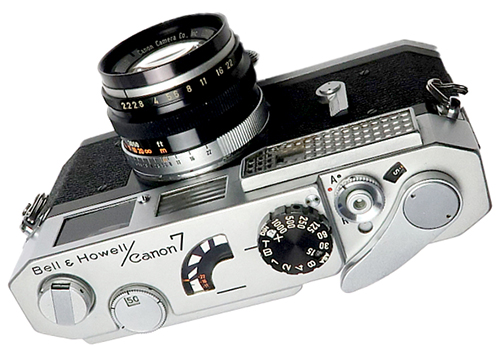 (Web images)
Canon 7s
Production (Peter Dechert) |
Marketed (Canon) |
Shutter Dial
|
Sync* |
S/Timer |
1965/02-1967/08 |
1965/04 |
X, T, B, 1-1000 |
M/FP/X |
Yes |
(*Sync: FP sync from 1 to 1/1000 plus B and T, except 1/30. M sync from 1 to 1/15 plus B and T, also from 1/60 to 1/250 “where only the central part of the picture is necessary”. F bulbs 1 to 1/30 plus B and T. Electronic flash at X, B, T and 1 to 1/30 positions)
Serial Numbers |
||
Source |
From |
To |
| Peter Dechert | 100000 |
118500 |
| Found | 10072x |
11557x |
| Lens Mount: Universal | |||
| Normal 50mm Lens (Peter Dechert): Canon f/0.95, f/1.2, f/1.4 or f/1.8 |
|||
| Found with Lens: | |||
| Lens | Focal Length/ Description | Serial Numbers |
|
|---|---|---|---|
From |
To |
||
| f/0.95 Canon | Black | 1700x |
|
| f/1.4 Canon | Black | 10767x |
|
| f/1.8 Canon | Black | 28777x |
33179x |
The Canon 7s was released in April 1965. This update brought two significant improvements and some smaller related changes. The biggest change was the replacement of the selenium cell exposure meter with a battery powered CdS type. In the process, a new small meter readout window in the top plate allowed the second major change, the return of the accessory shoe.
The new exposure meter resulted in several other changes as well. A battery compartment was added to the base plate (see below) and the Canon 7 meter sensitivity switch, function now incorporated into the CdS cell bezel, was replaced by a meter off/on switch with battery check position.
Two minor unrelated changes were the removal of the bayonet flashgun mount, probably due to rationalising flashgun production away from bayonet models to more standard types shared with Canon's SLRs and fixed lens rangefinders, and restarting serial numbers at 100000 with 6 digits instead of ticking over to 7 digits.
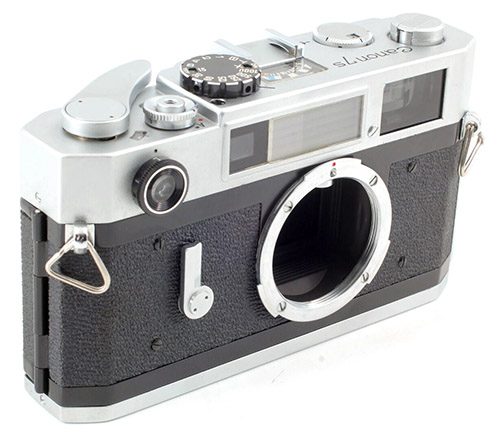 (Web image)
The rear of a different camera, this one has the <EP> mark on the film wind lever. The light meter sensitivity knob is now an exposure meter on-off switch and battery check:
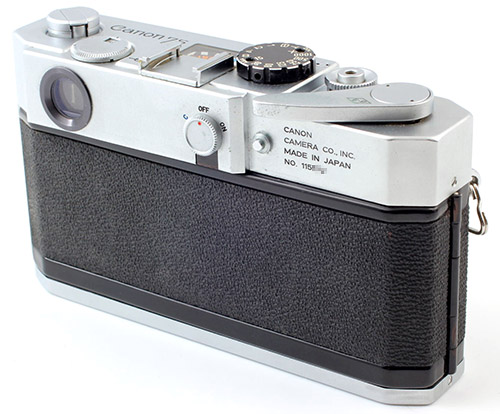 (Web image)
The battery compartment for the CdS meter is where the tripod mount used to be so the mount was moved towards the other end:
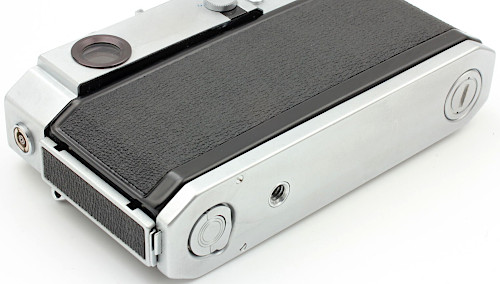 (Web image)
The PC flash sync socket on the end of the camera is now without the bayonet fitting of the Series 5 to Canon 7 models making it necessary to use either a typical accessory shoe mount type or bottom mount bracket. Note the spanner slots in the fitting, these disappeared with the 7sZ:
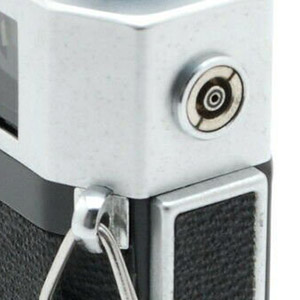 (Detail from larger web image)
Canon 7sZ (Peter Dechert name)
Production (Peter Dechert) |
Marketed (Canon) |
Shutter Dial
|
Sync* |
S/Timer |
1967/08-1968/09 |
n/a |
X, T, B, 1-1000 |
M/FP/X |
Yes |
(*Sync: FP sync from 1 to 1/1000 plus B and T, except 1/30. M sync from 1 to 1/15 plus B and T, also from 1/60 to 1/250 “where only the central part of the picture is necessary”. F bulbs 1 to 1/30 plus B and T. Electronic flash at X, B, T and 1 to 1/30 positions)
Serial Numbers |
||
Source |
From |
To |
| Peter Dechert | 115000 |
123000 |
| Found | 11647x |
123001 |
| Lens Mount: Universal | |||
| Normal 50mm Lens (Peter Dechert): Canon f/0.95, f/1.2, f/1.4 or f/1.8 |
|||
| Found with Lens: | |||
| Lens | Focal Length/ Description | Serial Numbers |
|
|---|---|---|---|
From |
To |
||
| f/1.4 Canon | Black | 11382x |
11693x |
| f/1.8 Canon | Black | 31873x |
34381x |
Canon made some improvements to the Canon 7s during its production run but whilst Canon chose not to identify it differently, or additionally, to the original, author Peter Dechert decided that it needed its own name and coined “Canon 7sZ”, the “Z” being the final letter in the Roman alphabet seemed to be a fitting name for the last model. For the record, I don't like the idea of inventing names for models that didn't exist, there are other ways of identifying an updated version, e.g. “late type”, maybe in brackets, but 7sZ has stuck almost universally so that is what we all call it, even though you will not find that model in the Canon Camera Museum.
The external changes are the screw-in PC flash sync socket no longer has any spanner slots, the rewind crank and knob are now larger diameter and lower profile but are no longer semi-recessed and the cover for the rangefinder adjustment screw and cover has moved from adjacent to the top right of the shutter dial, just opposite the shutter button, to above and between the “n” and “7” in the name “Canon 7s”. The more important internal change was a new viewfinder/rangefinder to address ghosting issues with the Canon 7/7s. Note, the changes didn't occur simultaneously, there was a transition period from about camera serial number 11532x (featuring only the new rewind knob) to 11836x (first with new sync socket as well as the other two changes). In my database, the signature change to the rangefinder/viewfinder was around camera 11647x:
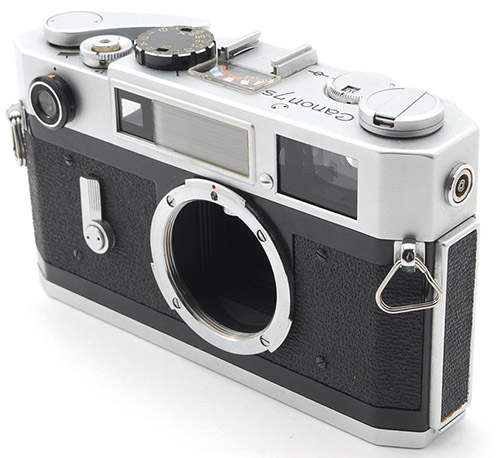 (Web image)
This then was the ultimate form of the ultimate series of Canon rangefinder cameras.