Canon
The first & most successful
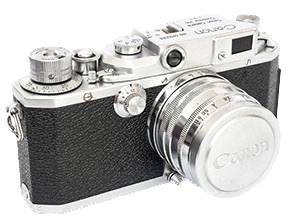
Contents Page 1
(Scroll down or click on Links)
User Manuals etc.
The Canon Story
Canon Distributors
Shimo-Maruko Factory
The “Canon” & Eagle Logos
The “Canon” Camera Name
“Made in” and Other Markings
Canon Serial No.s & Naming Conventions
Marked Model Names
Canon Rangefinder Body Dimensions
The Canon Rangefinder EBL
Black Bodies
Odd Spec Canon L and VL Cameras
The Canon Pages
Page 1 Canon
Page 2 Kwanon Prototypes
Page 3 Canon Models
Page 4 Canon X-Ray Cameras
Page 5 Canon Lenses & Accessories
Page 6 Canon Flash Units
My Canon Pages
I understand that there are Canon rangefinder owners, as there are Minolta 35 owners, that will take offence at the term “Leica copy” in reference to their camera. Like all categorisations, things are rarely black or white, most often they fall somewhere along a spectrum, in the case of Leica copies, from inspired by to exact copy. As explained on the Leica Copies Japan page, collectors, historians and authors such as HPR and Pont and Princelle have used certain criteria, not always agreed amongst themselves, to determine whether a camera is a Leica copy or not. In that context, the visual appearance and technical design solutions are secondary at best and maybe even immaterial. However, there is no doubt that Canon cameras were heavily influenced by Leica and that at least from 1951 onward, Canon was fully compatible with Leica, even if it offered unique features and the designs diverged widely from the mid-1950s on.
My Canon pages are different to both my other Japanese Leica copies pages on this site and my other site, Yashica TLR. Whilst I am fairly confident that those pages and site are the most detailed and accurate about their camera models that you will currently find on the Internet, I cannot claim the same level of confidence for this Canon page, although I will continue to work hard towards that end.
I have come to Canon rangefinder cameras late, in fact it is the last step in my journey, whereas it is actually the starting point for the Japanese Leica copies story and along with initial lens partner, Nikon, one of the milestones and major drivers of the Japanese photographic industry. There are many Canon enthusiasts everywhere with a lifetime interest and commitment to the brand and I could not hope to match their knowledge in such a short space of time. And of course there is Canon itself.
Nevertheless, to complete this website and put the Leotax, Nicca, Minolta and Yashica models I have previously written about into context, I've dived right in. The Canon rangefinder range is vast and the lens and accessories ecosystem is huge and therefore I have had to be selective as to what is included. Some of the more nuanced detail may be lacking but I have tried to provide enough guidance about where to look. As with all my pages, my aim is to question everything and be as accurate as possible.
One area that I have devoted significant effort to are the historical facts around the Kwanon prototypes and the first production camera, the Hansa Canon. The reason is that the two heavyweights in Canon history research, author Peter Dechert and Canon itself, are in the ring duking it out over whether the advertised Kwanon cameras existed, or not, and hence their impact. In the process, some interesting observations and tidbits from Japanese sources seem to have been missed. Without giving anything away, I note that whilst Canon does seem to mess up some of the detail on its Camera Museum site, in regard to the big questions, it did have people there at the beginning, including one of its later presidents.
My name is Paul Sokk and I can be contacted by email at paulsokk@live.com.au.
Links to the Good Stuff
First to the books. Anyone serious about collecting Canon interchangeable lens rangefinder cameras and/or their history should seek out the seminal work, “Canon Rangefinder Cameras 1933-1968” by Peter Dechert. This was first published in 1985 but time has not diminished its stature - work by others since has added to our knowledge but changed little of what Peter had researched. That's not to say that there is nothing that invites questioning. One such instance, concerning his Canon 1950 model, he corrected himself with his 2006 Shutterbug article. Nevertheless, I have relied heavily on the guidance his book provides, both directly and through other sites and authors. Now out of print but used copies do become available. His monograph, “The Contax Connection”, which can be found on the Internet, also covers early Canon history and the company's relationship with Nikon and is worth the read for that, but in my view, then gets some things wrong about post-War Nicca history and Yashica rangefinder models, which in fairness was not the focus of this article, or his research. However, that is more of a problem for those pages of this site than this one.
In his preface, Peter Dechert acknowledges people that assisted him along the way. Two of the most important are Japanese contributors Mikio Awano and Hayato Ueyama. Mikio Awano was the editor and publisher of “Camera Collectors' News” and also a key contributor to Koichi Sugiyama's book, “Collector’s Guide to Japanese Cameras”. I have relied on Camera Collectors News articles for several camera histories on this site, including this page, see below. Hayato Ueyama was a Canon ex-employee and is the author mentioned further below.
A camera is only as good as the lens/lenses it is offered with. Peter Dechert didn't provide much detail in this regard, particularly of the many minor variations found, but Canon aficionado and author Peter Kitchingman has covered it all in his really excellent book “Canon M39 Rangefinder Lenses 1939-1971”. Published in 2008, also out of print but in early 2023, the author still has some copies. (I'll say it now, whilst it is easy shorthand and has become common practice, I think the use of the “M39” name is misguided, the “M” stands for metric and applies to mainly Soviet cameras, both rangefinder and early SLRs. Although early Canons used bayonet, “J” and semi-universal mount lenses, the vast majority of Canon lenses used the Leica standard 26 threads per inch Whitworth, i.e. it is not a metric thread despite the 39 mm diameter. To argue that M39 is acceptable is to argue that the J mount with its 39 mm diameter is also M39.)
An excellent book recommended by Peter Kitchingman and others is “Canon Vol.1 All About Seiki Kogaku” by Japanese author Hayato Ueyama (see connection to Peter Dechert above) published in 1990 in Japanese. It covers the Seiki Kogaku period from the beginning to the name change to Canon in September 1947 with the focus being on the cameras and variations, including lenses, accessories and also prototypes, but there are also fascinating insights that only a native Japanese speaker with many contacts in the enthusiast community would have acces to, including Seiki Kogaku employees from the early days. Flynn Marr has a machine translated version on his website, link below. That in itself has been a massive task but be aware that not everything in Hayato Ueyama's book is included in the PDF, nor does the PDF reflect the quality of the images.
Japanese enthusiast magazine, Camera Collectors’s News. This is the magazine edited and published by Mikio Awano mentioned above. Both the magazine and Mikio Awano are referenced by Hayato Ueyama. I have a December 1977 edition with an article by Awano on the Canon J, JS and J II and I also have the May and June 1982 editions which include Parts 2 and 3 respectively of the early Canon story, both featuring the Hansa Canon and Canon original and offering some interesting insights and alternatives. I believe that Part 1, presumably April 1982, covers the Kwanon period and that there is at least a Part 4 covering subsequent models, these I have yet to find. The author of Parts 2 and 3, and possibly all parts, is Kannonji Makoto.
Next the Facebook page, “Canon Historical Society” established by Pacific Rim Camera. Peter Dechert posted here before his passing and Peter Kitchingman is a regular plus there are other luminaries and many, many other contributors doing their own research - an excellent resource. However, note that as with any forum, you have to discern reliable information from the merely opinionated, or ill-informed comment.
Finally, links to Canon Rangefinder Related Sites. Not in any particular order but for anyone looking for documentation like user manuals, brochures etc., Pacific Rim Camera offers a boatload of free stuff for download as PDFs (plus lots of stuff for sale) and a great guide for identifying your Canon model (similar on the flynngraphics site):
https://global.canon/en/c-museum/ Canon History Museum (Note, Canon is not infallible with its own history, there do appear to be errors and omissions)
https://pacificrimcamera.com/rl/rlCanonRF.htm Reference Library - Canon Rangefinder. Camera, lens and flash manuals, brochures, price lists
https://butkus.org/chinon/canon.htm Mike Butkus. Camera and flash manuals
http://photosynthesis.co.nz/nikon/lenses.html#RF_5cm Roland. Nikkor lenses for early Canons
https://w.atwiki.jp/saltysugar/pages/28.html A PDF copy of the 1936 Omiya Photo Supply catalogue with 7 pages devoted to the new Hansa Canon can be downloaded from Hansa Canon & Canon Original below, or Mike Eckman's Hansa Canon/ Canon Original review page, however, the original document was located on this Japanese site. Unfortunately, the links to PDFs of manuals and catalogues no longer work, but for lens nerds, clicking on “Top Page” in the sidebar will take you to a page of links including “Calculating the Canon 50mm F0.95”. Suggest using the Google Translate feature of Chrome
https://mikeeckman.com/2022/02/canon-original-hansa-1935/ Mike Eckman. Hansa Canon
https://mikeeckman.com/2019/10/canon-ivsb-1952/ Mike Eckman. Canon IV-Sb
https://mikeeckman.com/2016/02/canon-p-1961/ Mike Eckman. Canon P
https://mikeeckman.com/2021/02/canon-7-1961/ Mike Eckman. Canon 7
http://corsopolaris.net/supercameras/CanonRF/CanonRF.html
https://flynngraphics.ca/the-collection/ Flynn Marr. Canon collection, camera and flash manuals
https://flickr.com/photos/80936052@N00/albums/72157704498817892 Kirk Thorsteinson. Canon X-ray cameras, copy stand and other Canon stuff.
https://yashicasailorboy.com/category/canon-model-7/ Chris Whelan. A little Canon 7 stuff, but this is an unashamed plug for my friend whose contributions have helped and encouraged me across the pages of my sites. For lovers of rangefinders, you'll also find a little on a Leica IIIg, Niccas and Yashicas. Not to mention his Canon F-1s.
User Manuals etc.
Links to download user manuals and other useful documents were provided above. Below are links to my own small number of manuals, some the same as elsewhere, some a little different. These are also linked from the items they relate too. Click on cover for PDF of full manual, or for larger image, as appropriate.
Cameras
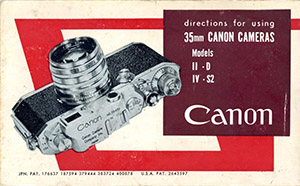
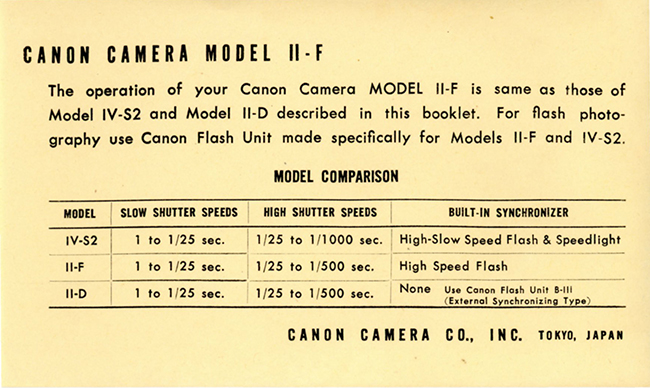
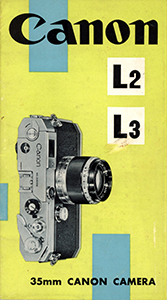
Canon II-D and IV-S2 manual (July 1953), Canon II-F (and D) addendum and Japanese Canon L2 and L3 manual (October 1957):
Lenses
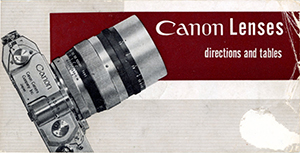
Canon Lenses Directions and Tables, undated but identical to August 1954 and January 1955 printings:
Flash
Two page Flash Unit B instruction sheet in English on fragile rice paper which may well be 75 years old. Whether this served as the English instructions at the time, or it has been copied from the original, the wording seems to be in the authentic Canon style:
.jpg)
Flash Unit B 1 packing slip below left and user manual on the right, both dated December 1950:

.jpg)
Late Flash Unit X manual, August 1952, and late Flash Unit Y manual, October 1955:
.jpg)
.jpg)
Auto-Up
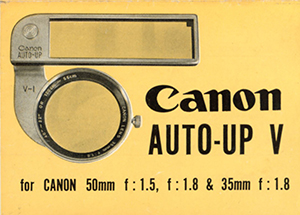
Japanese instructions for V series Auto-Up, June 1957:
The Canon Story
The historical context leading up to the establishment of Canon as Seiki Kogaku Kenkyujo (Precision Optical Instruments Laboratory) and its early models, including Nippon Kogaku's (today's Nikon) important role, is broadly covered in The Japanese Copy Makers. Seiki Kogaku was founded in November 1933 by two men with no real experience in camera design, or production, and no product but they had a belief that Japan could produce a camera equal to the German Leica and Contax. The enterprise was initially located on the third floor of the Takekawaya apartment building at 62 Roppongi, Azabu-ku (Azabu Ward, these days, 7-14-4 Roppongi, Minato-ku, or Minato Ward) in Tokyo:

Goro Yoshida had the ideas and his brother-in-law, Saburo Uchida, was the businessman. Others that joined them included Takeo Maeda, a colleague of Uchida, and Tomitaru Kaneko who became the first factory manager. Only Maeda would remain long term, becoming Canon's president in 1974. Goro Yoshida (1900-1993) at age 41 after he had left Seiki Kogaku and later in life:
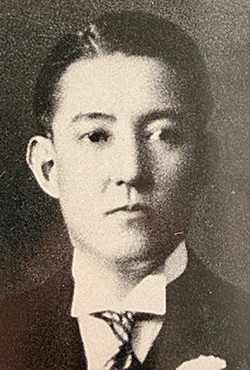
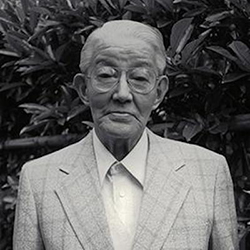
(Left image from Hayato Ueyama's book)
Later in life photos of Saburo Uchida (1899-1982) and Takeo Maeda (1909-1977):
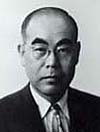
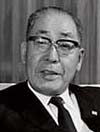
Goro Yoshida was the driving force force for developing a Japanese precision 35 mm camera and principally responsible for the prototype, or perhaps more correctly, concept designs. Without his dream, there likely would not have been the birth of Canon, although ultimately, he probably contributed little to the first Canon production model. Yoshida was born in Fukuyama-shi, Hiroshima-ken (Fukuyama City, Hiroshima Prefecture) in 1900 and went to Tokyo before completing his middle school education and was apprenticed with a company repairing and remodeling motion picture cameras and projectors so he knew his way around camera type equipment, tools and instruments. In October 1933, Yoshida approached Uchida to ask for financial assistance for his venture and so the journey commenced. Uchida was born to a wealthy kimono wholesaler in Kurashiki-shi, Okayama-ken (Kurashiki City, Okayama Prefecture) in 1899 and after graduating in law at Tokyo Imperial University, was employed by a securities firm. At some point between 1932 and 1934, Yoshida famously disassembled a Leica II camera and discovered it was made of ordinary materials that didn't seem to justify its exorbitant price, not “special items like diamonds”.
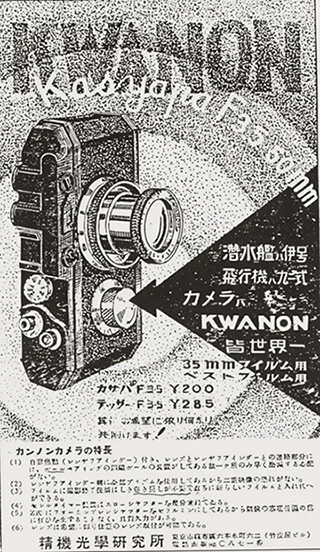
The prototype designs, the first evidence of which was a drawing that appeared in a June 1934 advertisement, were named “Kwanon” after the Buddhist Goddess of Mercy and its 50 mm f/3.5 lens with Leitz Elmar-like collapsible lens barrel was called “KasyaPa” (note, written on the lens with a capital “P”) after a disciple of the Buddha, Mahakasyapa. The source of the lens is unknown but also presumed to be a prototype - there, was as yet no market for a 35 mm lens. According to Hayato Ueyama, when asked about the source of the KasyaPa lens, Goro Yoshida claimed it was made by a “lens shop near Kanda Manseibashi Bridge”, but Ueyama says that the actual location of the “lens shop” is unknown and the claim can't be verified. June 1934 ad:
The body design was influenced by both an admiration for the Contax I and its Zeiss Ikon creator and the practicality of the Leica II. Film transport was cassette to cassette so no rewind knob was required. The film winding and shutter cocking knob looked similar to the Leica item but was mounted on the front in Contax I style.
It was decided to rename the production camera “Canon” which was pronounced the same but perceived as less religious and also more acceptable in English. Somewhat perversely, “canon” means rule, law or principle but is most often used in the context of Christian law. A trademark application for the name was filed in June 1935 and granted in September 1935. The first mention of the Canon (already as the “Hansa Canon”) was in the new products column of the October 1935 edition of Asahi Camera magazine with sales believed to have begun in February 1936. Below is a schematic of the Laboratory's workforce structure in around 1935 translated from Hayato Ueyama's book (page 14):
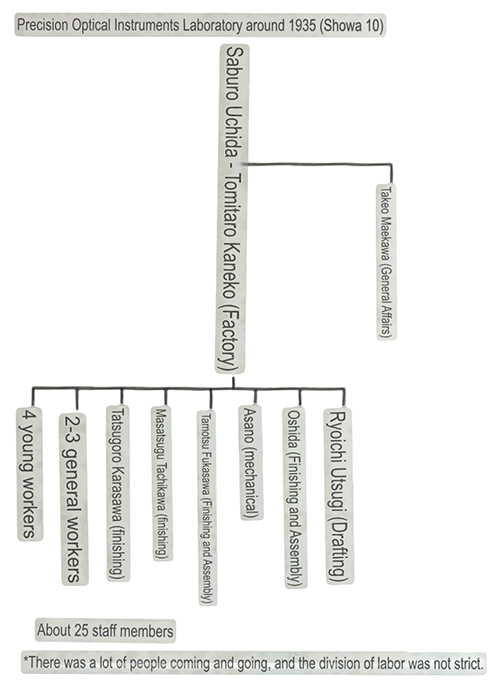
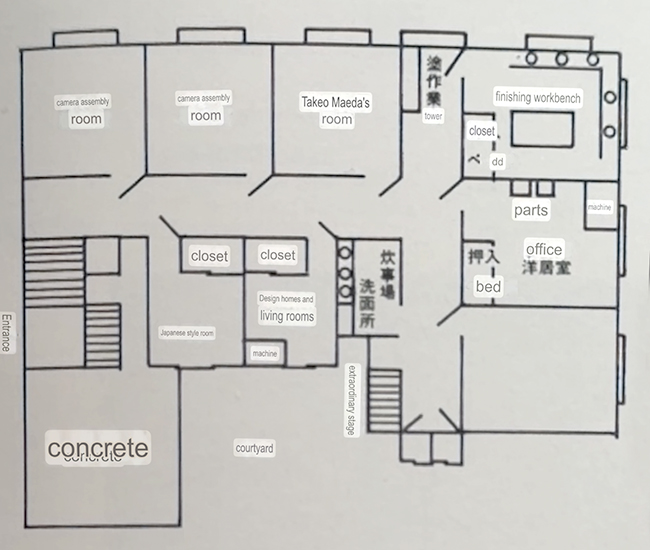
Internal layout of the Laboratory, as translated from page 13 of Hayato Ueyama's book. I suspect that this is also from 1935, or early 1936, as it seems to be set up more for making cameras than the design phase and there is no mention of Goro Yoshida. Ueyama lists the equipment as one Pauley(?) bench mill, one Lorch bench lathe, one small lathe and two drill presses. He says that drawings were done freehand and the only inspection tools were callipers and micrometers:
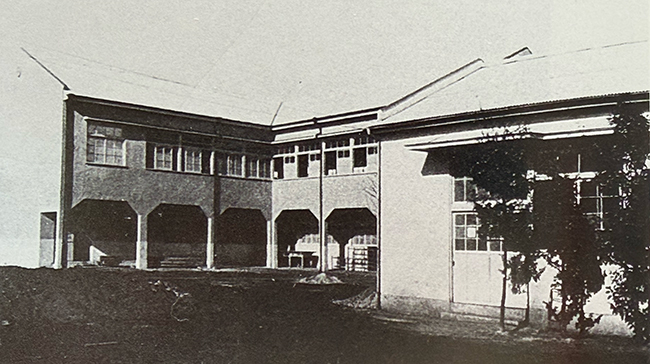
Initially, production was very low as new skills were being learnt and experience developed with much rework needed. Equipment was basic. It picked up in June 1936 when a larger facility was acquired at No. 82, Nakane-cho (Nakane town), Meguro-ku (Meguro Ward), Tokyo. According to Hayato Ueyama, it was a long single story building among farming plots near the Nomigawa River. At the same time, the Laboratory's name was changed to “Nippon Precision Optical Instruments Laboratory”, first appearing in the Hansa Canon ad in the August 1936 edition of Asahi camera. The new factory pictured in 1937 (page 16 of Hayato Ueyama's book):
The production camera was somewhat different to the Kwanon with lens, focusing mount and rangefinder system now designed and made by Nippon Kogaku. These were significantly changed to avoid infringing Leica's Japanese patents granted in 1934. Goro Yoshida had been unable to come up with a workable alternative so Saburo Uchida approached Nippon Kogaku where his brother, Ryonosuke Uchida, had worked as an auditor. Nippon Kogaku had been actively seeking to diversify from mostly military work and had appointed Toyotaro Hori to investigate potential opportunities. However, it meant that probably more than half of the value of the camera and lens set was now contributed by Nippon Kogaku, as was the accompanying research and development. Goro Yoshida became disillusioned with the direction camera production was taking and departed in late 1934 with design becoming the responsibility of Tomitaru Kaneko, a Nippon Kogaku graduate and factory manager.
Instead of the Leica mount's 39 mm thread with a pitch of 26 threads per inch (TPI), the mount for the Canon featured the same 39mm diameter but with a pitch of 24 TPI and the Nippon Kogaku made focusing mount was screwed into this. The removable lens barrel was inserted into it using a bayonet fitting. The design and execution was more than somewhat similar to the Zeiss Contax arrangement but the rangefinder connection was unique.
The viewfinder arrangement was also different, the rangefinder windows were in their expected positions but the viewfinder itself was a pop up type designed by Tomitaru Kaneko. This was colloquially known as “surprise box” (Canon Camera Museum, and Hayato Ueyama). The initial Kwanon drawings showed a centrally placed typically Leica type whereas the last design show a folding type mounted in a shallow recess on top of the rangefinder cover. The large dial on the front was the frame counter left over from the earlier Kwanon designs with the winding knob on the front. Curiously, but no doubt coincidentally, the counter arrangement was also somewhat reminiscent of the 1913 Ur-Leica (original prototype). Brochure featuring earliest type with viewfinder popped up in viewing position:
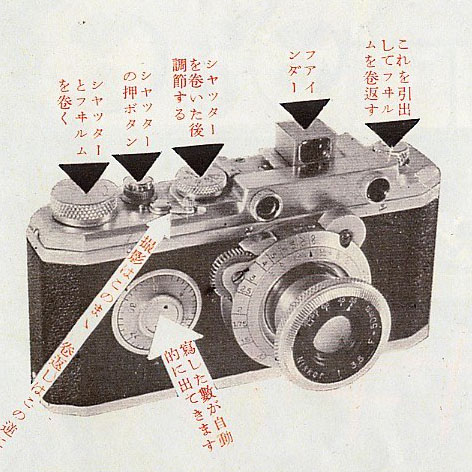
Slightly later example showing viewfinder stowed:
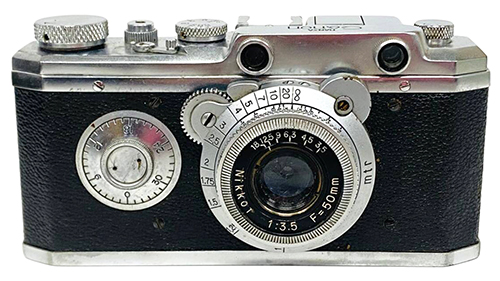 (Web image)
Perhaps in response to the 1934 release by Kodak of the disposable film cassette, production cameras featured a typical rewind knob in place of the cassette to cassette system of the prototype Kwanon (the reason for the change was possibly more complicated than that, see Kwanon D - Peter Dechert, Hayato Ueyama).
Commonly called “Hansa Canon” by collectors for convenience sake, and even by Canon in more recent times, the model name was simply “Canon” and back then, Seiki Kogaku called it “The Canon Camera”, or “Canon Standard Model”. “Hansa” was, and still is, a trademarked brand name used by the camera's distributor, Omiya Shashin Yohin Kabushiki-Kaisha (meaning Omiya Photo Supply Co., Ltd.) which usually appears above “Canon” on the camera's top plate (apparently derived from the “Hanseatic League”, a middle and northern European mercantile network originating in medieval times). Omiya Shashin Yohin owner, Hikotaro Noro, was one of the people instrumental in changing the name from Kwanon to Canon along with Saburo Uchida, Goro Yoshida’s brother-in-law and manager of the Laboratory’s business affairs. A very small number of cameras were sold directly by the factory and these don't have the Hansa engraving (called “Canon Original” by collectors). Marketing material issued by Omiya Shashin Yohin usually referred to the camera as “Hansa Canon”.
At this stage, the fledgling camera maker was only barely being kept afloat by Nippon Kogaku's interest in the project when Dr. Mitarai, an obstetrician and friend of Saburo Uchida, made his first investment in the business in 1937 and became its auditor. On 10 August of that year, with capital of 1 million yen, Precision Optical Instruments Laboratory was formed into Precision Optical Industry, Co., Ltd. (Seiki Kogaku Kogyo Kabushiki Kaisha) with the abbreviated maker name “Seiki Kogaku” appearing on models after the Hansa Canon.
In an article for Camera Collectors' News of September 1982, Kannonji Makoto writes that in September 1937, following Seiki Kogaku becoming a company, the Hansa name disappeared from advertising and later, also from the top plate. This is also confirmed by Hayato Ueyama. My database contains two early Canon Originals, one in the late middle and four right at the end, so that is consistent. More on this at Hansa Canon & Canon Original.
Peter Dechert tells us that “Dr Mitarai appears at first to have been interested in the development of indirect X-ray recording cameras” and Peter Kitchingman goes further to say that he “encouraged the company in its early days to produce and develop special X-ray equipment”. However, according to Hayato Ueyama, Seiki Kogaku first got involved when approached in 1939 by Dr Junjiro Okanishi, a relative of Saburo Uchida and Deputy Director of the National Research Institute for Infectious Diseases. Takeo Maeda and Katsuo Ando met with Dr Okanishi who showed them a foreign magazine which described how such a device might work and asked whether Seiki Kogaku could make him one to experiment with. The request was declined because there wasn't enough information about the camera and set-up and pressures of other work. Although nothing came of this, 12 months later when Nippon Kogaku and Konishiroku (later day Konica) couldn't accept orders placed by the Navy and Army Medical Schools because of exisiting military commitments, Seiki Kogaku was asked to develop one. It was a simple device and although it evolved over time, the basic design remained largely the same from 1940 until 1956, a 6 x 6 cmm version was added to the 35 mm camera in the late 1940s.
Back in 1939, a young lens technician cum designer Ryouzou Furukawa (Canon Camera Museum calls him Yoshizo Furukawa which may be more correct given translation issues) and several other workers were transferred from Nippon Kogaku along with some lens making equipment. One of the Seiki Kogaku first lenses was for a finger print camera and according to Hayato Ueyama, a number of prototype lenses were made including a 13.5 cm f/4 and a 20 cm f/4. An X-ray camera lens was developed (initially f/2 but redesigned into the R-Serenar 5 cm f/1.5) with the “Serenar” name being trademarked in December 1941.
To put the X-ray camera into perspective, Seiki Kogaku was not the only War-time producer. Konishiroku did actually develop their own Rubicon X-ray camera around 1940. It was based on its pre-War Rubikon prototype fixed lens leaf shutter 35 mm rangefinder camera and fitted with its own Luminon f/1.6 lenses (both 50 mm and 75 mm lenses are known to have been used). Like Seiki Kogaku's camera, versions continued to be made after the War. There was also the Nippon Koken X-ray camera, dating from 1942 or 1943, fitted initially with a Lumitar (unknown maker) 5cm f/1.5 and then a 5cm f/1.5 Xebec for Röntgen lens made by K.O.L. (Kajiro Optical Laboratory).
In July 1940, the Japanese Military Government had proclaimed that all camera production was to be for military use only, thereby complicating Seiki Kogaku's growth options. Production increasingly turned to munitions of various kinds, some optical, some not, some supporting Nippon Kogaku, some direct orders. In 1944, the company was placed under the control of the Ministry of Munitions, the Ministry of War and the Ministry of the Navy.
Earlier, Dr Mitarai became concerned with its business direction and in 1942, he became president of Seiki Kogaku. He guided the company through the War years including the acquisition of independent optical manufacturing company, Yamato Kogaku Seisakusho, in February 1944 and also the post-War reconstruction. Note, I understand that the Kanji character “大和” for Yamato can also be pronounced Daiwa - Canon uses Yamato, Peter Dechert calls it Daiwa. At the time of acquisition, it's production was almost entirely focused on 10x aviation binoculars.
To avoid confusion and lack of recognition between the company name and its product name, Dr Mitarai was instrumental in changing the Seiki Kogaku company name to “Canon Camera Company, Ltd.” with effect 15 September 1947 (Peter Dechert's book says 15 August), changing again in January 1951 to “Canon Camera Co., Inc.” On 1 March 1969, the name was shortened to “Canon Inc.” to reflect the fact that Canon was no longer just a camera company. Together with Takeo Maeda, the only surviving member of the original team, Dr Mitarai continued to lead Canon through its growth as president until 1974 after which he served as chairman until his death on 12 October 1984. Takeo Maeda succeeded Dr Mitarai as company president until 1977.
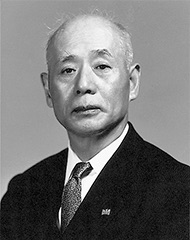 Dr Takeshi Mitarai (1901-1984)
The pre-War introduced models following the Hansa Canon continued to be different from Leica because of patent concerns. According to Hayato Ueyama, the Canon S was announced in October 1938 and advertised in November 1938 but the camera was still a prototype with the slow speed shutter dial offset and without crank - this was not finalised until 1939 which fits with the Canon claim that it was “marketed” in April 1939. It wasn't called the “S” back then, Seiki Kogaku called it “Canon Newest Model” whilst referring to the still current Hansa Canon/Canon Original as “Canon Standard model without slow speeds”. After Hansa Canon/Canon Original production ended and stock petered out, probably in 1940, the Newest Model became the new “Canon Standard model”. According to Peter Dechert, the reference to it as the “S model” became so established that by the end of the War, even the factory used the name:
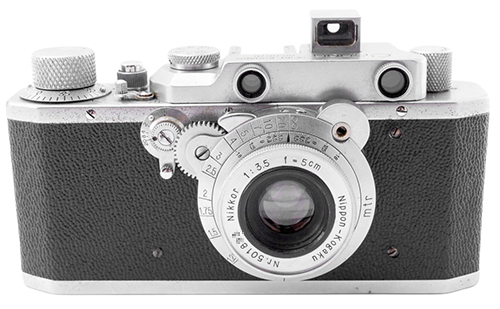 (Web image)
Also released in 1939, the budget model Canon J without rangefinder and slow speeds eliminated the expensive Nikon focusing mount and instead used the 39 mm 24 TPI screw mount directly in Leica fashion but of course was not Leica compatible. Without a rangefinder, it avoided Leica's focusing patent. This is now referred to as the “J mount”. At the time, Seiki Kogaku called the camera “Popular Model”. Peter Dechert tells us that early orders referred to as the “Junior Canon”, hence “J”, and after the War, the name stuck.
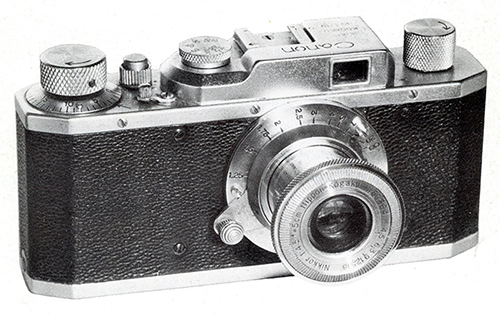
(From December 1977 edition of Camera Collectors' News magazine)
There were also the minor variations, the pre-War budget Canon NS, an S without slow speeds, and the Canon JS, a J with added slow speeds, perhaps intended as a copy camera for the military.
The War devastated Japan and afterwards companies were struggling to exist let alone survive or thrive. Seiki Kogaku had been fortunate, only the Itabashi factory, a legacy of the Yamato acquisition, sustained significant damage and that was the result of an accidental fire. The main Meguro factory and the Takara-mura and Yamura-machi factories, established to undertake War-time production evacuated from Tokyo, remained operational but were closed with the end of the War. In order to restart production, Dr Mitarai applied to the Allied Occupation Forces for permission to produce consumer goods and this was granted on 1 October 1945. According to sources quoted by Mikio Awano in his December 1977 Camera Collectors' News article, camera production restarted with a workforce of 156, including 43 women.
Initially, production used up War-time stocks of mainly Canon S parts but the focus was on the J model because this was the easiest and quickest to assemble into a saleable camera. The formally big and well resourced Nippon Kogaku was in a much worse postion post-War and may have struggled to provide focusing mounts, rangefinders and even lenses. Although a few J model cameras may have been made for the military during the War, “volume” production of a “few hundred” had ended in 1941 so the post-War version commonly used S bodies with the slow speed shutter dial hole blanked off and S viewfinder/rangefinder cover pressings. This version was called the “Canon J II”.
The Canon J II went on sale in December 1945 (Mikio Awano, January 1946 according to Canon) but by the end of 1945, only three cameras had been completed. However, by the time production ended in November 1946, some 560 had been made. The S model was produced at the same time but according to Peter Dechert, there were only a total of 97 made. However, unlike the J II, it appears to be physically identical to late War-time production and much the same as when released. This post-War production was referred to as the “S I” model but because they were assembled mainly from parts produced perhaps years earlier, even experts have trouble identifying an S I from an S.
Interestingly, the Canon Camera Museum acknowledges the role of an American automobile engineer, William Reagan Gorham, who became a naturalised Japanese citizen in 1941, having moved there in 1918, and during the 1940s provided Seiki Kogaku valuable production and quality assurance advice.
With German patents no longer an issue, the first post-War designed model was the Canon S II released in October 1946. Still with the signature Canon hexagonal body ends, it otherwise looked very similar to a Leica III except for the first major innovation, the rangefinder and viewfinder were combined and there was a single viewfinder window. It was initially fitted with Seiki Kōgaku's newly developed “Serenar” 5 cm f/3.5 lens followed by an f/2 option, although early on, there were still some Nikkor f/3.5 lenses as well. As Seiki Kōgaku production increased, the partnership with Nippon Kōgaku finally ended in 1948. Canon S II with Serenar f/3.5 5 cm lens shortly after the maker name change to “Canon Camera Co.”:
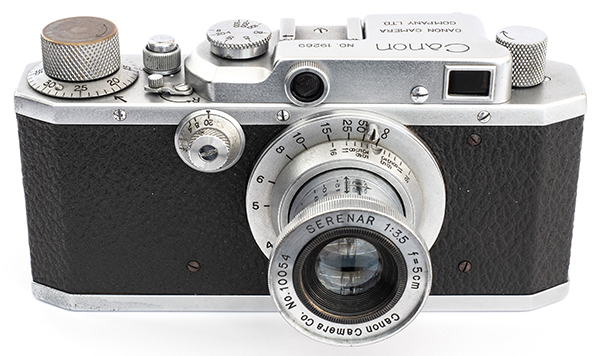
Peter Dechert tells us that the Canon S II featured a mount referred to as “semi-universal” which was close to the Leica standard but would accept the earlier J mount lenses as well as most Leica lenses - to make it work, the threads were cut sloppier (some have suggested more so on the body mount). Peter Dechert says that until 1947, Seiki Kōgaku and Nippon Kōgaku engineers, like the Soviets before them, believed that the Leica thread pitch was 1 mm (metric) without realising it was 0.977 mm (based on 26 threads per inch Whitworth). The rigid barrel f/1.8 50 mm Serenar, developed during 1951 and released with the Canon IV-F in January 1952, was the first Canon lens with “universal” mount, meaning it was finally fully Leica compatible.
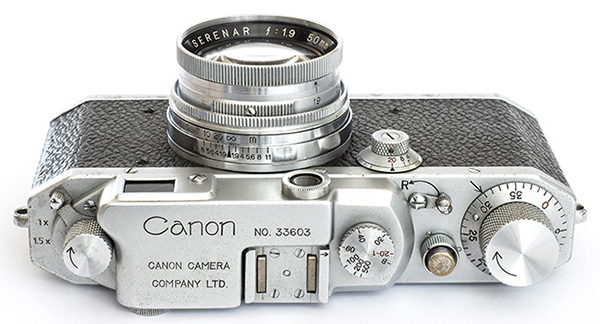
The real innovation and major success came with the next model, the 1949 Canon II B (initially called the S IIb), which added three level magnification to the viewfinder and was a unique Canon feature appreciated by photographers until parallax corrected frame lines were introduced in 1959:
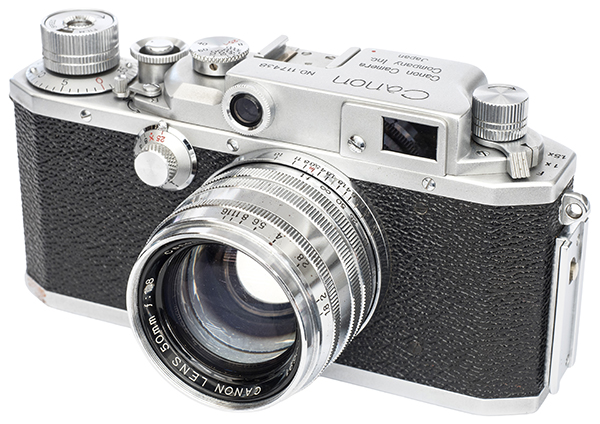
Progress continued with evolution rather than revolution with flash sync being added in 1951. The IV-Sb (IV-S2 in export markets) released at the end of 1952 became the biggest selling Canon bottom loading model and the first to find real succes in export markets:
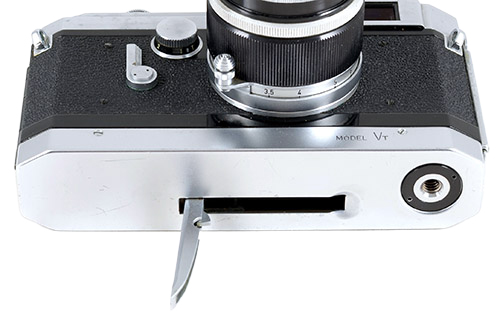
The last of the Series IV models receiving a new shutter in 1954 with 1/30 changeover speed and a two piece main dial that could be set cocked or uncocked. However, the Leica M3 release, also in 1954, caused shockwaves in the industry and Canon responded with bigger changes in 1956 introducing a revised body with hinged opening back, a viewfinder with provision for the 35 mm focal length and a choice of trigger or lever film wind. The single non-rotating shutter dial appeared in 1958.
1956 Canon VT with trigger wind:
 (Web image)
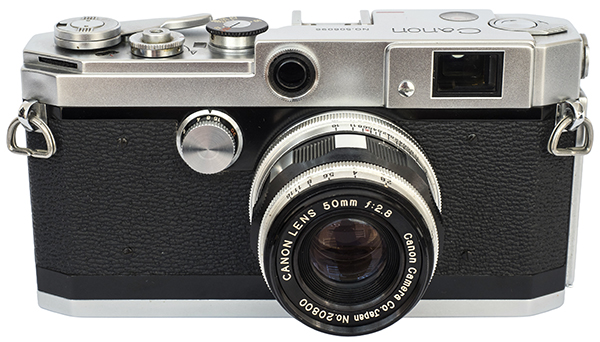
1957 Canon L2 with lever wind:
It was also in 1956 that Canon diversified into movie cameras with the release of the Canon Cine 8-T:
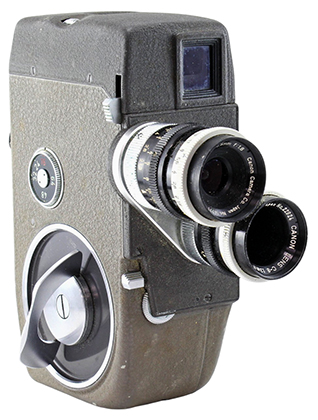 (Web image)
The interest in SLRs was rising, something Canon could not ignore, and in May 1959 Canon launched its first model, the Canonflex. Its state of the art features included an instant return mirror, automatic aperture control, accessory clip-on shutter coupled exposure meter and it also featured a removable prism for waist level viewing, but not interchangeable finder screens. There was also no mirror lock up. It was developed alongside the VI series rangefinders and shared some of the technical design and also Canon's ill-founded fondness for bottom winding designs. Whilst the rangefinders used a sliding trigger design, this used a new 130 degree pivoting lever with folding tab and although superior to the sliding design in use with a claimed shooting rate of up to 3 frames per second, it retained most of the deficiencies including difficult tripod use. Although four automatic lenses were announced, only one automatic lens, one semi-automatic lens and one pre-set manual lens were initially offered: the standard Super-Canomatic R 50 mm f/1.8, the Canomatic R 200 mm f/3.5 and the pre-set Canon R 135 mm f3.5. The only wideangle type available was the 35 mm f/2.5 Super-Canomatic R released in August 1960 when the original Canonflex had already ceased production.
Although undoubtedly well built and of professional quality, the Canonflex felt more of a design exercise to test the market and complement the rangefinders rather than compete with them whilst its arch-competitor, the Nikon F, which had been designed for professionals by professionals and announced one month earlier, was released in June 1959 with an initial complement of five automatic and one manual lenses and specialised accessories, including the first SLR motor drive. Whilst both were capable, the Canonflex was iterative, the Nikon was a disruptor:
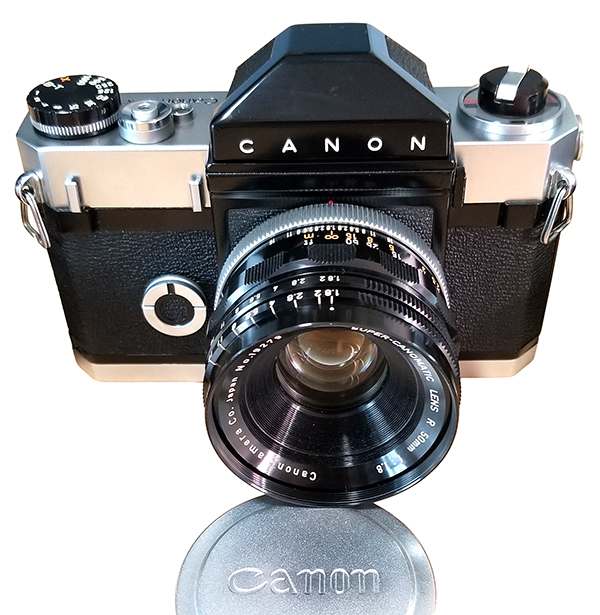
(Image courtesy of Chris Whelan)
By 1959, most interchangeable lens rangefinder makers had either fallen by the wayside, or were moving on to SLRs themselves. Nikon also bet its future on the SLR and discontinued mass production of its professionally successful rangefinders. However, Canon was still principally a rangefinder company and in September 1961, Canon launched its most successful model yet, the Canon 7. It took the shutter coupled accessory Canon Meter of recent models, and built it in, the frame lines were projected rather than the reflected of the earlier Canon VI and P models and the lens mount included an external bayonet for the optional f/0.95 50mm lens:
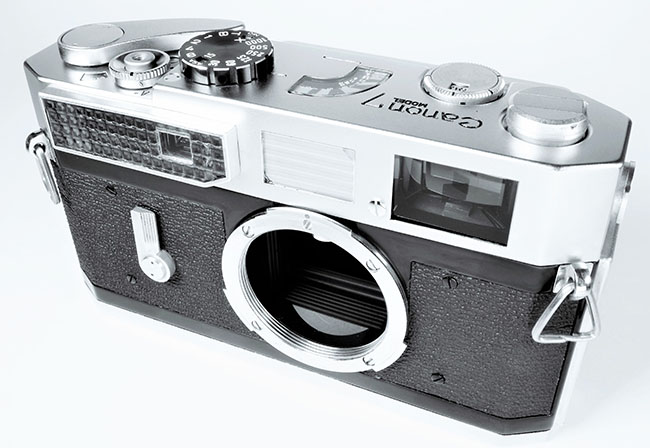
(Image courtesy of Chris Whelan)
One of the reasons for Canon's growth and success during the 1950s was its strategy to leverage the development costs of its premium models and offer many variations of lower spec'd models at various price points to appeal to the biggest cross section of the market possible. If you wanted a Canon rangefinder, there was likely to be one within your budget and it still looked like the premium offering. By the time of the Canon 7, the market had changed and SLRs were making inroads at an ever increasing pace. Canon now only offered a single spec body but you could have a 50 mm lens with an f/1.8, f/1.4, f/1.2 or f/0.95 aperture.
The updated 1965 7s with CdS exposure meter was the last hurrah and in 1968, Canon's, and Japan's, interchangeable lens rangefinder camera era was over, although lens production petered out more gradually until the last lens was made in 1975. SLRs, fixed lens leaf shutter rangefinders, point and shoot cameras, movie cameras and diversification into other products was now the company's future.
Canon Distributors
Seiki Kogaku was a small start-up camera maker without marketing or sales skills trying to sell into a difficult, low wages market. The use of sales agents and distributors seemed to be common practice by the Japanese photographic industry both before the War and in the early post-War years, and later in Canon's case. As we have already seen, Omiya Shashin Yohin Co., Ltd. (Omiya Photo Supply), was appointed the exclusive sales agent for the Hansa Canon. Whilst the Hansa name didn't appear on subsequent models, the relationship seemed to continue until at least the War.
After recovering post-War, a large part due to targeting sales to occupation forces, Canon sought to kick-start exports to achieve further growth. In early 1950, C.R. Skinner Manufacturing Co. of San Francisco was appointed to handle US sales, but as it turned out, a role it was apparently ill equipped to do. C.R. Skinner ad for the Canon II B in the April 1950 Popular Photography magazine:
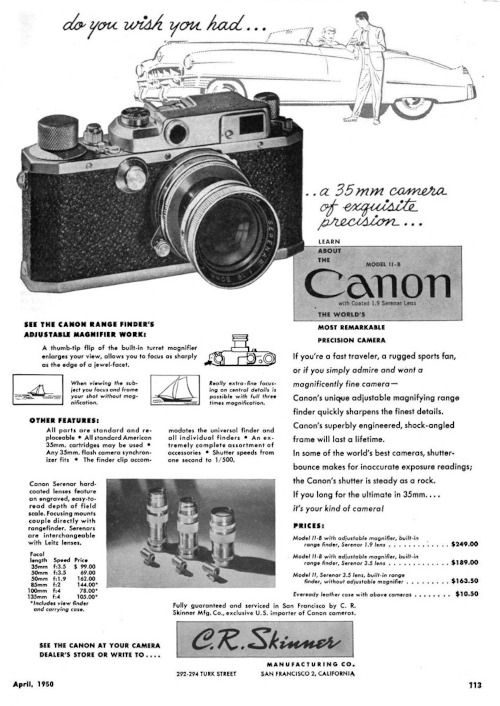
There is also a lower price for the “Model II .....without adjustable magnifier”. This is clearly the Canon S II, stocks of which must still have been available st this time.
Also in 1950, Dr Mitarai visited the US International Trade Fair in Chicago, held from 7 to 20 August. Whilst in the US, Dr Mitarai met with Bell and Howell to seek a distribution deal but this proved unsuccessful, mainly because of concerns about Canon's timber factories, typical for Japan, and the fire risk they posed.
In November 1951, a five year export agreement was entered into with Hong Kong based trading company Jardine Matheson Co. and with continued disappointing sales in the US, Canon and Jardine replaced Skinner with Balfour, Guthrie and Co., Ltd. which continued to be responsible for sales operations even after Canon set up New York based Canon Sales Co., Inc. in 1955 to take over US distribution. This was located at 550 Fifth Avenue, New York 10036, NY. In 1957, Canon opened the European Distribution Center in Geneva, Switzerland, to replace Jardine in that market area, in 1963 becoming Canon Geneva S.A.
Back in the US, Canon appointed Scopus to handle distribution for subsidiary Canon Camera Co., Inc., a role that Bell & Howell took over in 1962. Bell & Howell co-branding appeared on a number of models including the Canon 7 rangefinder.
In relation to some shared early SLR products, Peter Dechert noted in his book “Canon Single Lens Reflex Cameras 1959-1991” that, “at the beginning of the 1960s Osawa was doing Canon's wholesaling in Japan, as well as Mamiya's”. J. Osawa & Co., Ltd., was a large Japanese trading company with fingers in many pies that included distributing Mamiya cameras in Japan from 1949 and from 1963 World wide and is believed to have been behind the acquisition of Tomioka in 1960 before resale to Yashica in 1968. However, I can find very little information about the Canon and Osawa relationship and when it started or ended. The present day Osawa website presents an historical timeline of key events and relationships but there is zero mention of Canon, which I would have thought would have been a feather in its cap.
Shimo-Maruko Factory
As a consequence of the initial rejection of a business relationship by Bell and Howell on fire safety grounds, Canon purchased the former Fuji Aviation Instruments Co., Ltd., factory in Shimo-Maruko, Ohta Ward, Tokyo, in June 1951. Note, these days, the hyphenated “Shimo-Maruko” is often translated as the single word “Shimomaruko”. According to a Japanese website, the building measured 23,255 square metres in total floor area on 23,100 square metres of land. By November, after some modifications, Canon began relocating major functions from its head office in Ginza and the Meguro and Itabashi factories to its new flagship site:
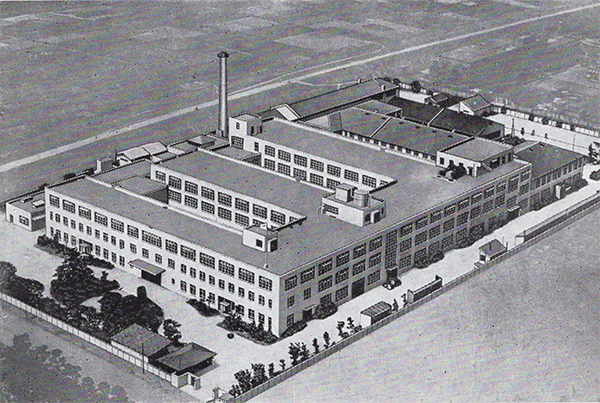
The official translated address in 1950s documents was usually in the form of “Canon Camera Co., Inc., 312, Shimo-Maruko-Cho, Ohta-Ku, Tokyo, Japan”.
The ad below, with a machine translated version below that, is from the beginning of 1952 and notified the Japanese public that the move was complete:
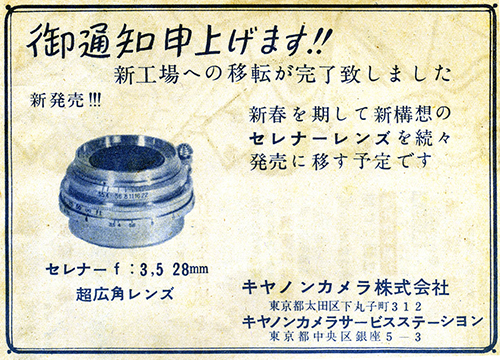
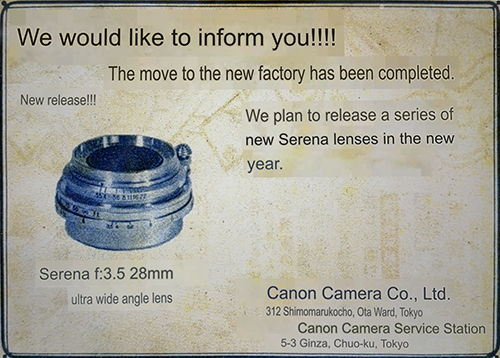
The Meguro and Itabashi factories were then apparently sold.
The “Canon” & Eagle Logos
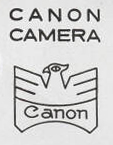
The development of the “Canon” logo is explained on the Canon Global site. The earliest prototype, the Kwanon X, featured an engraving of the Kwanon deity, see Kwanon X. The “logos”, as defined as such by Canon, seem to progress from what was on the camera (but often not on other items) to what remains now as the official corporate identity:
 1934 Engraved on some of the Kwanon prototype series.
 1935 Engraved on cameras from Hansa Canon to early production 1957 Canon L2.
 1953 Described as “unification” & “further refined” (the “Canon” name on the covers of the 1946 S II & 1949 II B manuals are already close).
 1956 Corporate logo (but which already appears on the cover of the February 1955 printing of the IV SB2 user manual). It began to appear on more recent cameras (1963 Canon Demi may have been the first), but not on interchangeable lens rangefinders, except for items such as user manuals, lens caps, cases, boxes, flash units and other accessories.
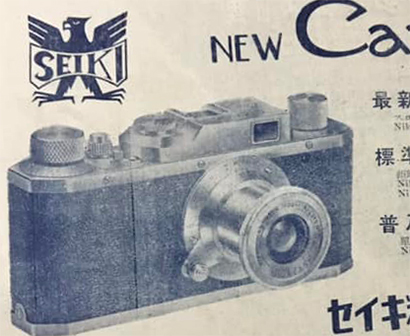
The Canon Eagle and the earlier Seiki Eagle logos don't rate a mention by Canon. The Seiki Eagle first appeared in advertising at least as early as August 1936. Initially, it appeared as a complete bird as in this ad for a “New Canon”, which is what we know as the Canon J, probably from 1939:
Possibly its final appearances was in an August 1947 Japanese magazine ad where it again was displayed as the full bird with legs:
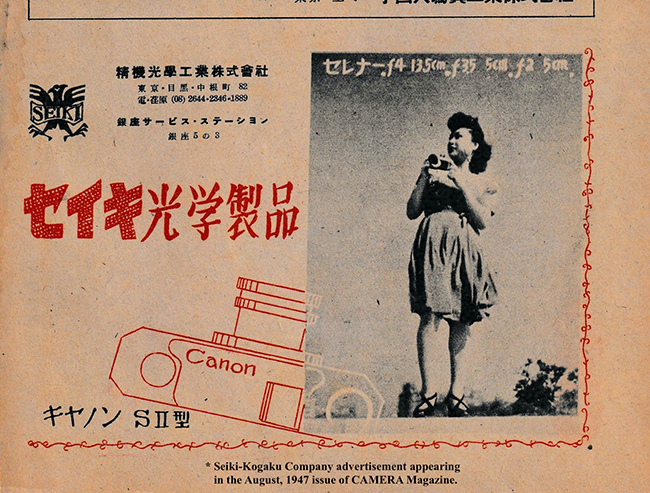
(Ad scan courtesy of Martin Bacardi of the Canon Historical Society Facebook group)
Martin Bacardi has collected and investigated Seiki Kogaku magazine ads and other marketing material and notes that there were two main versions of the Eagle design, the second replacing the first in literature from 1937 but the first continuing to be used on accessories such as the Seiki Albada Finder, Seiki Precision Finder and Seiki Sport Finder, possibly because it was easier to engrave. The quality of the graphic design also varied. It was also sometimes depicted without legs as on the early X-Ray camera below and the finger print camera from probably 1940, or 1941, shown in Peter Kitchingman's Book:
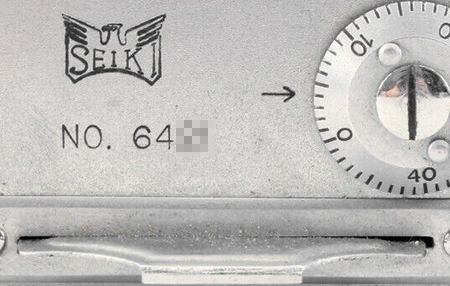
With the change of the company name to Canon in September 1947, it became the Canon Eagle but now lost its legs for evermore. These examples linked to the company name changes are courtesy of Kirk Thorsteinson and are smaller versions of those on the Canon page of his Flickr site:
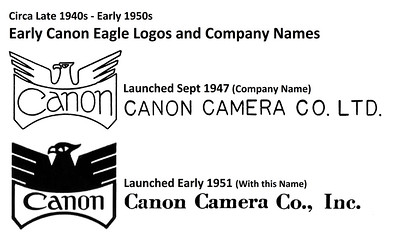
However, as with the Seiki Eagle, there were variations depending on use case, compare his first type with the version embossed on a 1947 13.5 cm f/4 Type 4 lens case (Peter Kitchingman classification):
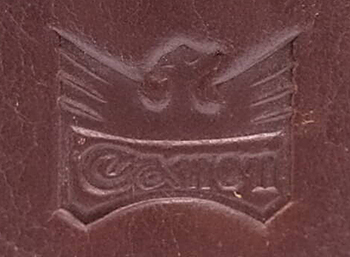 (Web image)
This example is from the inside of the lid of a presentation box for a Serenar 100mm f/4 lens from 1952 (see Lens Boxes):

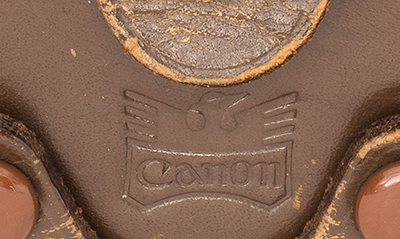
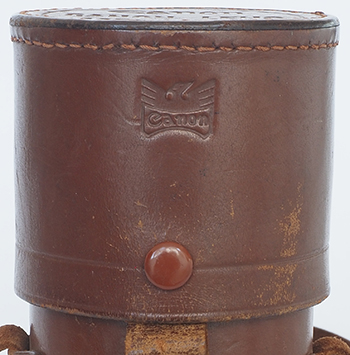
The Canon Eagle was embossed on late 1940s to 1955 camera ever-ready cases and lens cases. This one is on the lower back of an IV-Sb ever-ready case:
And this one is on a similar vintage 135 mm f/3.5 lens case:
It also featured on the backs of user manuals and on many ads and brochures, the last widespread appearance being for the 1956 “Model V” (Model VT). The eagles at the end of a circa 1956 brochure and on the back of the Model V instructions:
The only camera to feature the Canon Eagle was the special edition 25th Anniversary Canon P (probably 1961 production) which was only offered to the Canon workforce, its last hurrah, as far as I am aware:
The “Canon” Camera Name
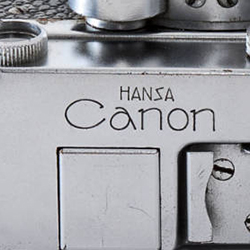
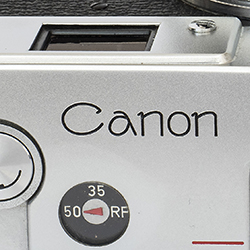
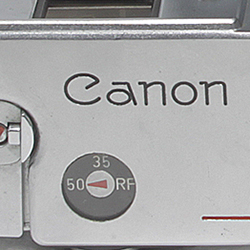
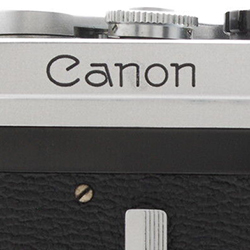
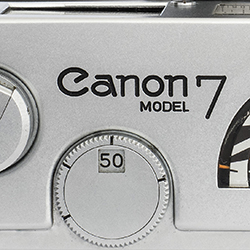
How the “Canon” name appeared on things like ever-ready cases, lens caps and other places varied over time with both logos and fashion, but, there was only one real change of style with how it appeared on cameras and a minor change in presentation. On every camera, the Canon name letters featured serifs, the little decorative angled pieces on the Canon “C” and “n”s and the later “a” at least. Some people refer to the 1957 “C” as the “C with the Serif” but whilst it has a long serif, the very short one on the Hansa Canon is also a serif. Top row are the bookends of the first style, the 1935 Hansa Canon and 1957 Canon L2 up to about serial number 523143. Next row is a Canon L1. It, the later production L2 and the VT de luxe ushered in the change to a longer serif on the “C” and flattened serifs on the “a” and two “n”s, but the size and emphasis remained similar - it may be a stylised interpretation of the 1956 Corporate logo, but it is certainly not the same. The Series VI cameras (VI-T, VI-L and P) moved the name from the top of the top plate to the left front on the top superstructure but the style didn't change. On the third row by itself is a Canon 7 which returns the name to the top of the top plate in the same font, but now in bold, and combining the model name for the first time:
“Made in” and Other Markings
“Made in”
The Japanese World War II surrender was announced on 15 August 1945 and formally signed on 2 September 1945. This was in accordance with the conditions of the Allies' Potsdam Declaration issued on 26 July 1945. On 14 August 1945, General Douglas MacArthur, Commander-in-Chief, U.S. Army Forces in the Pacific, CINCAFPAC, was appointed Supreme Commander for the Allied Powers in Japan, SCAP, pursuant to the agreement reached by the Allies and became the head of the Occupation forces.
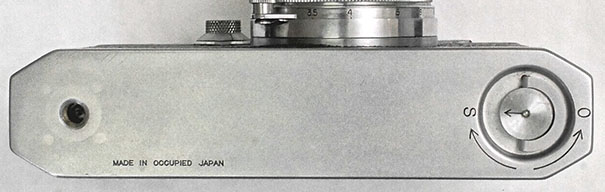
On 20 February 1947, SCAP issued an instruction, SCAPIN 1535 (the “IN” in SCAPIN standing for Index Number) requiring all export products to be marked “Made in Occupied Japan” (MIOJ). Prior to this, it was not common practice to mark the country of origin on Japanese items, such as cameras, as most had not been intended for export. The need to earn export income only became an imperative after the War. Under the US Tariff Act of 1930, for example, items imported into the US were required to have their country of origin marked. With General MacArthur handing power over to the Japanese government, the requirement to use the MIOJ marking was repealed by SCAPIN 2061 on 5 December 1949 and could be replaced by “Made in Japan” or simply, “Japan”. However, the occupation only ended with the San Francisco Peace Treaty signed on 8 September 1951 to take effect on 28 April 1952. Many camera makers (e.g.makers of Minolta, Leotax and Nicca cameras) continued to use the MIOJ marking until 1951 but Canon ceased more quickly - as far as I am aware, no 1951 examples of any model have the marking, although there are some other early 1951 items).
On Canon cameras, the marking was engraved on the base plate:
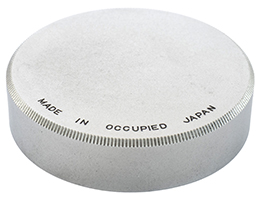
With lenses, it was on the lens end cap and lens hoods of accessory lenses sold separately whereas as standard lenses sold with the camera were not marked:
Camera ever-ready cases and lens cases had it embossed on the bottom. On the left is an early 13.5 cm lens case, also with the <CPO> marking explained further below, and on the right is a slightly later example with the Japanese katakana version of the CPO mark and a new curved style MIOJ marking:
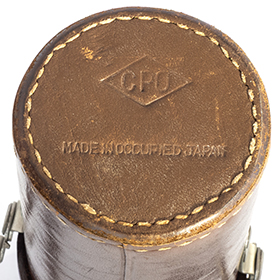
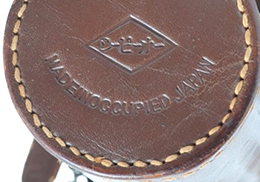
(Web image on right)
In my database, there are a few Canon S II examples marked MIOJ starting from serial number 1610x onward with increasing frequency until, after 2021x, it is nearly all examples. There are the odd ones without it, perhaps destined for domestic consumption, and/or possibly, there has been some swapping of base plates. Most Canon II Bs have the marking up to and including 38944. From 39333 onward, none have the marking and like all Canon examples before MIOJ was introduced, there is nothing to indicate country of origin until late Canon III and all III-A examples have “Japan” engraved on the top plate. A few of those also have “Made in Japan” engraved on the bottom plate, a practice that seemed very short-lived. Top and bottom plates of same camera:
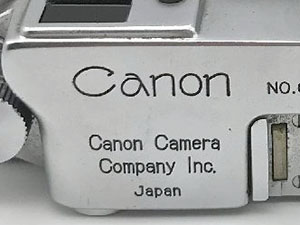
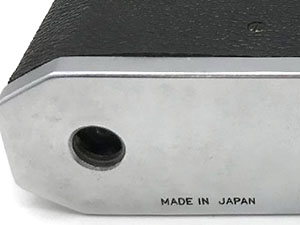
(Detail from larger web images)
From then on, “Japan” remained on the top plate, or back of top plate for Series V and VI models, until and including the Canon P. Series 7 models changed to “Made in Japan”, still on the back of the top plate. Canon L2 on left and Canon 7 on right:
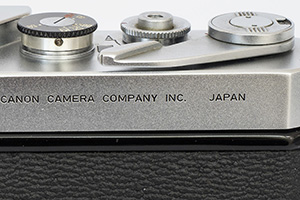
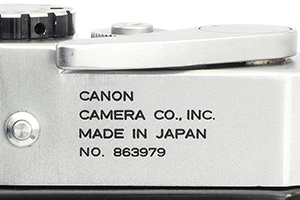
<CPO> Mark
Cameras sold to occupation forces, typically, but not only, through US Military Exchange stores (see <EP> Mark below), were not subject to the high taxes applied to post-War domestic Japanese consumption and in order to control those sales to prevent a black market developing with consequent loss of revenue to the Japanese Government, cameras and some other goods (accessory lenses, binoculars and porcelain have been identified) destined for the stores were marked with a diamond and inside that, the letters <CPO> standing for Central Purchasing Office, later changing to their Japanese katakana equivalent, <シーピーオー>, so that it was understandable to the Japanese population.
Note: Peter Dechert referred to the Japanese version as an “ideogram” and this has been repeated by many people and websites. This is incorrect. The Japanese language has three sets of characters, hiragana, katakana and kanji. Kanji is based on Chinese characters where each character has a particular meaning. It is the only form which is an ideogram. Both hiragana and katakana represent phonetic sounds and are NOT ideograms. The katakana characters in the mark represent the sounds; “shee” (シ), “pee” (ピ) and “oh” (オ), each followed by a dash, or hyphen.
Camera-wiki.org tells us that the use of the <CPO> mark started in 1948, or 1949. In the Notes at the bottom of the page are these quotes from a 23 November 1948 General HQ, Far East Command (GHQ, FEC) letter:
“The Central Purchasing Office is established as a special staff section of General Headquarters, Far East Command, for the purpose of purchasing indigenous Japanese merchandise for resale to the Post Exchange type systems of the Allied Occupation Forces”. And “All CPO marked merchandise found in the possession of other than Allied personnel will be confiscated.”
I think that Camera-wiki.org has based its start date estimate on the date of that letter but to me, it is a statement of fact, not necessarily a notice of introduction, or implementation. The found cameras and lenses suggest that the requirement was introduced in 1947.
Chapter 3 of the Volume 1 Supplement to the Reports of General MacArthur published by Department of Army tells us that FEC had been established on 1 January 1947 as a reorganisation of the earlier AFPAC (see MIOJ above) and General MacArthur's title changed from CINCAFPAC to CINCFE (Commander-in-Chief, Far East). GHQ, FEC (and GHQ, AFPAC beforehand) and GHQ, SCAP were physically combined. General MacArthur was two-hatted; as SCAP, his responsibility was limited to Japan, but as CICFE, he was responsible for all US Army Forces in the Pacific. An organisation chart locates the Central Purchasing Office within the Administrative and Executive Group of FEC. As I understand it, FEC also provided support to SCAP.
Canon put the mark on its camera base plates and the bottom of camera and lens cases (see MIOJ above), typical <CPO> shown on left and red <シーピーオー> on right. The earliest CPO mark is in red as are more than 50% of the katakana marks. I believe that the red infill was applied over black, with wear and time, it is likely that all of the black ones were originally red:
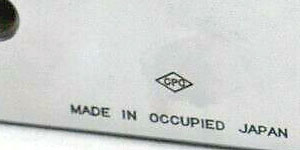
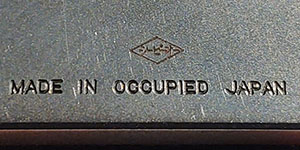
(Detail from larger web images)
The bodies of lenses not sold as part of the standard camera package were also marked. According to Peter Kitchingman, the <CPO> mark on lenses was introduced in October, or November 1947. Below are two Canon Camera Co. Serenar 13.5 cm f/4 lenses, both Peter Kitchingman's Type 7. Both marks have remnants of red infill, difficult to see. The serial numbers are only a few hundred apart, 34209 on the left which has a <CPO> mark and 34703 on the right with a <シーピーオー> mark:
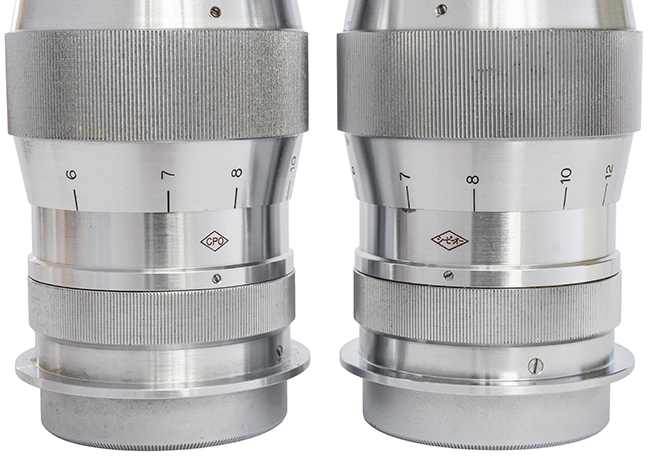
As Type 7 lenses ran from the beginning of January 1948 until the end of March 1949, and the range was from 31547 (found) to 34754, roughly 3,000 lenses, or 200 per month, you could guess that the right lens was from March 1949 and therefore the left lens might be from January 1949. So based on these two lenses, the changeover from <CPO> to <シーピーオー> probably occurred in the January to March 1949 period. Peter Kitchingman seems uncertain of how long <シーピーオー> lasted but certainly seems to believe that it ended before 1950. I agree that it seemed to end in late 1949, perhaps because SCAP was handing power and responsibilities back to the Japanese.
Cameras with removable base plates are more difficult to place because no doubt some swapping does occur. Also, as noted elsewhere, according to Hayato Ueyama, Canon subcontracted engraving to a number of suppliers and there are anomalies with the order of Canon S II models caused by some being returned slower than others. The earliest Canon camera in my database with the mark and serial number visible is Canon S II 1802x with the already later katakana <シーピーオー> version - that one is unlikely to be an original base plate. Next are late Canon S II examples from perhaps the end of 1948, beginning of 1949 with serial numbers 2237x and 2279x with <CPO> marks and 2265x with a <シーピーオー> version sandwiched in between and another immediately following this group, by now it should be the correct type. The katakana <シーピーオー> mark appears on a number of early Canon II Bs, the last example being camera 2936x, almost certainly from before the end of 1949. The cameras in my Nicca database are also of the katakana type and span from the end of 1948 to 1949, however, my Minolta 35 database is more interesting. I have details of five early cameras with the earlier <CPO> mark. The earliest of these are three Model A, type b examples which are undoubtedly from 1947 based on the many claims that the Minolta 35 was introduced in May 1947. That would make the start of the scheme at least 12 months earlier than the 1948-1949 claimed by Camera-wiki.org and maybe earlier than Peter Kitchingman's estimate. Then there are another 6 katakana types in the period from late 1948 to 1949 but none later, just like the other camera brands.
<EP> Mark
In 1953, a new <EP> mark was introduced for similar purposes, presumably by the Japanese Government, i.e. the mark indicates that the item was sold without excise tax being paid and is not available to Japanese consumers (or non-eligible foreigners). Items found with the mark include cameras, accessory lenses, binoculars and 1960s and 1970s hifi gear. Items so marked have commonly been claimed to have been purchased in US military Exchange stores located in Japan and on the weight of evidence, that seems to be correct. There have also been claims that some could have been sold outside the US Exchange system in Japan and other claims that <EP> marked items were sold in US Exchange stores throughout the World. None of these have been verifiable and I think that the World-wide sales claim particularly is very unlikely to be correct.
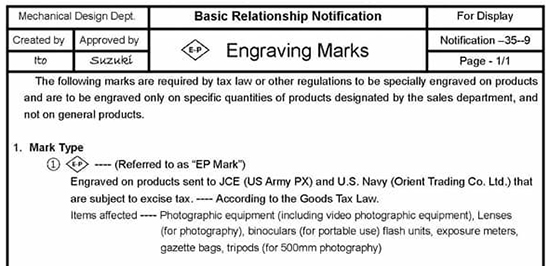
Incredibly, the mark was in use for at least 29 years (1953 to 1982, see below), yet the only concrete information I have seen about it is the existence of the mark itself, the fact that it was found only/predominantly on items sold tax free by Military Exchange stores in Japan and a document which purports to be a translated Nippon Kogaku (Nikon) notification (instruction) update for engraving the mark issued in July 1960. This document was noticed by contributor Chris Whelan on a Nikon Facebook group, top half shown (rest refers to binoculars and the <EP> engraving itself, for the “T” mark, see Canon's “TE” mark further below):
The original poster cannot remember where he found the document but has provided a copy of the original in Japanese:
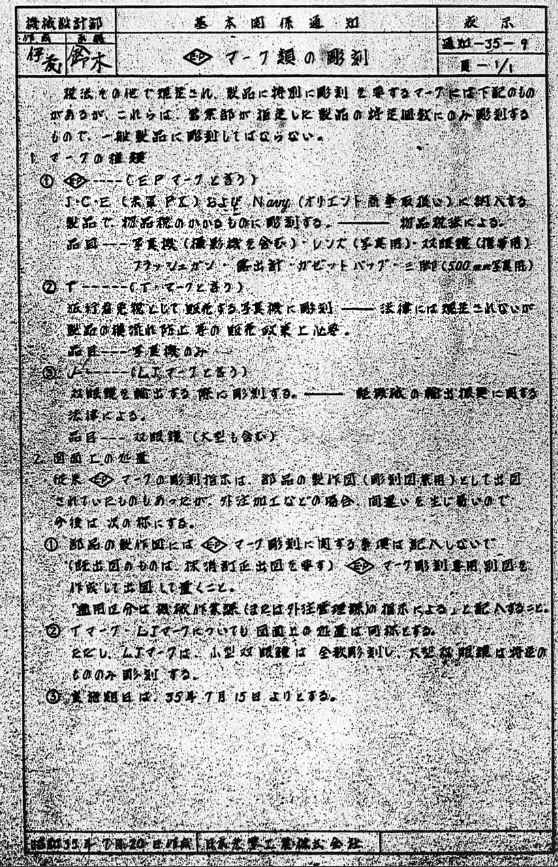
For the <EP> mark, the relevant words are:
“Engraved on products sent to JCE (US Army PX) and U.S. Navy (Orient Trading Co. Ltd.) that are subject to excise tax --- according to the Goods Tax Law. Items affected --- photographic equipment (including video photographic equipment), lenses (for photography), binoculars (for portable use), flash units, exposure meters, gazette bags, tripods (for 500mm photography).”
(Note, “video photographic equipment” is presumably a modern mis-translation of cine equipment.)
My interpretation is that the specified items sent by Nippon Kogaku to Army and Navy Exchange stores, either directly, or through an intermediary, are to be engraved with the <EP> mark in accordance with the Japanese Goods Tax Law, i.e. the requirement applies to goods sold through US military Exchanges in Japan only.
The US Exchange stores are typically Army Post Exchange (PX), Navy Exchange (NEX), Air Force Base Exchange (BX) and Marine Corps Exchange (MCX), but Army and Air Force Exchanges are run by the same organisation and Navy and Marine Corps are both Department of Navy and their Exchange stores are named according to whether ship, or whose base. The important thing to note here is that the Army PX has no more precedence than the others and the widely reported belief that “EP” stands for “Exchange Post”, which is Post Exchange backward, doesen't really make sense on any logical level, nor have I seen any evidence to support it.
The exact meaning of the abbreviation seems to have been lost in the mists of time. The suggestions that it is “Exchange Purchase”, or “Exchange Product”, seem more plausible. Others focus on the tax status with examples such as “Exempt Purchase”, “Exempt Product”, “Export Product” and “Export Permitted”.
Contributor Chris Whelan was stationed at a US Naval base in Japan in the late 1970s, by then the system had probably been phased out, he thought, because the mark didn't appear on any of the photographic, or HiFi, items he bought, but see below. He's of the understanding that the <EP> mark stood for either “Exempt Purchase”, or perhaps “Exempt Product”.
Camera-wiki.org claims that it started in 1948 (confused with CPO mark?) and was phased out starting from 1955 as inventories were sold off, but “was applied until the early 1970s”, none of which make much sense to me and seems to be just plain incorrect. The mark does not appear on Canon, or other brand cameras I have collected information on, before 1953 and that is consistent with other sources. My Yashica TLR website notes quite a few 1960's Yashica cameras and two from as late as 1976 and 1977 with the marks and the latest Canon rangefinder I have found is a latish 7s. A member of the Canon Historical Society posted photos of his Canon EF SLR, released in 1973, with the mark and another noted his purchase of a Canon F-1 in Okinawa. More recently, a Canon FD 50 mm f/1.4 lens was listed on eBay with the mark on the rear of the lens next to the Canon date code which indicates 1982:
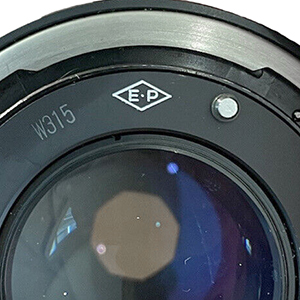 (Web image)
Given Wikipedia's comments, Chris Whelan's experience and the diminishing numbers of Canon cameras with the mark from 1956 onward, it may be that the system was indeed phased out gradually but retained much longer for some special circumstances.
Typical of the Canon Series IV to VI models on left, typical of Series 7 models on right:
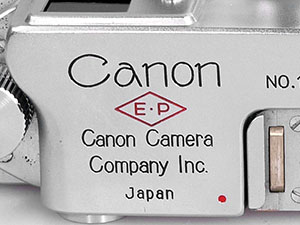
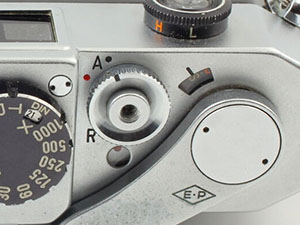
(Detail from larger web images)
Note, the mark on Canon, Minolta, Nicca and most marked cameras includes a central dot between the “E” and the “P”, peculiarly, Yashica cameras omitted the dot from 1953 until at least 1960.
As I have already noted, the <EP> mark first appeared on Canon cameras in 1953. The first Canon IV-Sb example in my database is 12013x after which almost 50% of that model have the mark. No Canon II-D model (or II-D1, or later II-D2) in my database has the mark. Some claim that the Canon II-F was only sold through Exchange stores - that may be close to being correct. There is no mark on the first 1953 cameras from 9817x to 10777x then most have the mark with only the odd exception, my 149293 being one exception. By the IV-Sb2, the incidence of the mark as a proportion of overall production was diminishing as Canon's exports to overseas markets was increasing and from the VT on, they only appear infrequently.
Other Markings
Apart from the mandated markings, small numbers of some models were produced with customer requested markings, or in one case Canon's own commemorative insignia.
After the Hansa Canon, the first known special marking was the War-time Canon S with Imperial Japanese Navy engraving and serial numbers, see Canon S below for details and photo.
In 1950, the U.S. Army Signal Corps purchased a very small number of Canon II B cameras and lenses (Peter Kitchingman has recorded three 135 mm f/4 and one 100 mm f/4 lens) which are engraved “U.S. ARMY Signal Corps”. There was a slightly larger and better known acquisition of Canon III-A cameras and lenses in 1952 which are engraved “U.S. ARMY. SIGNAL CORPS”.
Cherry Blossom, or Sakura
There were later cameras, most commonly the Canon P, marked with what is believed (but not confirmed) to be the cherry blossom logo of the Japan Self-Defense Force on the top plate in red, or less often in black, below left, and on the right, the version claimed to belong to the Japan Maritime Self-Defence Force complete with presumably a sequence number of some sort - this is the only one I have seen, maybe real, maybe not (although I have seen a similar, but not the same, unnumbered logo in white on a make-believe green painted fantasy P):
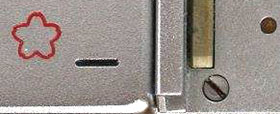
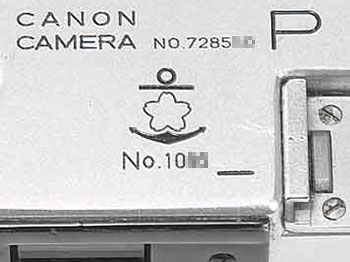
(Detail from larger web images)
The logo is also referred to as “Sakura” meaning cherry blossom in Japanese.
Canon Eagle
Canon P cameras are also found in small numbers with a Canon eagle engraving. This was to commemorate the 1962 25th anniversary of the establishment of Seiki Kogaku Kogyo Kabushiki Kaisha (Precision Optical Industry, Co., Ltd.) in 1937. According to Peter Dechert, these cameras were only made available to Canon employees:
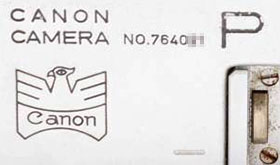 (Detail from web image)
With all the engraving types, if there is money to be made from adding perceived value, you can be fairly certain that there will be forgeries. The anniversary eagle seems to be one of the more lucrative and great care is needed if seeking to buy one. Obvious deficiencies found with fakes include incorrect eye detail and the missing vertical line delineating the beak from the head. Also, low serial numbers are an issue. Canon P production was from 1958 to 1961 so it seems likely that engraved cameras will be from towards the end.
TE
Some Canon Ps have a “TE” in a rectangular box marking in their accessory shoes. These seem to appear in the last 1/3 of production, probably from sometime in 1960 onward:
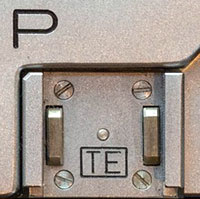 (Web image)
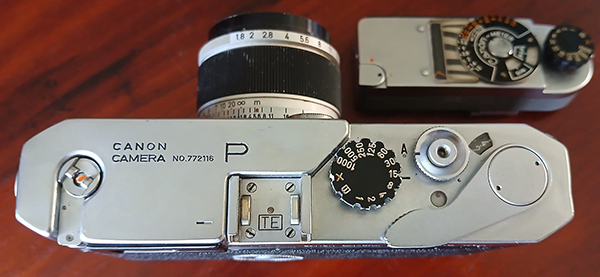
(Image courtesy of Bruce Thomas)
Although the mark has been found on mainly Canon P cameras, it has been found on the bottom mounted film wind lever of at least three Canonflex RP examples that I have seen photos of and there are claims of at least 10 others being counted. Released in September 1960, the RP is from a similar period as the found P examples:
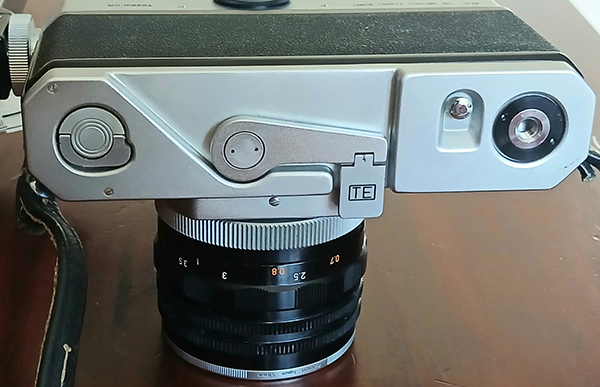
(Image courtesy of Bruce Thomas)
As far as I am aware, little substantive is known about the origin of these. One theory is that it is the initials of some unknown company, organisation, or group. I doubt that is likely, I've seen at least half a dozen without looking too hard and a respected collector in the Canon Historical Society Facebook Group has recorded at least 28 Canon P examples with the mark - that means that there would have been quite a few made, far more than likely for any organisation and only one brand and two models at that. Another theory is that TE stands for “Tax Exempt”. Whilst clearly it is not a form of the <EP> mark, which continued unchanged through the 1970s to at least 1982, it could have had a different use case, or even have been applicable to some other jurisdiction, such as Hong Kong, popular with international tourists, but again, if it was a formal scheme, why was it only found on one brand?
In fact in one case, Hong Kong and duty free shopping are definitely linked to the mark, but not in an obvious way and not limited to Hong Kong. According to contributor Bruce Thomas, the above Canonflex RP was purchased in 1961 from a duty free store at Kai Tak International Airport in Hong Kong. The store had been opened by two Americans in November 1960 and later became the large Worldwide chain, Duty Free Shoppers.
Based on my research, with the assistance of contributor Chris Whelan, I do agree that the mark very likely stands for “Tax Exempt” and that it is related to tax free purchases by tourists but also that the marking of cameras was not mandated and was an informal arrangement managed by camera makers themselves for their own purposes, i.e., if a mark was used, different brands used different marks. For evidence, we have to look to several other brands from the early 1960s.
At the time, the Japanese Government operated a tax exemption scheme for tourists. Whilst there was no broad based commodity tax, there were narrowly focused sales taxes on certain items (a Japanese forum participant recalled these to be a tax imposed on luxury goods, the rates varying depending on item). Based on period price lists, the tax on cameras and lenses was around 10-11%. Duty free shopping was in its infancy Worldwide and in Japan, it seemed to be available at a number of licensed camera stores (I'm aware of one chain in Tokyo and one in Kyoto, neither mention airport outlets). The first example is an item sold at one of these stores and is relevant as background for the second example. It is a “TAX EXEMPTED MUTSUMIDO” label on a Nikkor 300 mm f4.5 lens released in 1964. Mutsumido was a Japanese camera chain with three stores in Tokyo which sold a number of popular brands of cameras, including Canon, so it is also possible to find Canon gear with similar stickers:
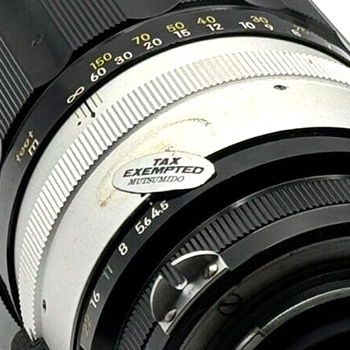 (Detail from web image)
The second example is part of the back page and cover of a 1961 Mutsumido brochure which explains how the government sponsored scheme worked:
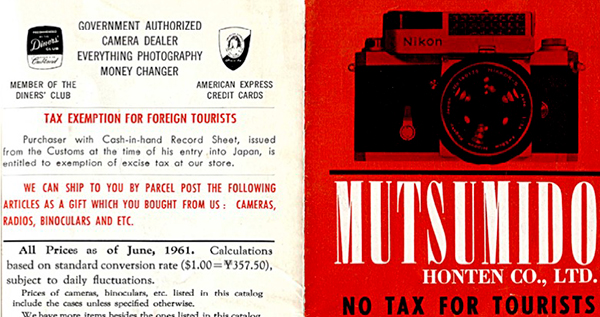
This was clearly a retail store managed process but at the factory level, even though it was not required by law, Nippon Kogaku in the early 1960s managed “traveler duty free” items with a “T” engraving. The reference to “damage” in the the “T Mark” description, which continues on from the 1960 EP mark notification translation further above, suggests to me that it may have been for warranty purposes, possibly because warranties were normally managed by distributors in the country of sale but they would have to cover these cameras as well:

The “T Mark” has been found in small numbers on the rewind crank knob of Nikon SP and S4 rangefinder cameras and the early Nikon F SLR. Below are a Nikon S4 and Nikon F:
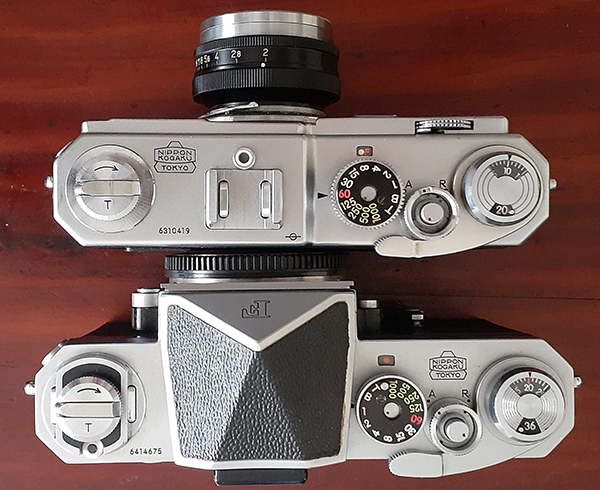
(Image courtesy of Bruce Thomas)
Contributor Chris Whelan has sent me details of what might be a similar mark on Asahi Pentax cameras. This is a “NO TAX” marking on the back left hand side edge of the bottom plate of an Asahi Pentax SV camera released in 1962 :
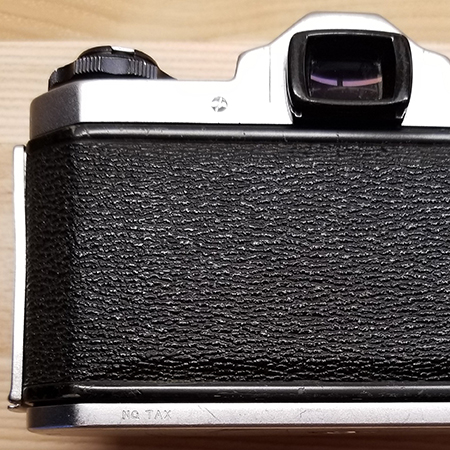
Other such markings have been recorded on Pentax SVs and apparently on earlier S2/H2 (released in 1959) and S3 models, and no, it's not a substitute for the <EP> mark which on SVs is usually found on the back edge of the film wind lever.
Interestingly, a 1971 Yokohama Camera Co., Ltd. catalogue confirms that at some point, the Japanese tourist tax exemption was extended to the merchant marine as well:
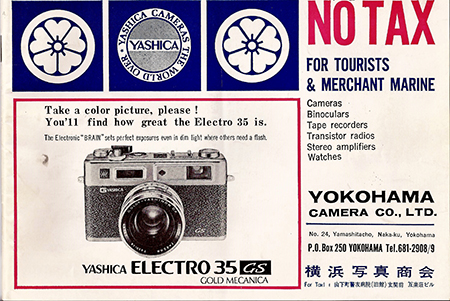
(Image courtesy of Chris Whelan)
By this time, there is no evidence of cameras being physically marked, that only seems to have lasted for a couple of years at the most; Canon from mid-1960 to June 1961 (release of the Canon 7), Nippon Kogaku from probably 1959 to the end of 1960 (based on 13 examples) and Asahi Optical Co. (AOC) a bit longer to at least 1962. Nippon Kogaku, or AOC, may have been the first and the other two followed suit. We know part of the reasoning behind Nippon Kogaku's “T” mark. Whilst only circumstantial, the timing and naming of Canon's “TE” and AOC's “No Tax” marks suggest that the purpose was broadly similar. I have not managed to find any evidence of similar markings on other brand cameras.
Canon Serial No.s & Naming Conventions
Some Canon models feature model names marked on the body but more don't. Canon serial numbers will get you to the correct series of models and even the correct model before serial number 52000 in 1951 or after 700000 in 1959. In the middle period range, you will also have to identify the camera's features against the specs listed further below.
Pacific Rim Camera have made the process easy with their Canon Rangefinder Identification Guide based on a question and answer process. There are other sites which have either borrowed it, or use a similar approach. “Naming Schema & Model Identification” after “Serial Numbering” below may not be as intuitive but it should get you to the right model, or close enough to confirm from more detailed information further down.
Serial Numbering
Peter Dechert tells us that the only way to identify the production order of the Hansa Canon/ Canon Original is by the lens mount serial numbers, the internally stamped 4 digit numbers on the base plate indicating design types; 1xxx, 2xxx, or 3xxx (see Hansa Canon & Canon Original). Whilst they may indicate design types, they are also Seiki Kogaku's serial numbers, but there's the obvious problem of the base plates getting swapped around. Japanese authors Hayato Ueyama and Kannonji Makoto note the issues and agree that both lens mounts and base plates were supplied wildly out of order, sometimes because of lens mounts needing rework, or base plates not fitting particular batches of cameras. However, they seem to prefer the base plate numbers. A wise person would consider both numbers and then date the camera relative to others by its particular set of variable design elements instead. I think that at least one of the authors also said something similar.
The next model was the Canon S but I'll come back to it. The Canon J, JS and J II had their own 4 digit serial numbers, the J and JS sharing one range and the J II with its own unique range.
The common style of serial numbers began with the Canon S model which used a 5 digit number starting with 10xxx. Peter Dechert says from 10520. These continued consecutively ever upward. When a new model was released, it was easy because even if production overlapped, up to a point in the numbering, all the cameras were one model, all numbers past that were the next model, usually with a small gap of unused numbers in between. According to Peter Dechert, there is a slight overlap at the end of the Canon S II and the beginning of the Canon II B, but so far, I haven't observed examples of either model in this range. However, that changed in early 1951 when the Canon II-C was released as a cheaper version of the Canon III and both shared the same serial number range starting from 52000. That was the first of many instances. There was no duplication but whilst a serial number remained a good indicator of relative ages of cameras, it could no longer assist with identifying the model, not till much later anyway.
One advantage for the company was that the same pool of pre-engraved viewfinder/rangefinder covers (top plates of later models) could be used for any of the models in production.
Some time in probably 1953, the serial numbers clicked over to 6 digits as 100000 was passed. In 1955, they reached around 229000 at the end of the Leica inspired models. The launch of the Canon VT at the beginning of V series cameras restarted numbering at 500000, Peter Dechert says VT production was numbered from 500010 on, but the system remained similar where a serial number could belong to any of several contemporary models but it was a little more complicated because there were differences in top plates, e.g. between knob wind and crank wind models, and even though numbers seem to overlap, they appear to have been issued in blocks so are not such a good indicator of relative age between cameras of different models, only within models. V series cameras continued until 1958 and ended at about serial 592000.
The Canon VI-T and VI-L launched in 1958 with serial numbering nominally starting at 600000 with both models using the same block. They ended at about 620000 and 621000 respectively. However, when the Canon P, a simplified VI-L, launched in 1959, the starting serial number was reset to 700000 and from that point, all models used a discreet block. The Canon P ended at 798000, the Canon 7 ranged from 800000 to 999000 and the Canon 7s turned back the clock to restart with 6 digit serial number 100000. This ended at about 123000 (last found is 123001). The 7sZ is an unofficial model first named that by Peter Dechert to identify late examples with an updated feature set. There was a transition period from 115000 to 118000 during which examples with either feature set, or with only half the feature set, can be found.
Naming Schema & Model Identification
Whilst Canon's naming schema seems to to be chaotic, it does sort of make sense. This might also be the point to note that I'm not altogether comfortable with Peter Dechert's practice for identifying variations as models and giving them their own model names; Canon 1950, VT de luxe Z, VT de luxe M and Canon 7sZ. It may be clever from a collector's point of view but it rewrites Canon's history.
Bottom Loading Knob Wind Models
Pre-War Designs: Seiki Kogaku called the Hansa Canon/Canon Original “Canon Standard Model”. This featured a frame counter on the front, a pop-up viewfinder and a bayonet mount lens in a fixed focusing mount. The Canon S added slow speeds and moved the frame counter to under the rewind knob. Before the War, it was known as the “Canon Newest Model”. When production of the Hansa Canon ceased in 1940, the Canon Newest Model, became the new Canon Standard Model, a title first briefly held by the short-lived Canon NS - with popular usage of the “model S” abbreviation, that name stuck after the War. Similarly, the model that became known as the Canon J was initially called “Canon Popular Model”. It had no rangefinder and a screw mount lens. Some initial orders referred to “Junior Canon” and from that, “J” for junior became accepted. Variations included the Canon NS which was an S without slow speeds (NS, “New Standard” because both it and the Hansa were without slow speeds) and the Canon JS which was a J with slow speeds added. The J II arose from War-time shortages and was a J typically using a Canon S body with blanked off slow speeds and an S rangefinder cover pressing without the rangefinder.
Series II (from 1946): These are the first post-War designs and feature a combined viewfinder/rangefinder window. Top speed is still 1/500 with shutter dial split at 1/20. There are only two models, the Canon S II and II B with variable magnification viewfinder.
Series III (from 1951): Shutter dial split now at 1/25, the top models, the Canon III and Canon III-A featured the new top speed of 1/1000. The III-A added a new one piece magnification lever and film reminder in the rewind knob. The Roman II would be used until 1955 and then, from 1956, the Arabic 2 to denote lesser variants with 1/500 top speed. The budget model Canon II-C had the same features as the Canon III, except the top speed remained 1/500.
Series IV (from 1951): Flash sync via side rail added to top models Canon IV, IV-F, IV-S, IV-Sb (IV-S2 in some markets, the “b” signifying the addition of X sync) and IV-Sb2 (the “2” signifying new shutter with 2 piece dial and 1/30 speed split). Lesser II variants included the Canon II-A (no sync or slow speeds), II-AF (FP sync only, no slow speeds), II-AX (X sync only, no slow speeds), II-D and II-D1 (slow speeds, no sync), II-F (slow speeds, FP sync only) and II-S (slow speeds, slow speed sync, high speed sync and X sync). There were also “2” versions; II-D2, II-F2 and II-S2.
Hinged Back, Trigger or Lever Wind
Series V (from 1956): The Canon VT was initially advertised as the “Canon Model V”, undoubtedly the V meaning 5. However, the way the names developed, if a “V” is in the name, it means self-timer, not simply Series V (“V” stands for the German “Vorlaufwerk” meaning self-timer, e.g. Compur MXV and Prontor SV shutters). “T” means trigger wind and “L” means lever wind - top models included Canon VT, VT de luxe, L1 and VL, the L1 not featuring a self-timer. A “2” in the name signified a top speed of 1/500 and and pop-up rewind knob instead of crank (except in the case of the VT which pioneered the pop-up rewind knob), some didn't have X sync and some did, e.g. L2 and VL-2 respectively. The one “3” model, the L3 was the L2 without any flash sync at all (except sometimes, see Canon L3).
Series VI (from 1958): Series VI is in the name of both the Canon VI-T and VI-L, the first with trigger, the second with lever. These introduced a single non-rotating shutter dial, parallax corrected reflected frame lines and auto frame counter reset. The 1959 Canon P (also known as “Populaire”) was a simplified VI-L:
Series 7 (from 1961): The Canon 7 incorporates an in-built selenium cell exposure meter, projected frame lines and an external bayonet on the lens mount. The Canon 7s replaced the exposure meter with a CdS version and added back the missing accessory shoe. The 7s7 (not an official Canon model) features an improved viewfinder and larger rewind knob.
Marked Model Names
More models don't than do have their names marked on the body. The following are the Canon cameras that have them, however, note that some models only feature them for the first or last part of their production runs:
Bottom Loading Knob Wind Models
(Note, earlier cameras don't have marked model names but whilst I don't have any idea about the Canon II-A, II-AF, II-AX or II-D1 models from a similar time as the cameras noted below, Peter Dechert doesn't include them either.)
The Canon IV, IV F, IV S, IV-Sb/IV-S2 and the IV-Sb2 and IV-Sb2 derivatives with the new shutter do not have their names marked.
Bottom loading cameras that have marked names have them on the bottom of the shutter crate like this Canon II-F:
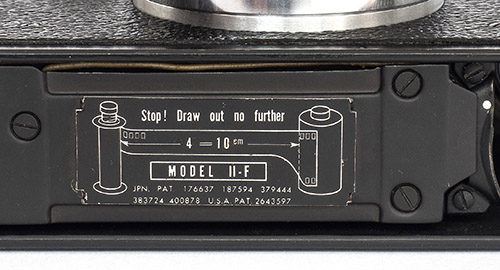
Canon II-D: No name inside up to serial no. 11399x, then all have “MODEL II-D”from serial no. 11498x on.
Canon II-F: No name inside up to serial no. 12704x, then all have “MODEL II-F” from serial no. 13991x onward (in between those numbers is a cross over period where both types are found).
Canon II-S: Serial no. 10826x doesn't have the name inside, serial no. 11327x and later cameras have “MODEL II-S”.
Hinged Back, Trigger or Lever Wind
Canon VT: “MODEL VT” on front face of base plate.
Canon L2: “MODEL L2” on bottom of
base plate.
Canon L1: “MODEL L1” on bottom of
base plate, in red on earliest example 54xxxx.
Canon VT de luxe: “MODEL VT de luxe” on front face of
base plate, in red on earliest examples 54011x, 54074x and 54126x I have found and in black from 54245x.
Canon L3: “MODEL L3” on bottom of
base plate up to serial no. 53734x, no name after serial no. 53797x.
Canon VI-T: “MODEL VI-T” on front face of base plate.
Canon P: “P” on top of top plate.
Canon 7: “Canon 7” on top of top plate.
Canon 7s: “Canon 7s” on top of top plate.
Canon Rangefinder Body Dimensions
The Canon History Museum gives dimensions and weights of each model but the problem is that it is very inconsistent. Quite obviously, the Museum changes the rules about what is being measured with each model without telling us what is included and sometimes lenses are included and sometimes not. Personally, I think small protuberances like slow speed dials and strap lugs are inconsequential, I'm more interested in the footprint, basically the length and width of the base plate and the height of a camera and that is consistent with my other Leica Copies Japan pages. The dimensions and bare body weights are listed further down.
The four cameras below represent the two basic generations of post-War bodies; the bottom loaders and the the hinged backs. Top to bottom; Canon II B, Canon II-F (same body as IV-Sb), Canon L2 and Canon 7. The top two have the same footprint and the bottom two the same slightly larger footprint (5 mm longer):
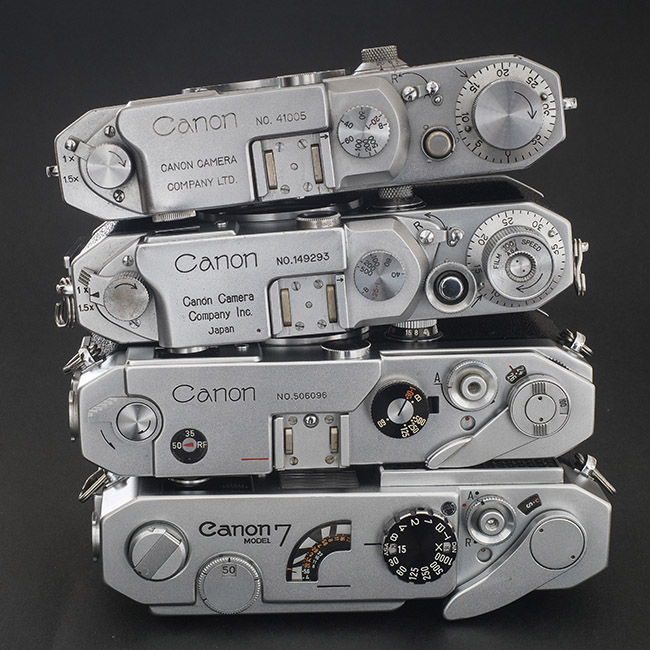
Canon II B on left, Canon 7 on right:
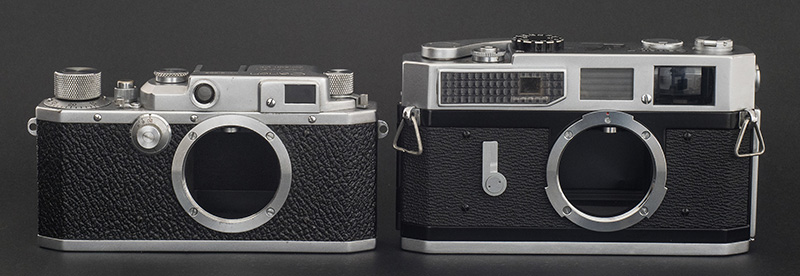
Canon L2 on left, Canon 7 on right. Lever wind models up to and including the Canon P are the same height as the Canon L2, the Canon VT and other trigger wind models are the same height as the Canon 7:
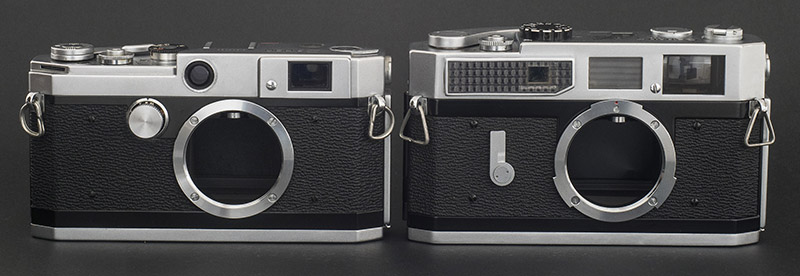
| Camera | Base Plate | Height | Weight | |
|---|---|---|---|---|
Length |
Width |
|||
Leica II/III |
133mm |
67mm |
406g |
|
Leica IIIc/IIIf |
135mm |
30mm |
69mm |
425/430g |
Canon S II |
135mm |
30mm |
69.5mm |
|
Canon II B |
135mm |
30mm |
71.5mm |
|
Canon III to IV-Sb2 |
135mm |
30mm |
72.2mm |
500g |
Canon VT to VI-T |
140mm |
31mm |
81mm |
|
Canon L1 to P |
140mm |
31mm |
76mm |
530g (L1-3) |
Canon 7 |
140mm |
31mm |
81mm |
670g |
Canon 7s/7sZ |
140mm |
31mm |
81mm |
630g |
The earlier model dimension from Hansa Canon to Canon S I are quoted within .05mm to 1 mm of the 1946 Canon S II and I suspect that the base plate dimensions are identical. As far as I can tell, I don't think that the basic body grew in this time except that the Canon S II seems to be 0.5 mm taller with its new single window viewfinder/rangefinder .
The Canon Rangefinder EBL
Rangefinder accuracy is critical to obtaining sharp in-focus images. With smaller apertures and shorter focal lengths there is greater depth of field (DoF) and it is less important but as apertures and/or focal lengths increase, particularly at shorter camera to subject distances, DoF becomes razor thin and there is little margin for error.
Rangefinder accuracy is determined by “effective base length” (EBL), the longer the better. EBL = base length x magnification. Canon rangefinders are a bit short in this regard, particularly the Canon P but also the Canon 7 series with its optional f/0.95 lens. The models with variable magnification have a respectable EBL but only at the 1.5x setting. Whilst you can focus using any of the positions, depending on DoF, switching to the 1.5x view to focus accurately and back again to recompose might be a bit inconvenient but whether it is better or worse than switching between eyepieces on a Leica III and similar cameras is a matter of personal preference and use case. However, best practice was to have a long base, combined viewfinder/rangefinder and a big viewfinder that did not require positive magnification to achieve accuracy, the best camera EBLs include Kiev 4 at 72 mm, Contax II & III at 67.8 mm, Leica M3 at 62.33 mm and Nikon S2 and later at 60 mm.
For the record, Leica III models have a 39 mm base and a rangefinder magnification of 1.5 times giving an EBL of 58.5 mm. Official and/or confirmed details of Canon EBLs are hard to find but this is what I know:
- Canon S II: Base length 38.5 mm, magnification 0.6x, EBL = 23.1 mm
- Canon II B: Only magnification is known, I'm guessing base length is the same 38.5 mm. At magnification 0.67x (F position, or 50 mm lens view), EBL = 25.8 mm. At 1x (100 mm lens view), EBL = 38.5 mm. At 1.5x (135 mm lens view and accurate focusing position), EBL = 57.75 mm.
- Series III and IV: The magnification is unchanged, the base length may be the same as the S II in which case the EBLs are the same as for the II B.
- Series V: Note, the Canon Camera Museum quotes a base length of 43 mm for both Series V and VI models but Internet references quote 41 mm for VI, V not mentioned. I'm basing my EBLs on 43 mm for both series but it may or may not be correct. Series V magnification is now 0.4x equating to a 35 mm lens view with EBL = 17.2 mm, 0.72x equating to a 50 mm lens view with EBL = 31 mm and 1.4x for accurate focus purposes only with EBL = 60 mm.
- Series VI, Canon VI-T & VI-L: The magnification has changed again. Magnification is now 0.65x equating to a 35 mm view with EBL = 28 mm, 1x equating to a 50 mm view with EBL = 43 mm and 1.55x with EBL = 65.5 mm.
- Series VI, Canon P: Variable magnification is absent on the Canon P and subsequent Series 7 models. I am assuming the same 43 mm Series VI base length. With 1x magnification, EBL = 43 mm.
- Series 7: Base length is 59 mm, with 0.8x magnification, EBL = 47.2 mm.
Black Bodies
A number of models were also offered with black painted metalwork instead of chrome plated finish. At the time, there was an extra cost and these days, they appear in very limited numbers and bring a significant premium at sales. This of course makes creating fakes a lucrative endeavour but there are also honest vendors that declare that a camera is a repaint and buyers who are willing to pay extra for a black body whether original or not. I'm not an expert in this regard and I would recommend that anyone interested in purchasing an original black body search the Facebook page of the Canon Historical Society first and then ask the forum if still not sure.
Of course, the first black bodies were the renderings of the Kwanon prototypes (not including the possibly earlier chrome version held by Canon). However, there were no black bodied versions of the bottom loaders made for retail sale or known military use.
According to Peter Dechert, the L1 and VT de luxe were the first Canon models offered in black and the Canon 7 was the last. The economy models, the L2, L3 and VL-2 were definitely not available in black. In regard to the VL, Stephen Gandy's Cameraquest site says the following: “Original black paint Canon VL rangefinder, a camera so rare that Peter Dechert had never seen one when he wrote his classic Canon Rangefinder Cameras 1933 to 1968. Apparently a few were produced as samples, but never marketed to the public.” The VL pictured, serial number 560986, appears to be the real deal, matching the obvious original Canon factory specs.
Apparently, until mid-way, or so, through Canon P production, Canon painted the black over the original chrome finish, it is only later Canon P and Canon 7 models which are painted over bare brass. Typically, black camera self-timer levers have a small circular indentation near their tip which is filled in with white paint, chrome cameras have no indentation (or paint). Black cameras also feature both black painted strap lugs and strap hangers. These detail differences are the same for all affected models and are reflected in the chrome Canon P on left, original black Canon P on right:
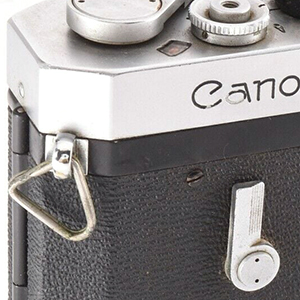
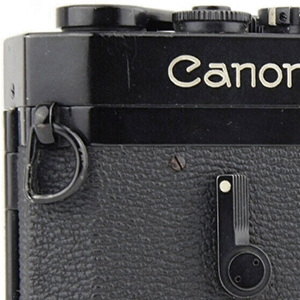
(Web images)
Note, the strap hangers changed from “D” shaped to triangular. All the black P bodies in my database with strap hangers have the “D” type but there may be later examples with the other, whereas the chrome bodies can have either depending on age. An additional feature with Canon 7 cameras is that the rewind crank handle remains chrome.
Although post 1956 lenses generally trended to predominantly black, Canon did offer special all black versions of three standard lenses for the black bodies. These were the 50 mm f/1.8, 50 mm f/1.2 and the very rare 35 mm f/1.8.
Odd Spec Canon L and VL Cameras
The Canon L3 entry in “The Models” below identifies 14 examples in my database with what is almost certainly factory installed flash sync when the key marketing headline of this model was that it was an “L” model without flash sync. Four of the examples have a 1000 shutter speed instead of 500. Also, the Canon VL entry identifies 5 examples that, on the face of it, appear to be VLs but 4 are outside the serial number range and all have some features/parts from other models, including three with L1 base plates. These may be the tip of the proverbial iceberg.
Canon rangefinder collector Todd Belcher has recorded a number of examples of Canon L (L1, L2 and L3) and VL (VL and VL-2) cameras that don’t comply with Canon’s published model specs of the time, i.e. there is a non-standard mix and match of features. It appears that only these noted model lines are affected, no VT, earlier bottom loading, or later VI, P and 7 series show this variability of feature additions (or subtractions). He notes features like a self-timer, electronic flash synch, metal curtains, 1000 shutter speed, or silver coated optics (cooler colour) may be an unexpected “upgrade” to a particular camera. Many decades and a lifetime later, there is no obvious simple explanation, but Todd has a theory these cameras may have been sold at a reduced price to Canon employees who were allowed to customise their camera from the parts bin. He thinks that with new models on the horizon, there may have been excess parts and camera inventory to clear of the L and VL model lines.
As the only thing that identifies the sync'd L3s is the “L3” base plate, which is only there on the first half of L3 production, and the synch features are a far more substantial differentiator, and likewise, the only reason I identified the odd VLs as VLs was the self-timer lever, it is perhaps best not to try to categorise these cameras into one formally defined model, or another. As Todd has said, they can be a mix of any feature of the L and VL models. There is one example, which is not in my database because the serial number is not visible, which has an L3 base plate, a self-timer and although the sync socket is not visible, it has a sync switch and main shutter dial with X sync and 1000 speed. So is it an L3 or VL? At heart, maybe neither.